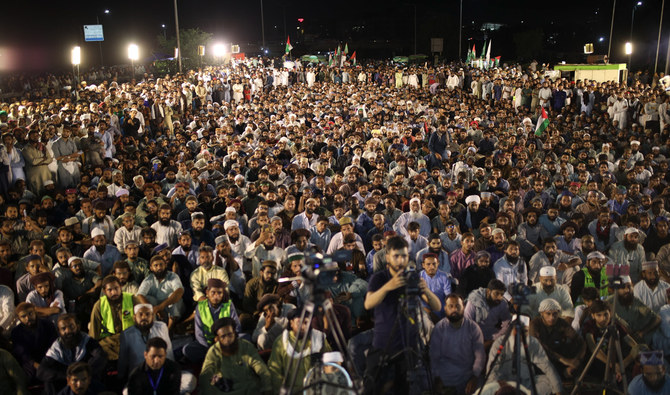
ISLAMABAD: A Pakistani religious party on Thursday vowed to continue its large pro-Palestine sit-in protest at a key junction connecting the twin cities of Islamabad and Rawalpindi until its demands are not met, as residents suffer traffic disruption.
Tehreek-e-Labbaik Pakistan (TLP), known for its hard-line stance on blasphemy laws, has previously staged sit-ins at the Faizabad Interchange. The presence of large numbers of protesters in the area significantly disrupts traffic, forcing drivers to take longer, alternative routes between the two cities.
The TLP workers, led by their young leader Saad Rizvi, took out a protest rally from Liaquat Bagh in Rawalpindi to Faizabad last Saturday before deciding to set up a protest camp at the interchange.
The TLP has asked the government to officially boycott Israeli products and send food and medical aid to Palestinians suffering Israel’s relentless military campaign in Gaza. They have also called on Pakistan’s government to declare Israeli Prime Minister Benjamin Netanyahu a “terrorist.”
“We are engaged with the government regarding our demands for the people of Palestine but no agreement has been reached yet,” Sajjad Saifi, a member of the TLP’s Shoura or consultative council, told Arab News over the phone.
“We will continue our dharna [sit-in] till all three of our demands are fully met.”
Saifi said TLP chief Rizvi was leading the party’s protest, adding that over 50,000 of their supporters were camped at the Faizabad Interchange.
“If the government accepts our demands, it will earn a huge respect in the Muslim world,” he said.
Israel’s war on Gaza has so far claimed at least 39,000 lives, many of them women and children. The casualties have sparked anger and protests worldwide, including in Pakistan, where the country’s civil society and political factions have consistently led pro-Palestine rallies.
When asked why the party decided to stage a sit-in protest nine months into the war, Saifi said the TLP had mobilized the public since October last year through rallies across Pakistan.
“Tens of thousands of our supporters have been waiting for the leadership’s call to join the dharna in Islamabad,” he said.
“We are doing it for a cause, for the people of Palestine. We don’t have any political agenda to achieve through this dharna.”
The large number of protesters at the Faizabad Interchange have effectively blocked the Islamabad Expressway, causing difficulty for commuters and creating gridlocks in the area.
When asked about the protest and the inconvenience being caused to the public, Information Minister Attaullah Tara said:
“Don’t worry, we are on it.”
‘STATE HAS SURRENDERED’
Political analysts called on the government to initiate strict action against the outfit to disperse them from the interchange.
“Freedom of movement is a basic right of the public, therefore the government and the Supreme Court should take notice of the dharna and initiate measures to disperse the protesters,” political analyst Adnan Rehmat told Arab News.
“If the government fails to initiate action against the TLP, it clearly means the state has surrendered before the outfit that doesn’t believe in any law and the constitution.”
Political science professor Rasul Bakhsh Rais agreed.
“There is no rationale behind the TLP’s sit-in as Pakistan has already dispatched food and medicines to the people of Gaza,” Rais told Arab News. “It is unfortunate the government is silent over the mess and taking no steps to disperse them.”


![]()

Pakistani religious party vows to continue pro-Palestine sit-in protest until demands are met
Short Url
https://arab.news/5syys
Pakistani religious party vows to continue pro-Palestine sit-in protest until demands are met
- Thousands of Tehreek-e-Labbaik Pakistan supporters remain camped at Faizabad Interchange connecting Islamabad, Rawalpindi since last week
- TLP protesters demand Pakistan government officially boycott Israeli products, send aid to Gaza and declare Israeli PM a “terrorist”
Latest updates


© 2026 SAUDI RESEARCH & PUBLISHING COMPANY, All Rights Reserved And subject to Terms of Use Agreement.