
NEW YORK CITY: Speaking on behalf of UN Secretary-General Antonio Guterres on Wednesday, his chef de cabinet, Courtenay Rattray, called for the violence in Gaza to end and all parties involved in the conflict to “reach a deal, now.”
He said the humanitarian situation in the territory has become “a moral stain on us all,” and added: “Amid continued reports of serious abuses against Palestinians in Israeli custody, I reiterate that all detainees must be treated humanely and those held without lawful cause must be released. And this terrible war must end.”
Speaking during a meeting of the Security Council to discuss Palestine, he underscored the importance of “ensuring that governance is restored in Gaza under a single, legitimate Palestinian government,” support for which is “critical.”
Riyad Mansour, Palestine’s permanent observer at the UN, accused Israel of killing those people most deserving of protection, “including children, humanitarians, doctors (and) journalists,” and of defying “every nation on earth” and “every organ ever set up to uphold the most fundamental rules.”

Riyad H. Mansour, permanent observer of Palestine to the United Nations, addresses delegates during a meeting of the UN Council in New York City on July 17, 2024. (Reuters)
He said: “What is happening in Gaza will go down as the most-documented genocide in history. How cruel could you be? How criminal must you be to bomb the same population, over and over and over again?
“Israel has manufactured a humanitarian catastrophe with famine as its core, starvation, dehydration and the spread of diseases as ultimate weapons.
“(Israeli Prime Minister Benjamin) Netanyahu does not care about Palestinian lives or even the hostages’ lives. He does not care about international law or human decency. He only cares about his own political survival. So what will you do to ensure this lunatic is not the one calling the shots, continuing this genocidal war against the Palestinian people?”
The Palestinian envoy vowed that his people would live “in freedom and dignity on their ancestral land. They will accept nothing less, they will accept nothing else but fulfilling this right.
“Being killed, maimed, oppressed, detained, starved, displaced is not our fate. There is a path to peace and prosperity.”
Mansour called on the Security Council to “strengthen those who seek peace rather than arm those who seek extermination; sanction those who colonize rather than allowing them to punish those who oppose the uprooting and displacement of communities; protect the victims rather than the perpetrators; recognize the state of Palestine rather than witness the destruction of the two-state solution.”
In his speech to the council, Israel’s envoy to the UN, Gilad Erdan, focused solely on Iran, accusing the regime in Tehran of being “obsessed with killing Jews everywhere, not only in Israel.”
He said: “Iran has a global reach and it’s exporting its bloodshed and destruction to the four corners of Earth.
“If one looks at all of the major conflicts in the Middle East, one finds the nefarious fingers of Iran. The people of Lebanon, Syria, Iraq, Yemen and many others have all suffered because of Iran’s attempts to inflame the region.”
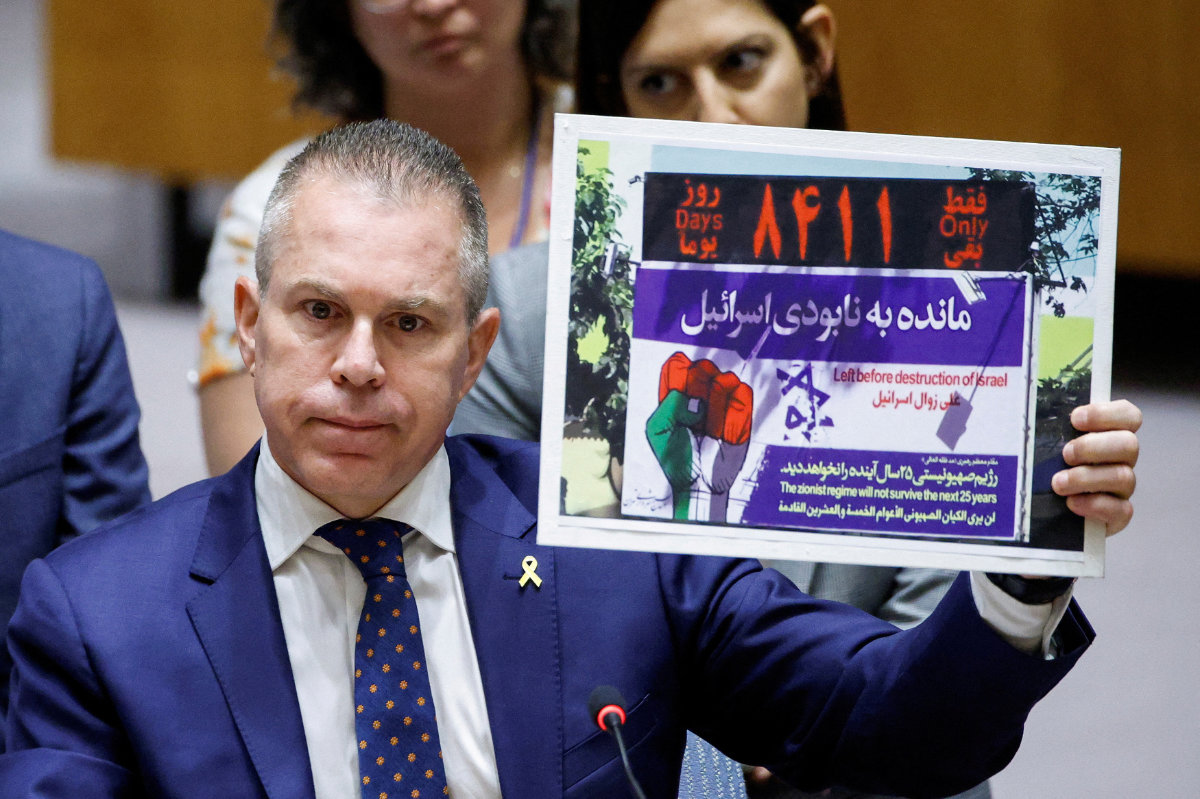
Israel's Ambassador to the UN Gilad Erdan shows a poster during a meeting of the United Nations Security Council in New York City on July 17, 2024. (Reuters)
Erdan said that since the Oct. 7 attacks by Hamas last year, Israel has also come under assault from Lebanon, Syria, Iraq and Yemen, and that “all of the terrorist groups targeting us have one thing in common: they are directed from Tehran.”
He warned: “If we reach a situation of full-scale war in Lebanon, it is only because Hezbollah has shot thousands of rockets at Israeli civilians with the support and funding of Iran. You cannot say you didn’t know.”
Erdan also warned the regime in Tehran that if it continues to threaten the region “it will find that its days are numbered. The proud Iranian people have had enough. The good people of the Middle East have had enough and so have we.”
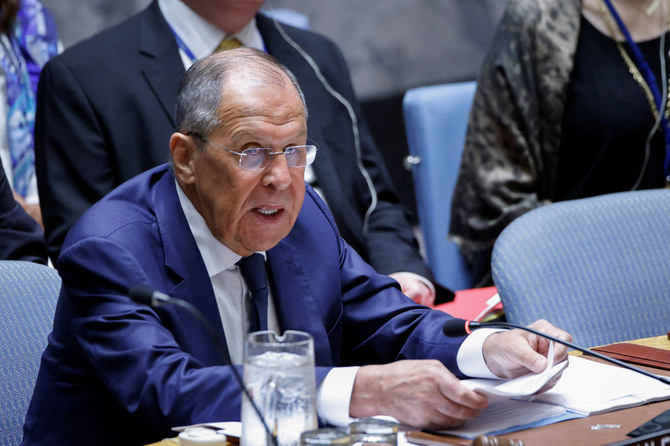
Russia holds the rotating presidency of the Security Council this month and the meeting was chaired by Sergey Lavrov, Russia’s foreign minister. He said a “frank and honest conversation” is needed about how best to immediately stop the bloodshed in Gaza and move toward the long-term settlement of “both long-standing and relatively new conflicts in the region.”
He added: “From the outset, we have highly valued the constructive potential of the Arab Peace Initiative launched by the Kingdom of Saudi Arabia in 2002. At the same time, we respected the decision of a number of Arab states to normalize relations with Israel prior to the resolution of the Palestinian question.”
Lavrov accused the US of becoming a direct accomplice in the conflict in Gaza “by providing diplomatic cover for Israel's actions and supplying (it with) arms and ammunition, just as it has done with the situation in Ukraine.
“If the US were to end its support, the bloodshed would stop but the US is either unwilling or unable to do so. It seems its goal is not saving human lives but various maneuvers that would help to score more points during the election campaign.”
He highlighted the important role the Gulf states can play and said the recent Iranian elections, and initial statements by the country’s new president, Masoud Pezeshkian, give “hope for rapprochement among all the countries of the Gulf in the interests of overcoming long-standing differences and mistrust, and joining efforts to determine the parameters of their own mutual security without external interference, and to speak with one voice to realize the aspirations of the Palestinian people and generally build an architecture of stability and good neighbors.”
Linda Thomas-Greenfield, the US representative at the UN, said progress is being made on a ceasefire deal. Israel and Hamas have both agreed to the framework for an agreement, which was endorsed by the Security Council in its adoption of Resolution 2735 on June 10, although there are still gaps to be closed, she said as she called on council members to maintain pressure on Hamas to accept the deal and begin implementing it “without delay and without conditions.”
She added: “We’re hopeful that a ceasefire in Gaza would assist diplomacy aimed at deescalating the situation along the blue line, which is necessary to enable displaced people in Israel and Lebanon to return home.”
Thomas-Greenfield condemned in “the strongest terms” the significant increase in deadly violence against Palestinian civilians by extremist settlers in the West Bank, and reiterated Washington’s concern about a recent announcement by Israeli authorities of settlement expansion, which she said is “inconsistent with international law and detrimental to the two-state solution.”
Slovenia’s envoy, Samuel Zbogar, said: “There is no moral equality between Israel and Hamas. However, the conduct of both actors against civilians is deplorable and constitutes a crime.
“Neither Hamas nor Israel care about civilians. Hamas is hiding among IDPs (internally displaced persons) and thus endangering lives of their fellow Palestinians, while Israel is showing complete disregard for the suffering of civilians, in (its) pursuit of Hamas.”