

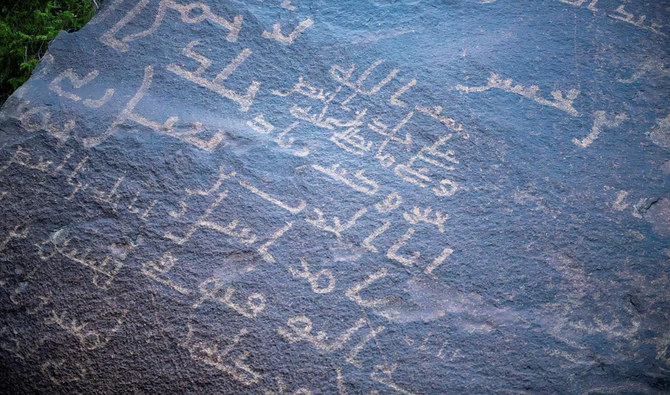
Rock inscriptions in Saudi Arabia’s Baha bookmark a historic era

1 / 4
The carvings are believed to date back some 1,400 years. (SPA)
2 / 4
The carvings are believed to date back some 1,400 years. (SPA)
3 / 4
The carvings are believed to date back some 1,400 years. (SPA)
4 / 4
The carvings are believed to date back some 1,400 years. (SPA)
Short Url
Updated 17 July 2024
Follow

Rock inscriptions in Saudi Arabia’s Baha bookmark a historic era

  • Site epitomizes rich cultural tapestry

RIYADH: The “Book Plateau,” in the heart of Saudi Arabia’s Baha region, is drawing visitors from far and wide. Nestled in Baljurashi, the inscribed rock epitomizes the rich cultural tapestry of the area.

Located at the confluence of two streams at the foot of Wadi Khara, this archaeological wonder has been likened to the pages of an open book and earned its name from the old inscriptions adorning its surface, the Saudi Press Agency reported.

The carvings are believed to date back some 1,400 years. The site boasts early Islamic inscriptions without diacritical marks, some of which bear the names of the Prophet’s companions and their followers.

There is another rock formation nearby which resembles a palm, bearing different inscriptions. Five graves can be found at the top of Mihras Mountain, two of which are noticeably elevated. While their exact history and occupants remain unknown, it is believed they belong to people who once inhabited the area.

Abdulrahman Al-Ghamdi, director general of the Heritage Authority in Baha, told the SPA that the authority had included the site in the National Antiquities Register following a survey in 2005. The inscriptions, which are etched onto granite rock faces, stand as silent witnesses to the area’s historic importance.

Baha’s summer season is attracting local and international visitors to its heritage villages and historic and archaeological sites.

These attractions have become crucial economic drivers, shaping the national tourism vision in line with the Kingdom’s ambitious goals.

They also showcase the region’s historic legacy for present and future generations.


Saudi wildlife center records rare sighting of critically endangered leatherback turtle in Red Sea

Updated 4 sec ago
Follow

Saudi wildlife center records rare sighting of critically endangered leatherback turtle in Red Sea

  • NCW says the leatherback traveled thousands of kilometers to reach the Red Sea
  • The closest known nesting grounds are located in India’s Andaman Islands, some 6,500 km distant

RIYADH: Saudi Arabia's National Center for Wildlife (NCW) has documented a rare sighting of a leatherback sea turtle in the Red Sea, marking a significant biological record for one of the planet's most critically endangered marine species.

The sighting occurred approximately 30 kilometers off the coast of Al-Qunfudhah within the Blue Holes Protected Area, a newly established marine reserve, according to the Saudi Press Agency.

The NCW confirmed that the presence of a leatherback in these waters is an exceptional event. Recognized as the largest turtle species on Earth, the leatherback can weigh up to 900 kilograms. It is easily identified by its unique leathery, black carapace—distinguished by five longitudinal ridges rather than a hard bony shell—and its ability to dive to depths exceeding 1,000 meters.

Shutterstock image

Noting the species' migratory nature, the center explained that leatherbacks travel thousands of kilometers foraging for jellyfish. The specimen likely navigated through the Bab el-Mandeb Strait in search of food. 

This is considered a remarkable journey, the NCW said, noting that the nearest known populations reside in the Indian Ocean, spanning waters from South Africa to Sri Lanka (roughly 7,000 to 8,000 kilometers away). The closest known nesting grounds are located in India’s Andaman Islands, approximately 6,500 kilometers distant. No nesting activity has been recorded in the Red Sea.

According to the IUCN Red List, the leatherback is Critically Endangered in the Indian Ocean. While data for the Red Sea and Arabian Gulf is scarce, recent isolated sightings include a juvenile recorded in Jordan in December 2025 and another off Djibouti in 2019.

The NCW emphasized that these rare appearances highlight the ecological importance of the Kingdom's marine conservation efforts in the Red Sea. The center pointed to the Farasan Islands Marine Protected Area, along with the new Blue Holes and Ras Hatiba reserves, as critical sanctuaries that could support the potential expansion of such endangered species' ranges.