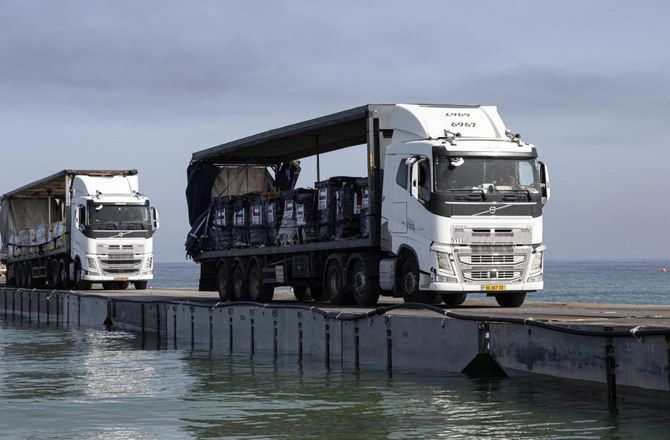
WASHINGTON: The US military’s problem-plagued mission to deliver desperately needed aid to Gaza via a temporary pier has ended, a senior American officer said Wednesday.
US President Joe Biden has expressed disappointment in the performance of the pier, which has repeatedly been detached from the shore because of bad weather since its initial installation in mid-May, limiting the time it has been operational.
“The maritime surge mission involving the pier is complete, so there’s no more need to use the pier,” Vice Admiral Brad Cooper told journalists.
The pier was damaged by bad weather in May and had to be removed for repairs. It was then reattached on June 7, but was moved to Ashdod on June 14 to protect it from anticipated high seas — a situation that was repeated later in the month.
Distribution of aid once it reaches land has also been a problem, with the UN World Food Programme suspending deliveries of assistance that arrived via the pier last month to assess the security situation after Israel conducted a military operation nearby.
Biden announced the pier project during his State of the Union address in March as Israel held up deliveries of assistance by land, and the Pentagon has said it helped push the Israeli government to open more aid routes.
“The deployment of this pier has... helped secure Israeli commitment to opening additional crossings into northern Gaza,” Deputy Pentagon Press Secretary Sabrina Singh told journalists last week.
Gaza is suffering through a war that broke out after Hamas’s unprecedented October 7 attack on Israel that resulted in the deaths of 1,195 people, mostly civilians, according to an AFP tally based on Israeli figures.
Israel’s retaliatory offensive has killed at least 38,794 people in Gaza, also mostly civilians, according to figures from Gaza’s health ministry.

US declares end to troubled Gaza aid pier mission
https://arab.news/ng5gx
US declares end to troubled Gaza aid pier mission
- Joe Biden has expressed disappointment in the performance of the pier, which has repeatedly been detached from the shore because of bad weather
- Vice Admiral Brad Cooper: ‘The maritime surge mission involving the pier is complete, so there’s no more need to use the pier’
Syrian foreign minister: National interest and the welfare of the people top priority
- Hassan Al-Shaibani highlights reconstruction efforts, internal reforms during Munich discussion
MUNICH: The Syrian Arab Republic Foreign Minister Asaad Hassan Al-Shaibani spoke on the sidelines of the Munich Security Conference about the country’s ongoing recovery, internal reforms, and the impact of Israeli military actions.
“We are satisfied with the achievements we have made, but we continue striving to deliver the best for our people,” Al-Shaibani said.
“We will not tire or give up and will work day and night to build the Syria we aspire to, together with our citizens.”
In the Syrian Arab News Agency report the minister stressed that the Syrian state had not shirked its responsibility for what happened in Sweida and other areas, noting that “the national interest and the welfare of the people have always been our top priority.”
He emphasized that the diversity in Syria is a source of strength.
We live in a country exhausted by war and by the mismanagement inherited from the deposed regime.
Foreign Minister, Asaad Hassan Al-Shaibani
“We share national interests, including the unity and territorial integrity of the country, and we operate within the framework of the law,” he added.
Al-Shaibani highlighted progress in rebuilding state institutions and restoring trust between the government and the public.
“We live in a country exhausted by war and by the mismanagement inherited from the deposed regime,” he said. “Syrian society remains fragmented, both inside the country and abroad, and continues to face humanitarian and infrastructure challenges.”
He emphasized that efforts to unify the country include consolidating state control over weapons, a principle established after the revolution’s victory.
The minister also highlighted the role of Syrian citizens in the recovery process.
“What we rely on is our people, who possess determination and ambition,” he said, adding that “lifting sanctions is the key to reconstruction.”
He noted that there are still displacement camps in the country and that many refugees continue to live abroad.
Turning to external issues, he expressed concern over Israeli military activity.
“Since Dec. 8, 2024, Syria has faced more than 1,000 airstrikes, the occupation of new areas in southern Syria, and over 500 ground incursions,” he said, adding that the Syrian state has pursued a realistic approach toward Israel, prioritizing reconstruction and national recovery.
He noted, however, that the policy might not have been acceptable to Israel, which “continues to seek regional conflicts.”
Al-Shaibani emphasized that negotiations should result in Israel withdrawing from the areas it occupied after Dec. 8, respecting Syrian sovereignty and airspace.
Syria’s deputy interior minister met with Germany’s interior minister on the sidelines of the Munich Security Conference.
They discussed security developments and prospects for cooperation, according to a statement from the interior ministry.
Maj. Gen. Abdulkader Al-Tahhan held talks with German Interior Minister Alexander Dobrindt during the annual conference.
The Syrian Interior Ministry said the meeting included a review of current developments in Syria and their impact on security and humanitarian issues.
It added that both sides stressed the importance of coordination and information-sharing in support of regional and international stability.
The statement said the officials also discussed possible cooperation between the two interior ministries, including training, capacity-building and the exchange of expertise.


