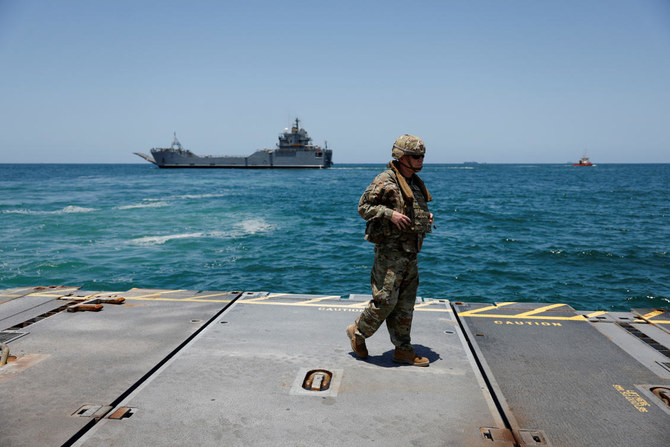
WASHINGTON: A temporary US aid pier has again been removed from the Gaza coast due to high seas and will be towed to an Israeli port, the Pentagon said on Friday.
It is the third time the pier has been detached from the shore because of weather conditions since its initial installation in mid-May, and the effort is also facing difficulties with distribution of assistance once it reaches Gaza.
“Due to high sea states expected this weekend, Central Command has removed the temporary pier from its anchored position in Gaza and will tow it back to Ashdod, Israel,” Deputy Pentagon Press Secretary Sabrina Singh told journalists, referring to the military command responsible for the Middle East.
She said she does not have a date for the pier’s reinstallation, and that “the commander will continue to assess the sea states over the weekend.”
The pier was first anchored to the Gaza coast in mid-May, but was damaged by bad weather later in the month and had to be removed for repairs.
It was then reattached on June 7, but was moved to Ashdod on June 14 to protect it from anticipated high seas — a situation that is now being repeated.
When the pier has been operational, it has been used to deliver a large amount of aid to the shore.
“Since May 17, Central Command has assisted in the delivery of more than 8,831 metric tons, or approximately 19.4 million pounds, of humanitarian aid to the shore for onward distribution by humanitarian organizations,” Singh said.
But distribution has been a problem, with the UN World Food Program suspending its deliveries of assistance that arrive via the pier earlier this month to assess the security situation.
The move came after Israel conducted a military operation nearby that freed four hostages, but which Hamas-run Gaza’s health ministry said killed more than 270 Palestinians.
As a result, aid is piling up in the marshalling yard where it is delivered onshore.
“There’s still some room there, but it’s, I would say majority is pretty full right now,” Singh said.
Gaza is suffering through a war which broke out after Hamas’s unprecedented October 7 attack on Israel that resulted in the deaths of 1,195 people, mostly civilians, according to an AFP tally based on Israeli figures.
The militants also seized hostages, 116 of whom remain in Gaza although the army says 42 are dead.
Israel’s retaliatory offensive has killed at least 37,765 people, also mostly civilians, according to data from the health ministry in Gaza.


![]()

US aid pier removed from Gaza due to high seas
Short Url
https://arab.news/5fv8q
US aid pier removed from Gaza due to high seas
- It is the third time the pier has been detached from the shore because of weather conditions since its initial installation in mid-May
- “Central Command has removed the temporary pier from its anchored position in Gaza and will tow it back to Ashdod, Israel,” Deputy Pentagon Press Secretary Sabrina Singh said


Latest updates


© 2026 SAUDI RESEARCH & PUBLISHING COMPANY, All Rights Reserved And subject to Terms of Use Agreement.