ACWA Power sells 35% stake in subsidiaries to China Southern Power Grid

1 / 2
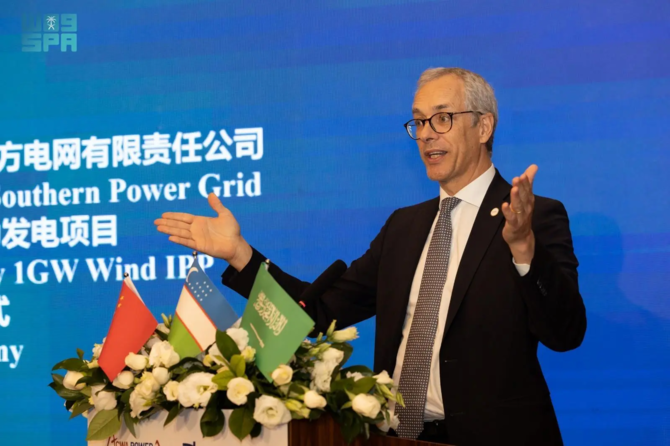
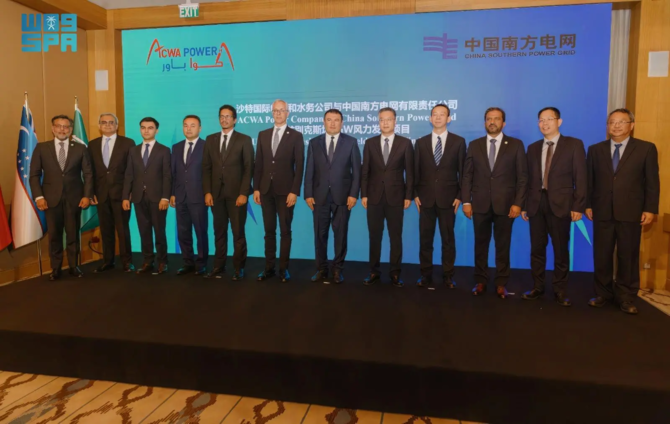
The deals were signed between ACWA Power Green Energy Holding and China Southern Power Grid International in Tashkent, Uzbekistan. (SPA)
2 / 2
The deals were signed between ACWA Power Green Energy Holding and China Southern Power Grid International in Tashkent, Uzbekistan. (SPA)
Short Url
Updated 17 July 2024
Follow

ACWA Power sells 35% stake in subsidiaries to China Southern Power Grid

  • The Saudi company has been pursuing renewable energy development goals to expand its global footprint and sustainable energy solutions

RIYADH: Saudi utility firm ACWA Power has finalized deals to sell 35 percent of its stake in two subsidiaries to China Southern Power Grid International for SR595.9 million ($158.87 million).  
In a statement to Saudi stock exchange Tadawul, the Public Investment Fund-backed company announced the closing of the sale and purchase agreement for its shareholding in ACWA Power Bash Wind Project Holding Co. and ACWA Power Uzbekistan Wind Project Holding Co. 

The SPAs were signed between ACWA Power Green Energy Holding and China Southern Power Grid International, with the Saudi firm now holding a 65 percent stake in these two projects following the successful completion of the conditions precedent. 

ACWA Power has been pursuing renewable energy development goals in various countries to expand its footprint and contribute to global sustainable energy solutions. 

The sale is part of the company’s capital recycling strategy, complementing its business model to partner with robust and reputable equity partners. 

Marco Arcelli, CEO of ACWA Power, said: “Through strategic collaboration with China Southern Power Grid International, we are proud to announce a significant milestone in our journey toward sustainable energy solutions.” 
ACWA Power is developing the Bash 500 megawatts and Dzhankeldy 500 MW wind farms in Uzbekistan under a 25-year power purchase agreement with JSC National Electrical Grid of Uzbekistan. 
Located in the Bukhara region, these projects aim to collectively generate 1 gigawatts of renewable energy under a Build, Own, Operate, Transfer model, with an estimated total investment cost of SR5.1 billion during construction. 
Arcelli added: “The agreement in relation to our Bash and Dzhankeldy wind projects in Uzbekistan not only enhances ACWA Power’s global presence but also strengthens ties between two industry leaders from different regions.” 
The SPA signing ceremony to complete the deal was held in the Uzbek capital, Tashkent, and marks the first significant collaboration between ACWA Power and China Southern Power Grid in Central Asia. 

“This historic partnership underlines our commitment to driving innovation and progress in the renewable energy sector,” said the CEO. 

The deal follows ACWA Power’s memorandums of understanding with nine Chinese entities at the December 2022 Riyadh Arab-China Summit, focusing on developing global clean energy projects in Saudi Arabia and countries of the Belt and Road Initiative. 

Once fully operational, the Bash and Dzhankeldi independent wind power plants will be among the largest renewable energy projects in Central Asia, the company said. 

“By leveraging synergies, we can strengthen our strategic partnership and work toward developing a series of benchmark projects and contribute to the implementation of the Uzbekistan-2030 Strategy,” said TANG Yifeng, vice president of China Southern Power Grid Co.

Uzbekistan represents ACWA Power’s second-largest market in terms of total investments, after its primary market in the Kingdom. 


Lebanese social entrepreneur Omar Itani recognized by Schwab Foundation

Updated 23 January 2026
Follow

Lebanese social entrepreneur Omar Itani recognized by Schwab Foundation

  • FabricAID co-founder among 21 global recipients recognized for social innovation

DAVOS: Lebanon’s Omar Itani is one of 21 recipients of the Social Entrepreneurs and Innovators of the Year Award by the Schwab Foundation for Social Entrepreneurship.

Itani is the co-founder of social enterprise FabricAID, which aims to “eradicate symptoms of poverty” by collecting and sanitizing secondhand clothing before placing items in stores in “extremely marginalized areas,” he told Arab News on the sidelines of the World Economic Forum in Davos, Switzerland.

With prices ranging from $0.25 to $4, the goal is for people to have a “dignified shopping experience” at affordable prices, he added.

FabricAID operates a network of clothing collection bins across key locations in Lebanon and Jordan, allowing people to donate pre-loved items. The garments are cleaned and sorted before being sold through the organization’s stores, while items that cannot be resold due to damage or heavy wear are repurposed for other uses, including corporate merchandise.

Since its launch, FabricAID has sold more than 1 million items, reached 200,000 beneficiaries and is preparing to expand into the Egyptian market.

Amid uncertainty in the Middle East, Itani advised young entrepreneurs to reframe challenges as opportunities.

“In Lebanon and the Arab world, we complain a lot,” he said. Understandably so, as “there are a lot of issues” in the region, resulting in people feeling frustrated and wanting to move away. But, he added, “a good portion of the challenges” facing the Middle East are “great economic and commercial opportunities.”

Over the past year, social innovators raised a combined $970 million in funding and secured a further $89 million in non-cash contributions, according to the Schwab Foundation’s recent report, “Built to Last: Social Innovation in Transition.”

This is particularly significant in an environment of geopolitical uncertainty and at a time when 82 percent report being affected by shrinking resources, triggering delays in program rollout (70 percent) and disruptions to scaling plans (72 percent).

Francois Bonnici, director of the Schwab Foundation for Social Entrepreneurship and a member of the World Economic Forum’s Executive Committee, said: “The next decade must move the models of social innovation decisively from the margins to the mainstream, transforming not only markets but mindsets.”

Award recipients take part in a structured three-year engagement with the Schwab Foundation, after which they join its global network as lifelong members. The program connects social entrepreneurs with international peers, collaborative initiatives, and capacity-building support aimed at strengthening and scaling their work.