

Libyan authorities discover two dozen unidentified bodies in a former stronghold of the Daesh group

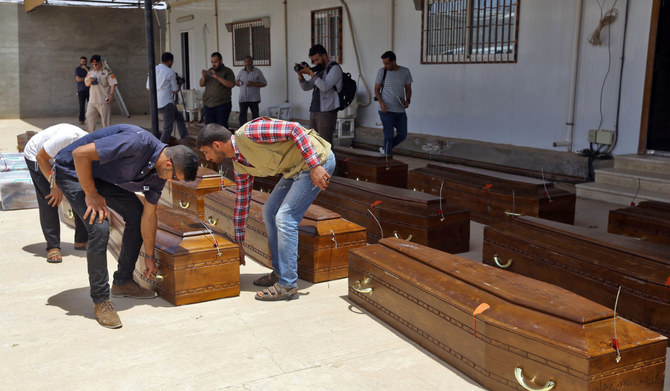
Coffins containing the remains of 20 Egyptian Coptic Christians beheaded by Daesh militants in Sirte, Libya, in 2015, are brought out of a criminal investigations office in Misrata for repatriation to Egypt on May 14, 2018. (AFP file photo)
Short Url
Updated 17 July 2024
Follow

Libyan authorities discover two dozen unidentified bodies in a former stronghold of the Daesh group

  • Daesh has exploited the turmoil across Libya after the 2011 uprising that ended Muammar Qaddafi’s four-decade rule

CAIRO: A mass grave containing two dozen unidentified bodies was discovered in the coastal city of Sirte, once controlled by the Daesh group, a Libyan government agency said Monday.
The National Authority for Searching and Identifying Missing People said its team recovered 17 of the 24 bodies found under destroyed buildings in the neighborhood of Al-Kambo in Sirte, about 450 kilometers (300 miles) east of the capital, Tripoli.
No details were provided about the potential date when the mass grave was created. However, Sirte city was a stronghold for Daesh for several years until the militants were expelled in December 2016 by US-backed forces in western Libya. Daesh has exploited the turmoil across Libya after the 2011 uprising that ended Muammar Qaddafi’s four-decade rule.
The Libyan authority also said Monday that workers with the forensic medicine department took DNA samples from a total of 59 unidentified bodies for testing. It was unclear whether those bodies include the two dozen found in Sirte.
Photos posted by the authority showed remains and bones buried in the ground, what appeared to be a small corpse wrapped in a white piece of cloth, and bones being marked and examined at the forensic department.
The bodies were relocated to a cemetery in Sirte after undergoing examination.
Mass graves have been discovered across over the past few years in Libya, a country that has experienced political turmoil and intense fighting among different armed groups. In March, the UN migration agency sounded the alarm after discovering a mass grave in western Libya that contained the bodies of at least 65 migrants.
Libya is a major route, albeit deadly, for migrants trying to reach Europe by crossing the Mediterranean Sea from different parts of Africa. Migrants who reach the coast pay to board poorly equipped and crowded ships before they set off on risky sea travels.


Hezbollah chief accuses Israel of ignoring ceasefire agreement

Updated 3 sec ago
Follow

Hezbollah chief accuses Israel of ignoring ceasefire agreement

  • Naim Qassem says moves to disarm his group in Lebanon are an 'Israeli-American plan'
  • Lebanese military is expected to complete Hezbollah’s disarmament south of Litani River as oart of ceasefire
BEIRUT: Hezbollah leader Naim Qassem on Sunday said moves to disarm the group in Lebanon are an “Israeli-American plan,” accusing Israel of failing to abide by a ceasefire agreement sealed last year.
Under heavy US pressure and fears of expanded Israeli strikes, the Lebanese military is expected to complete Hezbollah’s disarmament south of the Litani River — located about 30 kilometers (19 miles) from the border with Israel — by the end of the year.
It will then tackle disarming the Iran-backed movement in the rest of the country.
“Disarmament is an Israeli-American plan,” Qassem said.
“To demand exclusive arms control while Israel is committing aggression and America is imposing its will on Lebanon, stripping it of its power, means that you are not working in Lebanon’s interest, but rather in the interest of what Israel wants.”
Despite a November 2024 ceasefire that was supposed to end more than a year of hostilities between Israel and the Iran-backed Hezbollah group, Israel has kept up strikes on Lebanon and has maintained troops in five areas it deems strategic.
According to the agreement, Hezbollah was required to pull its forces north of the Litani River and have its military infrastructure in the vacated area dismantled.
Israel has questioned the Lebanese military’s effectiveness and has accused Hezbollah of rearming, while the group itself has rejected calls to surrender its weapons.
“The deployment of the Lebanese army south of the Litani River was required only if Israel had adhered to its commitments... to halting the aggression, withdrawing, releasing prisoners, and having reconstruction commence,” Qassem said in a televised address.
“With the Israeli enemy not implementing any of the steps of the agreement... Lebanon is no longer required to take any action on any level before the Israelis commit to what they are obligated to do.”
Lebanese army chief Rodolphe Haykal told a military meeting on Tuesday “the army is in the process of finishing the first phase of its plan.”
He said the army is carefully planning “for the subsequent phases” of disarmament.