DHAKA: Rival students in Bangladesh clashed on Monday leaving at least 100 people injured, as demonstrators opposing quotas for coveted government jobs battled counter-protesters loyal to the ruling party, police said.
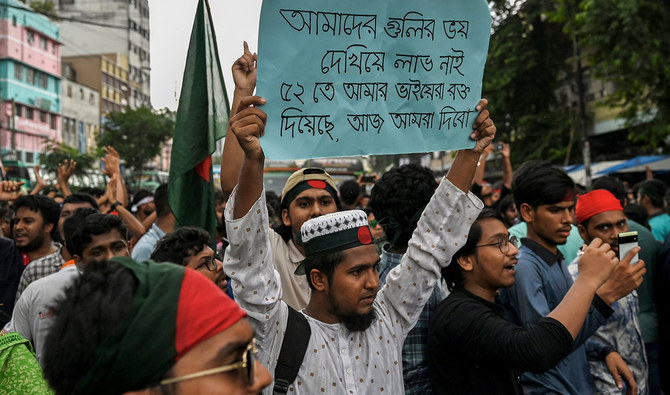
Police and witnesses said hundreds of anti-quota protesters and students backing the ruling Awami League party battled for hours on Dhaka University campus, hurling rocks, fighting with sticks and beating each other with iron rods.
Some carried machetes while others threw petrol bombs, witnesses said.
The quota system reserves more than half of well-paid civil service posts totalling hundreds of thousands of government jobs for specific groups, including children of heroes from the country’s 1971 liberation war from Pakistan.
“They clashed with sticks and threw rocks at each other,” local police station chief Mostajirur Rahman told AFP.
Masud Mia, a police inspector, said “around 100 students including women” were injured, and had been taken to hospital. “More people are coming,” Mia added.
Students launched protests earlier this month demanding a merit-based system.
They have continued despite Bangladesh’s top court suspending the quota scheme.
Anti-quota protesters blamed the ruling party students for the violence.
“They attacked our peaceful procession with rods, sticks and rocks,” Nahid Islam, the national coordinator of the anti-quota protests, told AFP.
“They beat our female protesters. At least 150 students were injured including 30 women, and conditions of 20 students are serious.”
Critics say the system benefits children of pro-government groups who back Prime Minister Sheikh Hasina.
Hasina, 76, won her fourth consecutive general election in January, in a vote without genuine opposition parties that saw a major crackdown against her political opponents, who boycotted the poll.
Injured student Shahinur Shumi, 26, said the protesters were taken by surprise.
“We were holding our procession peacefully,” she said from her hospital bed at Dhaka Medical Hospital.
“Suddenly, the Chhatra League (the ruling party student wing) attacked us with sticks, machetes, iron rods, and bricks.”
Police said hundreds of students from several private universities shouting anti-quota slogans joined the protests in Dhaka, halting traffic near the US embassy for more than four hours.
“Some 200 students squatted and stood on the road,” deputy police commissioner Hasanuzzaman Molla told AFP.
Thousands of students also marched in a dozen universities overnight Sunday into the early hours of Monday morning, protesting against what they said were Hasina’s disparaging comments.
Protesters said they were compared to collaborators of the Pakistani army during Bangladesh’s war of independence.
“This is unacceptable,” a female student from Dhaka University said, asking not to be named for fear of reprisal.
“We want a reform of the quota system so that meritorious students can get a fair chance.”
Violence also erupted during protests in Bangladesh’s second city Chittagong late on Sunday, anti-quota students said.
Khan Talat Mahmud Rafy, the organizer, said two fellow protesters were injured.
“Dozens of Chhatra League activists attacked one of our processions,” Rafy said.
Students are demanding that only those quotas supporting ethnic minorities and disabled people — six percent of jobs — should remain.
Bangladesh was one of the world’s poorest countries when it gained independence in 1971, but it has grown an average of more than six percent each year since 2009.
But much of that growth has been on the back of the mostly female factory workforce powering its garment export industry, and economists say there is an acute crisis of jobs for millions of university students.


![]()

100 injured as Bangladesh student groups clash over job quotas
Short Url
https://arab.news/jc2a2
100 injured as Bangladesh student groups clash over job quotas
- The quota system reserves more than half of well-paid civil service posts totalling hundreds of thousands of government jobs
- These jobs are reserved for specific groups, including children of heroes from the country’s 1971 liberation war from Pakistan
Latest updates


© 2026 SAUDI RESEARCH & PUBLISHING COMPANY, All Rights Reserved And subject to Terms of Use Agreement.