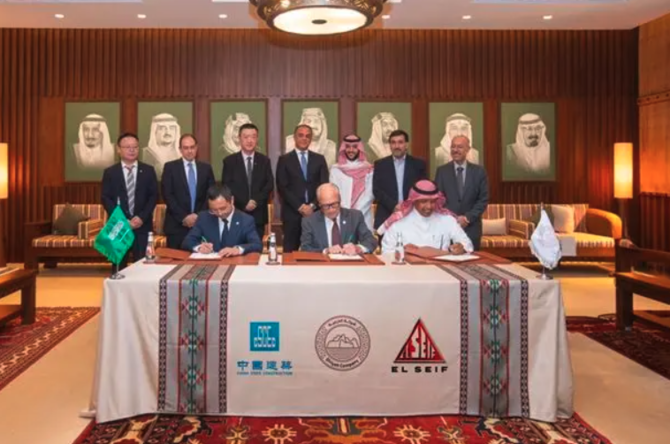
Saudi heritage city Diriyah awards $2bn contract for mixed-use district

Ahmed Al Bassam, CEO of El Seif Engineering Contracting, Chuanhai Wei, CEO of China State Construction Engineering Corp., and Diriyah Company Group CEO Jerry Inzerillo signed the contract
Short Url
Updated 01 October 2024
Follow

Saudi heritage city Diriyah awards $2bn contract for mixed-use district

RIYADH: Saudi heritage city Diriyah has awarded its largest single contract to date for the development of a district featuring educational institutions, cultural venues, and a luxury hotel. 

The SR7.8 billion ($2 billion) deal was agreed with a joint venture of El Seif Engineering Contracting Co. and China State Construction Engineering Corp., with work on the area in the north of the city due to commence in the third quarter of the year.

Developing historical sites like Diriyah is crucial for Saudi Arabia as the Kingdom aims to diversify its economy by reducing its dependence on oil and focusing more on sectors like tourism. 

Upon completion, the project will host 100,000 residents, workers, students, and visitors, offering a diverse range of cultural, entertainment, and retail, as well as hospitality, educational, and residential spaces. 

Diriyah Co. Group CEO Jerry Inzerillo said: “This (contract) represents a major step in our accelerating development strategy and commitment to making Diriyah a place for the world to be able to learn, absorb culture, and experience a vibrant and welcoming visitor destination.” 

He added: “The size and scale of this joint venture demonstrates the increasing speed and momentum of our plans for building The City of Earth and creating one of the world’s truly remarkable gathering places, and marks a major milestone in our master planning process.” 

Moreover, the contract marks the first major implementation of Diriyah Co.’s new delivery partnership procurement strategy. This approach fosters a collaborative environment among Diriyah and its main contractors, small and medium enterprises, manufacturers, and suppliers, ensuring efficient and effective project execution. 

Diriyah CEO further mentioned that the agreement with China State Construction Engineering Corp. exemplifies the growing economic ties and constructive business partnerships between Saudi Arabia and China. 

Ahmed Al-Bassam, CEO of El Seif Engineering Contracting Co. welcomed the deal by saying: “We are enormously proud to continue our strategic partnership with the Diriyah Co. and to be entrusted with a project of such importance in developing some of the highest profile assets within the Diriyah development area, and indeed across the Kingdom.” 

Diriyah is located on the outskirts of Riyadh, the Kingdom’s capital city, and is home to the UNESCO World Heritage Site of At-Turaif, the historic capital of the first Saudi state. 

Amidst these developments in the Kingdom’s tourism sector, Inzerillo was appointed as a UN Tourism ambassador in April, joining an elite group including Lionel Messi, Giorgio Armani, and Plácido Domingo. 


India and US release a framework for an interim trade agreement to reduce Trump tariffs

Updated 07 February 2026
Follow

India and US release a framework for an interim trade agreement to reduce Trump tariffs

  • Under the deal, tariffs on goods from India would be lowered to 18 percent, from 25 percent, after Indian Prime Minister Narendra Modi agreed to stop buying Russian oil, Trump had said.

NEW DELHI: India and the United States released a framework for an interim trade agreement to lower tariffs on Indian goods, which Indian opposition accused of favoring Washington.
The joint statement, released Friday, came after US President Donald Trump announced his plan last week to reduce import tariffs on the South Asian country, six months after imposing steep taxes to press New Delhi to cut its reliance on cheap Russian crude.
Under the deal, tariffs on goods from India would be lowered to 18 percent, from 25 percent, after Indian Prime Minister Narendra Modi agreed to stop buying Russian oil, Trump had said.
The two countries called the agreement “reciprocal and mutually beneficial” and expressed commitment to work toward a broader trade deal that “will include additional market access commitments and support more resilient supply chains.” The framework said that more negotiations will be needed to formalize the agreement.
India would also “eliminate or reduce tariffs” on all US industrial goods and a wide range of food and agricultural products, Friday’s statement said.
The US president had said that India would start to reduce its import taxes on US goods to zero and buy $500 billion worth of American products over five years, part of the Trump administration’s bid to seek greater market access and zero tariffs on almost all American exports.
Trump also signed an executive order on Friday to revoke a separate 25 percent tariff on Indian goods he imposed last year.
Indian Prime Minister Narendra Modi thanked Trump “for his personal commitment to robust ties.”
“This framework reflects the growing depth, trust and dynamism of our partnership,” Modi said on social media, adding it will “further deepen investment and technology partnerships between us.”
India’s opposition political parties have largely criticized the deal, saying it heavily favors the US and negatively impacts sensitive sectors such as agriculture. In the past, New Delhi had opposed tariffs on sectors such as agriculture and dairy, which employ the bulk of the country’s population.
Meanwhile, Piyush Goyal, Indian Trade Minister, said the deal protects “sensitive agricultural and dairy products” including maize, wheat, rice, ethanol, tobacco, and some vegetables.
“This (agreement) will open a $30 trillion market for Indian exporters,” Goyal said in a social media post, referring to the US annual GDP. He said the increase in exports was likely to create hundreds of thousands of new job opportunities.
Goyal also said tariffs will go down to zero on a wide range of Indian goods exported to the US, including generic pharmaceuticals, gems and diamonds, and aircraft parts, further enhancing the country’s export competitiveness.
India and the European Union recently reached a free trade agreement that could affect as many as 2 billion people after nearly two decades of negotiations. That deal would enable free trade on almost all goods between the EU’s 27 members and India, covering everything from textiles to medicines, and bringing down high import taxes for European wine and cars.
India also signed a comprehensive economic partnership agreement with Oman in December and concluded talks for a free trade deal with New Zealand.