

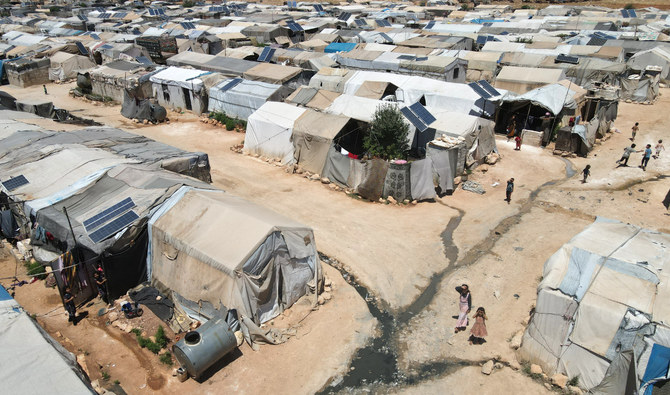

SARMADA, Syria: Hussein Al-Naasan struggles to provide water for his family in the scorching summer, as aid funds have dried up and conditions deteriorated in impoverished displacement camps in Syria’s rebel-held northwest.
“Water is life, it is everything... and now we are being deprived of water,” Naasan told AFP from a camp near Sarmada, close to the Turkish border.
“It’s like they are trying to kill us slowly,” said the 30-year-old father of two, who has been displaced for more than a decade.
After 13 years of conflict, a lack of international funding has severely undercut the provision of basic services such as water, waste disposal and sanitation in displacement camps in northwest Syria, according to the United Nations.
More than five million people, most of them displaced, live in areas outside government control in Syria’s north and northwest, the UN says, and many rely on aid to survive.
Residents told AFP that tap water was unavailable at the camp and aid organizations had stopped trucking water in, blaming aid budget cuts.
Naasan is sharing a water tank with three other families to reduce costs.
“We are finding it very difficult to secure water that we can’t even afford to buy,” he said.
Diminishing water access could lead to a “major disaster,” Naasan warned as the summer sun beat down on the camp.
He said waste was piling up, adding to the risk of disease in an area with war-ravaged medical facilities.
Syria’s war, which broke out after President Bashar Assad repressed anti-government protests in 2011, has killed more than 500,000 people, displaced millions and battered the country’s infrastructure and industry.
In the northwestern Idlib region, some 460 displacement camps hosting around 571,000 people do not have any water, sanitation and hygiene support from UN partner organizations, the UN Office for the Coordination of Humanitarian Affairs (OCHA) told AFP.
“Without increased funding, 111 additional camps hosting nearly 165,000 people will be cut off” from such support by the end of September, it warned in a statement.
About 80 percent of northwest Syria’s population requires water and hygiene support including “access to drinking water, waste disposal, and rehabilitation of sanitation facilities,” OCHA said.
Yet the critical sector is “consistently” neglected, having received only two percent of necessary funding in the first quarter of 2024, it added.
Camp resident Abdel Karim Ezzeddin, a 45-year-old father of nine, filled plastic barrels of water from a nearby well for his family, grateful to have a truck to transport them.
“How can they stop supplying water in the summer?” he said.
“Do they want us to die?“
David Carden, UN deputy regional humanitarian coordinator for the Syria crisis, said conditions in camps in the northwest were “deplorable.”
“Families in worn-out tents face suffocating heat,” he told AFP.
“Rubbish is piling up in camps without sanitation support. Children are getting sick.”
Response Coordination, an umbrella of local organizations in Syria’s northwest, warned skin diseases were spreading in camps as temperatures soar and water becomes scarcer.
“In some camps, more than 90 percent of residents have scabies,” said Fidaa Al-Hamud, a doctor in charge of a mobile clinic near Sarmada, decrying “water scarcity, refuse piling up... and the lack of sewage networks.”
Firas Kardush, a local official in the Idlib region, ruled by the Hayat Tahrir Al-Sham jihadist group, said authorities were “trying to find alternatives” but warned of a “humanitarian catastrophe” if aid money runs dry.
In another camp in the Idlib countryside, Asma Al-Saleh said water scarcity had made it harder to cook and bathe her five children, expressing worry as one of them has a rash.
When she runs out of water, she has to fill containers at a nearby well and walk them back to her tent.
“I do not have a water storage tank... nor am I able to buy one,” Saleh, 32, said.
“We don’t even have cold water to drink” in summer, she added.


