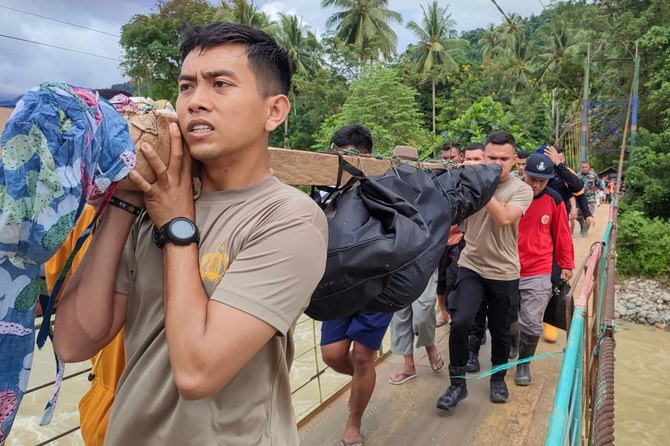
PALU: Search efforts for those trapped in a deadly landslide intensified Wednesday, with more rescuers deployed to search an unauthorized gold mine on Indonesia’s Sulawesi island that saw 23 deaths over the weekend.
More than 100 villagers were digging for grains of gold Sunday in the remote and hilly village of Bone Bolango in Gorontalo province when tons of mud plunged down the surrounding hills and buried their makeshift camps.
The provincial Search and Rescue Office said Wednesday that 81 villagers managed to escape from the landslide, several of them pulled out by rescuers, including 18 with injuries. It said 23 bodies were recovered, including a 4-year-old boy, while 33 others were missing.
More than 1,000 personnel, including army troops, were deployed to increase the strength of search efforts, said Edy Prakoso, the National Search and Rescue Agency’s operation director.
He said the Indonesian Air Force would send a helicopter as it was the only way to speed up the rescue operation that has been hampered by heavy rains, unstable soil, and rugged terrain.
Informal mining operations are common in Indonesia, providing a tenuous livelihood to thousands laboring in conditions that pose a high risk of serious injury or death. Landslides, flooding and collapses of tunnels are just some of the hazards facing miners. Much of gold ore processing involves highly toxic mercury and cyanide with workers frequently using little or no protection.
The country’s last major mining-related accident occurred in April 2022, when a landslide crashed onto an illegal gold mine in North Sumatra’s Mandailing Natal district, killing 12 women who were looking for gold.
Environmental activists have campaigned for years to shut down such operation across the country, especially on Sulawesi, where the practice has grown in recent years. Sunday’s landslide reignited their outcries.
“The local government which has allowed illegal gold mining activities in this area to continue has contributed to the deadly disaster,” said Muhammad Jamil, who heads legal division of the Mining Advocacy Network, an environment watchdog known as JATAM.
He said that gold mining involves many people who share blame, from those working on the ground all the way up to officials in the local council and even the police.
“This mafia network appears to have helped shield the miners from law enforcement, even as they tear up protected forests,” Jamil said, “When natural resources such as rivers, forests, land and the sea are damaged, it will be a complete loss to the country’s economy.”
Ferdy Hasiman, a mining and energy researcher from Alpha Research and Datacenter, said the proliferation of the pit mines has long been blamed for environmental damage in upstream areas that has in turn exacerbated flooding and landslides downstream.
“Flash floods and landslides would persist if illegal mining and the deforestation in the practice continue,” Hasiman said, “We call on the local and central government to expand their efforts to shut down illegal gold mining across the country.”

The search intensifies for dozens buried in an Indonesian landslide that killed at least 23 people
https://arab.news/j9wpx
The search intensifies for dozens buried in an Indonesian landslide that killed at least 23 people
- More rescuers deployed to search an unauthorized gold mine on Indonesia’s Sulawesi island that saw 23 deaths over the weekend
- 81 villagers managed to escape from the landslide, several pulled out by rescuers
Two high-speed trains derail in Spain, police sources say 21 people killed
- The accident happened near Adamuz, in Cordoba province. So far, 21 people have been confirmed dead by police
MADRID: A high-speed train derailed and smashed into another oncoming train in southern Spain on Sunday, pushing the second train off the tracks in a collision that police sources confirmed to Reuters had killed at least 21 people.
The accident happened near Adamuz, in Cordoba province. So far, 21 people have been confirmed dead by police, with state broadcaster Television Espanola adding that 100 people had been injured, 25 seriously. The driver of one of the trains, which was traveling from Madrid to Huelva, was among those who died, the TV station added.
“The Iryo 6189 Malaga — (to Madrid) train has derailed from the track at Adamuz, crashing onto the adjacent track. The (Madrid) to Huelva train which was traveling on the adjacent track has also derailed,” said Adif, which runs the rail network, in a social media post.
Adif said the accident happened at 6:40 p.m. (1740 GMT), about 10 minutes after the Iryo train left Cordoba heading toward Madrid.
Iryo is a private rail operator, majority-owned by Italian state-controlled railway group Ferrovie dello Stato. The train involved was a Freccia 1000 train which was traveling between Malaga and Madrid, a spokesperson for Ferrovie dello Stato said.
The company said in a statement that it deeply regretted what had happened and had activated all emergency protocols to work closely with the relevant authorities to manage the situation.
The second train was operated by Renfe, which also did not respond to a request for comment.
Adif has suspended all rail services between Madrid and Andalusia.
HORRIFIC SCENE
The Iryo train had more than 300 passengers on board, while the Renfe train had around 100.
Paco Carmona, Cordoba fire chief, told TVE the first train heading to Madrid from Malaga had been evacuated.
The other train’s carriages were badly damaged, he said, with twisted metal and seats. “There are still people trapped. We don’t know how many people have died and the operation is concentrating on getting people out of areas which are very narrow,” he said. “We have to remove the bodies to reach anyone who is still alive. It is proving to be a complicated task.”
Transport Minister Oscar Puente said he was following events from rail operator Adif’s headquarters in Madrid.
“The latest information is very serious,” he posted on X. “The impact was terrible, causing the first two carriages of the Renfe train to be thrown off the track. The number of victims cannot be confirmed at this time. The most important thing now is to help the victims.”
The mayor of Adamuz, Rafael Moreno, told El Pais newspaper that he had been among the first to arrive at the scene of the accident alongside the local police and saw what he believed to be a badly lacerated body several meters from the accident site.
“The scene is horrific,” he said. “I don’t think they were on the same track, but it’s not clear. Now the mayors and residents of the area are focused on helping the passengers.”
CALLS FOR MEDICS
Images on local television showed a reception center set up for passengers in the town of Adamuz, population 5,000, with locals coming and going with food and blankets amid nighttime temperatures of around 42 degrees Fahrenheit (6 degrees Celsius).
A woman named Carmen posted on X that she had been on board the Iryo train to Madrid. “Ten minutes after departing (from Cordoba) the train started to shake a lot, and it derailed from coach 6 behind us. The lights went out.”
Footage posted by another Iryo train passenger, also on X, showed an Iryo staffer in a fluorescent jacket instructing passengers to remain in their seats in the darkened carriages, and those with first aid training to keep watch over fellow passengers. He also urged people to maintain mobile phone batteries to be able to use their torches when they disembarked.
Salvador Jimenez, a journalist for RTVE who was on board the Iryo train, shared images showing the nose of the rear carriage of the train lying on its side, with evacuated passengers sitting on the side of the carriage facing upwards.
Jimenez told TVE by phone from beside the stricken trains that passengers had used emergency hammers to smash the windows and climb out, and they had seen two people taken out of the overturned carriages on stretchers.
“There’s a certain uncertainty about when we’ll get to Madrid, where we’ll spend the night, we’ve had no message from the train company yet,” he said. “It’s very cold but here we are.”