US intelligence official indicates Russia prefers Trump as election victor

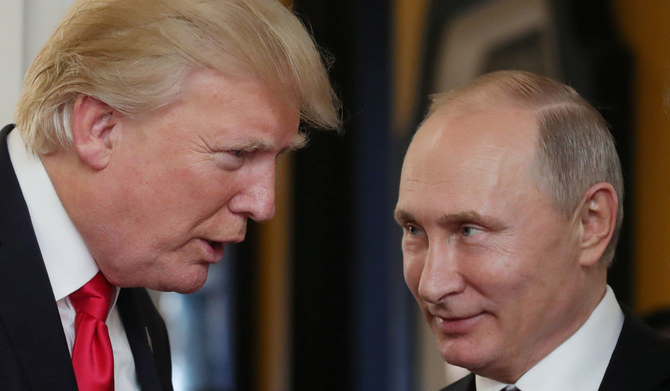
In this file photo taken on November 11, 2017 US President Donald Trump (L) chats with Russia's President Vladimir Putin as they attend the APEC Economic Leaders' Meeting, part of the Asia-Pacific Economic Cooperation (APEC) leaders' summit in the central Vietnamese city of Danang. (AFP)
Short Url
Updated 10 July 2024
Follow

US intelligence official indicates Russia prefers Trump as election victor

  • Trump frequently has criticized the scale of US military support for Ukraine — some $60 billion since Russia’s full-scale invasion in 2022 — and called Ukrainian President Volodymyr Zelensky “the greatest salesman ever”

WASHINGTON: The US has not seen Russia shift on its preference from previous US presidential elections on who it prefers to win this year, a US intelligence official said on Tuesday, indicating Moscow again favors Republican Donald Trump.
The official, briefing reporters on US election security, did not name the former president and presumptive Republican nominee when asked who Moscow wants as the next US president.
But, he indicated that Russia favored Trump, saying the US intelligence community had not changed its assessments from previous elections.
Those assessments found Moscow tried through influence campaigns to help Trump win in 2016 against Hillary Clinton and in 2020 against President Joe Biden.
“We have not observed a shift in Russia’s preferences for the presidential race from past elections, given the role the US is playing with regard to Ukraine and broader policy toward Russia,” said the official from the Office of the Director of National Intelligence (ODNI).
The Trump campaign did not immediately respond to a request for comment.
Trump frequently has criticized the scale of US military support for Ukraine — some $60 billion since Russia’s full-scale invasion in 2022 — and called Ukrainian President Volodymyr Zelensky “the greatest salesman ever.”
Two of his national security advisers have presented Trump with a plan to end US military aid to Ukraine unless it opened talks with Russia to end the conflict.
On policy toward NATO, Trump has said he would “encourage” Russia to do “whatever the hell they want” to any alliance member that did not spend enough on defense and he would not defend them.
The NATO charter obliges members to come to the defense of those who are attacked.
The ODNI official conducted the briefing on condition of anonymity with ODNI colleagues and officials from the FBI and the National Coordinator for Critical Infrastructure Security and Resilience, an agency that conducts cyber defense for the government and works with private industry.
He defined election influence as efforts to shape the outcome of polls or undermine democratic processes, while interference constitutes efforts to disrupt the ability of the US to hold a free and fair vote.
The US has not monitored plans by any country to “degrade or disrupt” the country’s ability to hold the November elections, he said.
But Russia, he continued, has begun through social media and other means trying to influence specific groups of US voters in battleground states, “promote divisive narratives and denigrate specific politicians” who he did not identify.
“Russia is undertaking a whole of government approach to influence the election, including the presidential, Congress, and public opinion,” he said.
Moscow “determines which candidates they’re willing to support or oppose largely based on their stance toward further US aid to Ukraine and related issues,” said the official. “It’s all the tactics we’ve seen before, primarily through social media efforts” and “using US voices to amplify their narratives.”
Russia recently has been seeking to influence US audiences through “encrypted direct messaging channels,” said the official. He did not elaborate.
China is assessed as currently not planning “to influence the outcome of the presidential race,” the official said.
The US views China as its leading geostrategic rival. Beijing and Washington have been working to ease strains. The Chinese embassy did not immediately respond to a request for comment.
Beijing is trying to expand its ability to collect and monitor data from social media platforms “probably to better understand and eventually manipulate public opinion,” the official said.
The official called generative artificial intelligence a “malign influence accelerant” being increasingly used to “more convincingly tailor” video and other content ahead of the November vote.


Putin warns that Russia will seek to extend its gains in Ukraine if peace talks fail

Updated 4 sec ago
Follow

Putin warns that Russia will seek to extend its gains in Ukraine if peace talks fail

Russian President Vladimir Putin warned Wednesday that Moscow will seek to extend its gains in Ukraine if Kyiv and its Western allies reject the Kremlin’s demands in peace talks.

US President Donald Trump has unleashed an extensive diplomatic push to end nearly four years of fighting following Russia’s full-scale invasion of Ukraine in February 2022, but Washington’s efforts have run into sharply conflicting demands by Moscow and Kyiv.

Speaking at an annual meeting with top military officers, Putin said Moscow would prefer to achieve its goals and “eliminate the root causes of the conflict” by diplomatic means, but he added that “if the opposing side and its foreign patrons refuse to engage in substantive dialogue, Russia will achieve the liberation of its historical lands by military means.”

Putin was referring to Ukrainian territory seized by Russia — action widely condemned in the West as a violation of Ukraine’s sovereignty and an unprovoked act of aggression.

Putin claimed that “the Russian army has seized and is firmly holding strategic initiative all along the front line” and warned that Moscow will move to expand a “buffer security zone” alongside the Russian border.

“Our troops are different now, they are battle-hardened and there is no other such army in the world now,” he said.

In this image, made from video provided by Russian Defense Ministry Press Service on Dec. 16, 2025, a Russian “Grad” self-propelled multiple rocket launcher fires towards Ukrainian positions on an undisclosed location in Ukraine. (Russian Defense Ministry Press Service via AP)

Putin praised Russia’s growing military might and particularly noted the modernization of its atomic arsenal, including the new nuclear-capable intermediate range Oreshnik ballistic missile that he said will officially enter combat duty this month. Russia first tested a conventionally armed version of the Oreshnik to strike a Ukrainian factory in November 2024, and Putin has boasted that it’s impossible to intercept.

At the same time, he rejected European officials’ statements about Moscow’s purported plans to attack European nations as “lies and sheer nonsense ... driven by short-sighted personal or group political interests, not by the interests of their people.”

Sharply different demands by Moscow and Kyiv

Putin’s tough statements follow several rounds of talks this week between Ukrainian. American and European officials on a U.S.-drafted peace plan. Ukrainian President Volodymyr Zelenskyy said after meeting with US envoys in Berlin that the document could be finalized within days, after which U.S. envoys will present it to the Kremlin.

Putin wants all the areas in four key regions captured by his forces, as well as Crimea, which was illegally annexed in 2014, to be recognized as Russian territory. He also has demanded that Ukraine withdraw from some areas in eastern Ukraine that Moscow’s forces have not captured yet.

The Kremlin also insists that Ukraine abandon its bid to join NATO and warns it won’t accept the deployment of any troops from NATO members and will view them as “legitimate target.”

Zelenskyy has expressed readiness to drop Ukraine’s bid to join NATO if the US and other Western nations give Kyiv security guarantees similar to those offered to NATO members. But Ukraine’s preference remains NATO membership as the best security guarantee to prevent further Russian aggression.

At the same time, Zelenskyy has rejected Moscow’s demands that it pull back its troops from other areas that Russia has not been able to take by force.

The Ukrainian leader described the draft peace plan discussed with the US during talks in Berlin on Monday as “not perfect” but “very workable,” noting that Kyiv and its allies were very close to a deal on “strong security guarantees.” But he also emphasized that the key issue of control over territory remain unresolved and rejected the U.S. push for Ukraine to cede control over the eastern Donetsk region.

Putin on Wednesday again praised Trump’s settlement efforts and seconded Trumps’ repeated claims that the war in Ukraine wouldn’t have erupted under his watch. He charged that the previous U.S. administration and some of the European allies he contemptuously called “piglings” had vainly expected Russia’s collapse.

The Russian leader said a dialogue with Europe “is unlikely to become possible with the current political elites, but in any case, it will be inevitable as we grow stronger if not with the current politicians, then with a change in political elites in Europe.”

Russian military maps out for more gains

Reporting to Putin at Wednesday’s military meeting, Defense Minister Andrei Belousov spelled out plans for further advances, saying the latest Russian advances in Donetsk have set the stage for a quick push into the Ukrainian-controlled part of the region.

Belousov also declared that Russian troops were preparing to drive Ukrainian forces from parts of the Zaporizhzhia region that Moscow also annexed in 2022 but never fully captured, as well as extend gains in neighboring Dnipropetrovsk.

“The key task for the next year is to preserve and accelerate the tempo of the offensive,” he said.

Belousov spelled out plans for expanding Russian military capabilities, focusing on drones, jamming equipment and air defense assets.

Aerial attacks continue

As Russia continues its grinding advances in many sectors of the front, it also pummeled Ukraine with daily missile and drone strikes.

At least 26 people were injured by Russian glide bombs in Zaporizhzhia and its vicinity, according to regional administration head Ivan Fedorov. The attack damaged several residential buildings, as well as infrastructure and an educational facility.

At least 69 long-range drones were launched by Russia overnight, the Ukrainian air force said. Air defenses intercepted or jammed 29 drones in the morning, with the assault continuing during the day.

Russia’s Defense Ministry said that air defenses downed 94 Ukrainian drones overnight.

In Russia’s southern Krasnodar region, drones injured two people and damaged several private houses, according to regional emergency officials. In the southwestern Voronezh region, Gov. Alexander Gusev said drone fragments damaged a power line serving an infrastructure facility, causing a blaze that was quickly extinguished.