

Embattled President Biden greets NATO allies in Washington

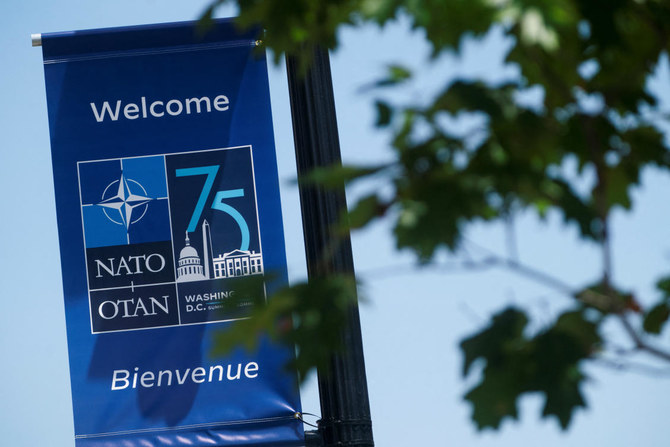
A banner promoting the NATO 75th anniversary celebratory event is seen outside the Walter E. Washington Convention Center in Washington DC. (Reuters)
Short Url
Updated 09 July 2024
Follow

Embattled President Biden greets NATO allies in Washington

  • Zelensky is due to meet with Biden in Washington
  • NATO, celebrating its 75th anniversary, has found new purpose in opposing Russian President Vladimir Putin’s Ukraine invasion

WASHINGTON DC: US President Joe Biden welcomes the heads of NATO member states to Washington on Tuesday for an annual summit that gives the embattled Democrat an international stage to convince allies at home and abroad he can still lead.
Biden, 81, has vowed to press on in his race against Republican Donald Trump, 78, despite concern from Democrats on Capitol Hill and donors that he will lose the Nov. 5 election after a halting debate performance on June 27.
Biden made restoring the United States’ traditional alliances abroad to counter the threat of autocracies the centerpiece of his foreign policy after Trump challenged allies as part of an “America First” approach. Who wins in November could have a substantial impact on NATO’s and Europe’s future.
Trump has suggested that, given a second term, he would not defend NATO members that did not meet the alliance’s defense spending target of 2 percent of their respective GDP if they came under military attack. He has also questioned the amount of aid given to Ukraine in its battle against Russia’s invasion.
Ukrainian President Volodymyr Zelensky arrived in Washington to attend NATO summit on Tuesday and said he would “fight” for strong decisions to strengthen Ukrainian air defenses and for more F-16 fighter jets.
“We are fighting for additional security guarantees for Ukraine — and these are weapons and finances, political support,” he said in a video on the Telegram messaging app.
Zelensky is due to meet with Biden in Washington and is scheduled to deliver an address on Tuesday evening at the Ronald Reagan Institute in Washington.
Aides said Biden’s opening speech expected at 5 p.m. Eastern time (2100 GMT) will highlight what his administration sees as a key accomplishment: a stronger and more united NATO, under Washington’s leadership, with more members and a resolve to meet their collective security needs.
That brings, they say, tangible results for American voters: a safer country, with a strong international economic position, more alliances and power abroad, and less at risk of conflict with its adversaries.
Trump and many of his Republican allies reject such arguments.
“Republicans, of course, celebrate the peace and prosperity that NATO has secured and will continue to stand by our partners as we prevent needless wars,” said US House of Representatives Speaker Mike Johnson, a top Republican and Trump ally, on Monday. “But we also believe that NATO needs to be doing more.”

WORRY FROM ALLIES ABOUT BIDEN’S STAYING POWER
NATO, celebrating its 75th anniversary, has found new purpose in opposing Russian President Vladimir Putin’s Ukraine invasion and welcomed Finland and Sweden as new members.
The grinding Ukraine-Russia war will dominate private conversations between the leaders of the 32 NATO member countries, who have an agenda focused on military and financial aid for Ukraine and offering some pathway toward eventual NATO membership for Kyiv.
But those leaders, already anxious about the prospect of Trump’s return, come to Washington with fresh concern about Biden’s staying power, according to diplomats from their countries. One described Biden as bruised after a difficult political period and said their government was looking for signs about whether he would survive.
NATO leaders face political uncertainty in Europe, with paralysis looming in France after gains for left and far right parties, and German Chancellor Olaf Scholz’s coalition weakened after a poor showing in European Parliament elections.
The week’s events in Washington will give Biden a chance to address the concerns, including his high profile speech on Tuesday and a rare solo press conference on Thursday.
Biden will highlight new support for Ukraine. During the summit, NATO leaders are expected to endorse an initiative that will see the alliance coordinate arms supplies and training for Ukrainian forces. They may also get more support on air defense.
US Secretary of State Antony Blinken said before a meeting with his Ukrainian counterpart Dmytro Kuleba that the summit would “further strengthen” Ukraine’s ties to NATO and its path to membership. He said he expected it would produce “a very strong package” for Ukraine.
A senior NATO official told reporters on Tuesday Russia lacks the munitions and troops to start a major offensive in Ukraine and needs to secure significant ammunition supplies from other countries beyond what it already has.
But he estimated Russia would be able to sustain its war economy for three to four more years and also said “it will be some time” before Ukraine has amassed the munitions and personnel it needs to mount its own large-scale offensive operations.
Ukraine ultimately wants to join NATO to ward against further future attacks by Russia, but candidates have to be approved by all of the alliance’s members, some of which are wary of provoking a direct war with Russia.
US officials have said the summit will offer Ukraine a “bridge to membership,” which would include the new NATO effort to coordinate arms supplies and training.
Some members want the alliance to make clear Ukraine is moving toward NATO “irreversibly” and are keen for language in a summit statement beyond the alliance’s pledge last year that “Ukraine’s future is in NATO.”


Women fleeing Mali’s conflict say they were sexually assaulted but silence hides many more

Updated 2 sec ago
Follow

Women fleeing Mali’s conflict say they were sexually assaulted but silence hides many more

DOUANKARA: The girl lay in a makeshift health clinic, her eyes glazed over and her mouth open, flies resting on her lips. Her chest barely moved. Drops of fevered sweat trickled down her forehead as medical workers hurried around her, attaching an IV drip.
It was the last moment to save her life, said Bethsabee Djoman Elidje, the women’s health manager, who led the clinic’s effort as the heart monitor beeped rapidly. The girl had an infection after a sexual assault, Elidje said, and had been in shock, untreated, for days.
Her family said the 14-year-old had been raped by Russian fighters who burst into their tent in Mali two weeks earlier. The Russians were members of Africa Corps, a new military unit under Russia’s defense ministry that replaced the Wagner mercenary group six months ago.
Men, women and children have been sexually assaulted by all sides during Mali’s decade-long conflict, the UN and aid workers say, with reports of gang rape and sexual slavery. But the real toll is hidden by a veil of shame that makes it difficult for women from conservative, patriarchal societies to seek help.
The silence that nearly killed the 14-year-old also hurts efforts to hold perpetrators accountable.
The AP learned of the alleged rape and four other alleged cases of sexual violence blamed on Africa Corps fighters, commonly described by Malians as the “white men,” while interviewing dozens of refugees at the border about other abuses such as beheadings and abductions.
Other combatants in Mali have been blamed for sexual assaults. The head of a women’s health clinic in the Mopti area told the AP it had treated 28 women in the last six months who said they had been assaulted by militants with the Al-Qaeda affiliated JNIM, the most powerful armed group in Mali.
The silence among Malian refugees has been striking.
In eastern Congo, which for decades has faced violence from dozens of armed groups, “we didn’t have to look for people,” said Mirjam Molenaar, the medical team leader in the border area for Doctors Without Borders, or MSF, who was stationed there last year. The women “came in huge numbers.”
It’s different here, she said: “People undergo these things and they live with it, and it shows in post-traumatic stress.”
Speechless after an assault
The aunt of the 14-year-old girl said the Africa Corps fighters marched everyone outside at gunpoint. The family couldn’t understand what they wanted. The men made them watch as they tied up the girl’s uncle and cut off his head.
Then two of the men took the 14-year-old into the tent as she tried to defend herself, and raped her. The family waited outside, unable to move.
“We were so scared that we were not even able to scream anymore,” the aunt recalled, as her mother sobbed quietly next to her. She, like other women, spoke on condition of anonymity for fear of retaliation, and the AP does not name victims of rape unless they agree to be named.
The girl emerged over a half-hour later, looking terrified. Then she saw her uncle’s body and screamed. She fainted. When she woke up, she had the eyes of someone “who was no longer there,” the aunt said.
The next morning, JNIM militants came and ordered the family to leave. They piled onto a donkey cart and set off toward the border. At any sound, they hid in the bushes, holding their breath.
The girl’s condition deteriorated during the three-day journey. When they arrived in Mauritania, she collapsed.
The AP came across her lying on the ground in the courtyard of a local family. Her family said they had not taken her to a clinic because they had no money.
“If you have nothing, how can you bring someone to a doctor?” the girl’s grandmother said between sobs. The AP took the family to a free clinic run by MSF. A doctor said the girl had signs of being raped.
The clinic had been functioning for barely a month and had seen three survivors of sexual violence, manager Elidje said.
“We are convinced that there are many cases like this,” she said. “But so far, very few patients come forward to seek treatment because it’s still a taboo subject here. It really takes time and patience for these women to open up and confide in someone so they can receive care. They only come when things have already become complicated, like the case we saw today.”
As Elidje tried to save the girl’s life, she asked the family to describe the incident. She did not speak Arabic and asked the local nurse to find out how many men carried out the assault. But the nurse was too ashamed to ask.
Scratch marks are part of story she could not tell
Thousands of new refugees from Mali, mostly women and children, have settled just inside Mauritania in recent weeks, in shelters made of fabric and branches. The nearest refugee camp is full, complicating efforts to treat and report sexual assaults.
Two recently arrived women discreetly pulled AP journalists aside, adjusting scarves over their faces. They said they had arrived a week ago after armed white men came to their village.
“They took everything from us. They burned our houses. They killed our husbands,” one said. “But that’s not all they did. They tried to rape us.”
The men entered the house where she was by herself and undressed her, she said, adding that she defended herself “by the grace of Allah.”
As she spoke, the second woman started crying and trembling. She had scratch marks on her neck. She was not capable of telling her story.
“We are still terrified by what we went through,” she said.
Separately, a third woman said that what the white men did to her in Mali last month when she was alone at home “stays between God and me.”
A fourth said she watched several armed white men drag her 18-year-old daughter into their house. She fled and has not seen her daughter again.
The women declined the suggestion to speak with aid workers, some of whom are locals. They said they were not ready to talk about it with anyone else.
Russia’s Defense Ministry did not respond to questions, but an information agency that the US State Department has called part of the “Kremlin’s disinformation campaign” called the AP’s investigation into Africa Corps fake news.
Wagner has a legacy of sexual abuse
Allegations of rapes and other sexual assaults were already occurring before Wagner transformed into Africa Corps.
One refugee told the AP she witnessed a mass rape in her village in March 2024.
“The Wagner group burned seven men alive in front of us with gasoline.” she said. Then they gathered the women and raped them, she said, including her 70-year-old mother.
“After my mother was raped, she couldn’t bear to live,” she said. Her mother died a month later.
In the worst-known case of sexual assault involving Russian fighters in Africa, the UN in a 2023 report said at least 58 women and girls had been raped or sexually assaulted in an attack on Moura village by Malian troops and others that witnesses described as “armed white men.”
In response, Mali’s government expelled the UN peacekeeping mission. Since then, gathering accurate data on the ground about conflict-related sexual violence has become nearly impossible.
The AP interviewed five of the women from Moura, who now stay in a displacement camp. They said they had been blindfolded and raped for hours by several men.
Three of the women said they hadn’t spoken about it to anyone apart from aid workers. The other two dared to tell their husbands, months later.
“I kept silent with my family for fear of being rejected or looked at differently. It’s shameful,” one said.
The 14-year-old whose family fled to Mauritania is recovering. She said she cannot remember anything since the attack. Her family and MSF said she is speaking to a psychiatrist — one of just six working in the country.
Aid workers are worried about others who never say a thing.
“It seems that conflict over the years gets worse and worse and worse. There is less regard for human life, whether it’s men, women or children,” said MSF’s Molenaar, and broke into tears. “It’s a battle.”