- Raimi laments the lack of support from authorities in Yemen, saying most of her training camps and competition trips were at her own expense
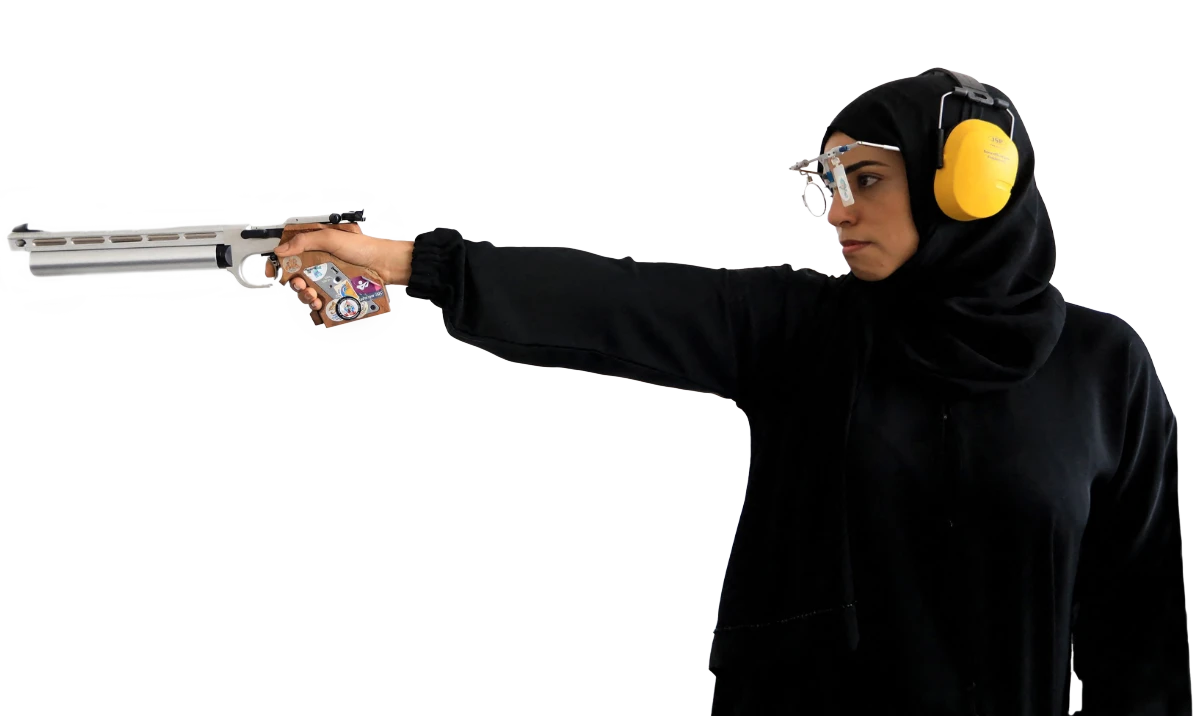
SANAA: Standing by the faded blue wall of an empty sports hall in Sanaa, Yasameen Al-Raimi raises her air pistol and pauses, studying the target 10 meters away.
Squeezing the trigger, the Yemeni Olympic hope fires a metal pellet through the middle of the paper square, rebounding with a clang off the metal plate behind.
Raimi, in black hijab, safety glasses and yellow ear protectors, is training for the Paris Olympics, one of the biggest competitions of her life.
But while her rivals are preparing on purpose-built ranges at high-tech shooting centers, the markswoman from conflict-torn Yemen must muddle through as best she can.
Her makeshift range is roped off by red-and-white plastic tape, the sort commonly seen on building sites. It is tied to a wooden desk bearing her equipment: extra targets, a pistol case, and an electric pulley.
Pushing a button on the pulley, a fresh black-and-white target rattles away on a string to the end of the range, marked by a low, spotlit grey wall. After the session she scrutinizes her pellet-ridden targets, pen in hand.
Raimi is no stranger to makeshift facilities, a fact of life in divided Yemen, which has been engulfed by conflict since the northern Houthi rebels seized Sanaa in 2014.
But recent months have been particularly tense, with the capital city under sporadic fire from US and British forces.
The Western allies are retaliating for the Houthis’ drone-and-missile campaign against shipping in the Red Sea, which they say is in solidarity with Palestinians during the Israel-Hamas war.
Raimi started shooting in 2010 but after Yemen’s war broke out, she put her career on hold for five years before returning to competition in 2020.
At times, with constant power cuts and nowhere else to train, she was reduced to training on the roof of her house.
“There was no electricity for me to shoot, and I could not find a place to train,” she told AFP.
“I even went through a period when I made the roof of my house a shooting spot to continue training.”
After finishing second-last at the COVID-delayed Tokyo Olympics in 2021, she competed at the 2022 World Championships in Cairo and the Asian Championships earlier this year.
“I never stopped training at all. It was daily and in two periods, morning and evening,” she said.
In Paris, she will be the only woman in Yemen’s four-strong team which also includes a swimmer, a sprinter and a judoka.
“I feel honored and proud to be a woman representing Yemen, and also to be a Yemeni player in this Olympics,” Raimi said, calling it “the dream of any athlete.”
Her coach, Amal Modhesh, is doing what she can for Raimi despite lacking any great experience and professional credentials.
“Yasameen does most of her training by herself. She is a very diligent shooter despite the lack of resources ... especially a professional coach,” Modhesh says.
These difficulties have only “increased her determination to reach her goal ... and raise the flag of Yemen high,” adds the coach.
Raimi laments the lack of support from authorities in Yemen, saying most of her training camps and competition trips were at her own expense.
However, she is pleased to receive support from the Yemen Olympic Committee, which funnels funding from the International Olympic Committee and the Olympic Council of Asia.
YOC secretary-general Muhammad Abdullah Al-Ahjri said Yemen’s athletes, present and future, need official help if they are to thrive.
“I say to the officials, whether at the level of Yemeni sports or at the level of the country in general: Yemeni sports must be given the attention it deserves in order for it to develop,” he told AFP.