Hezbollah releases video it says shows surveillance of Israeli-occupied Golan

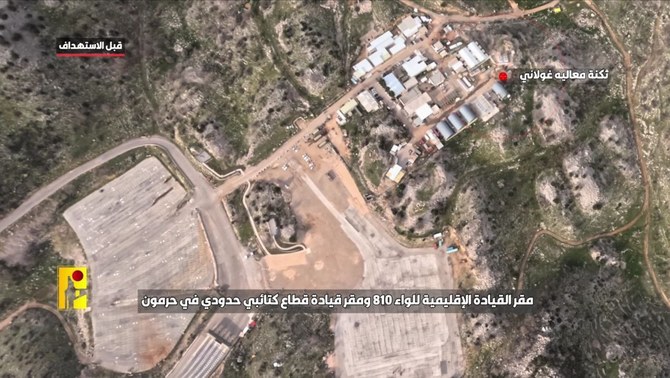
Lebanon's Hezbollah published an almost 10-minute video on Tuesday showing footage of 17 military sites in the Israeli-occupied Syrian Golan Heights which it said had been gathered by the armed group's surveillance aircraft. (X/@TharayIsaac2)
Short Url
Updated 09 July 2024
Follow

Hezbollah releases video it says shows surveillance of Israeli-occupied Golan

  • The video is the second episode in a series intended to show how far Hezbollah’s surveillance of Israel has reached
  • The Iran-aligned group published a more than nine-minute video in June

DUBAI: Lebanon’s Hezbollah published an almost 10-minute video on Tuesday showing footage of 17 military sites in the Israeli-occupied Syrian Golan Heights which it said had been gathered by the armed group’s surveillance aircraft.
The video is the second episode in a series intended to show how far Hezbollah’s surveillance of Israel has reached as tensions mount over Israel’s war against Hamas in Gaza and over frequent exchanges of fire across Lebanon’s border with Israel.
The Iran-aligned group published a more than nine-minute video in June of what it said was surveillance footage of locations in Israel, including the city of Haifa’s airport and sea ports.
“Publishing this video sends a clear message to the enemy and its army,” said Hezbollah media relations officer Muhammad Afif.
“The importance stems from demonstrating our technical and technological capabilities in the field of surveillance and obtaining necessary information we need in times of war,” Afif added.
Lebanese pro-Iranian television channel Al Mayadeen said in June, after the first video was published, that unmanned aircraft had bypassed Israel’s defense systems and returned to Lebanon without being detected or shot down.
Hezbollah has sent both surveillance and attack drones into Israel since the start of the Israel-Hamas war last October, and has said the drone launches are in solidarity with Palestinians in the Gaza Strip.
The conflict between Hezbollah and Israel has been gradually intensifying for months, raising fears of a full-scale war, which both sides say they wish to avoid and diplomats are working to prevent it.
The United States and France are working on a negotiated settlement to the hostilities along Lebanon’s southern border with Israel.


Israel spied on US forces at Gaza aid base: Sources

Updated 08 December 2025
Follow

Israel spied on US forces at Gaza aid base: Sources

  • US commander summoned Israeli counterpart to say: ‘Recording has to stop here’
  • Staff, visitors from other partner countries have also raised concerns about Israeli surveillance

LONDON: Israel conducted widespread surveillance of US forces involved in an aid mechanism for Gaza, The Guardian reported.

The Civil-Military Coordination Center in southern Israel was launched in October as a joint body to monitor the ceasefire and oversee the entry of aid into the war-torn Palestinian enclave.

But sources with knowledge of internal disputes told The Guardian that open and covert recordings of meetings at the CMCC had prompted disputes between the two partners.

Lt. Gen. Patrick Frank, the US commander of the center, summoned his Israeli counterpart to explain that “recording has to stop here.”

Other countries, including the UK and UAE, are also involved in the CMCC. Staff and visitors from partner countries have likewise raised concerns about Israeli surveillance activities at the center.

When the CMCC began operations, media in the US and Israel reported that the latter was handing over authority to American forces.

Yet Israel still retains effective control over what enters the territory despite Washington’s considerable leverage, according to one US official.

US forces who arrived at the CMCC, including logistics experts, were keen to increase the flow of aid into Gaza.

But they soon discovered that Israel had implemented a wide range of controls on purported “dual-use” goods, creating a larger impediment than any engineering challenge relating to aid delivery. These included basic goods such as tent poles and chemicals used for water purification.

Dutch Foreign Minister David van Weel has said he was briefed at the center on “one of the dual-use barriers that was being lifted as a result of the conversations (there).”

It came in response to growing awareness that Israeli restrictions on deliveries stood as the biggest barrier to the entry of aid into Gaza.

Israeli authorities had also restricted basic items such as pencils and paper — required by Palestinian students for school — without explanation.

There is widespread hesitancy among aid organizations and diplomats over joining the CMCC’s efforts, despite being invited to do so.

The center lacks any Palestinian representation, and even US efforts to schedule video calls with Palestinian officials were vetoed by Israeli staff there.