

Israeli drones breach rules of engagement pursuing Hezbollah

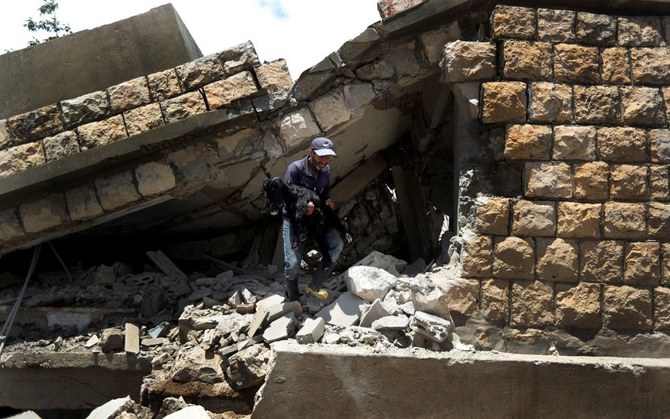
Yussef Halimeh carries a surviving goat from a destroyed house that was hit by an Israeli airstrike, which killed hundreds of goats in a nearby pen, Jabal Tourah, Lebanon, July 8, 2024. (AP Photo)
Short Url
Updated 08 July 2024
Follow

Israeli drones breach rules of engagement pursuing Hezbollah

  • UN coordinator discusses de-escalation on the Blue Line in Tel Aviv
  • Iranian Foreign Ministry: ‘Israel will bear the consequences of any attack on Lebanon’

BEIRUT: An Israeli military drone targeted a car in Tyre and a motorcycle in Qlaileh in southern Lebanon on Monday, killing a Hezbollah member and severely injuring another. 

Hezbollah announced the death of the victim, identified as Mustafa Hassan Salman, born in 1991, from Qlaileh.

The Israeli military also hit a goat farm in Jabal Tourah in Jezzine, killing over 500 goats.

The reason for the expansion of hostilities, which violate the rules of engagement, remains unclear.

After targeting a Hezbollah operative in Deir Qanoun En Nahr three weeks ago, the Israeli military targeted Maaroub in southern Lebanon and Chaat in Baalbek–Hermel on Saturday and Sunday.

As well as expanding the scope of its operations, Israel is also penetrating deeper into Lebanon.

One political observer worried that “Israel, which probably doesn’t want to expand the war, might want to continue its assassinations and targeting of Hezbollah members in any Lebanese region, even if the war in the southern front came to an end.”

Israeli Defense Minister Yoav Gallant said on Monday: “We want to bring Hezbollah to reach an agreement that allows residents to return to their homes.”

Sunday was one of the most challenging days on the southern front, as Hezbollah carried out an operation in the Israeli Golan Heights in response to the assassination of Hezbollah member Maytham Mustafa Al-Attar in Chaat, Baalbek.

Israeli Army spokesperson Avichay Adraee said on Monday that the military “carried out Sunday night raids on Hezbollah’s targets in Lebanon, including a military site in Jabal Tourah, a Hezbollah weapons depot in Qabrikha, a military building in Tallouseh and facilities in Houla and Aita Al-Shaab.”

He added that the army carried out artillery shelling to remove threats in several areas in southern Lebanon.

A family in Marjayoun miraculously escaped death after a missile hit their home but did not explode.

Another rocket fell in Qabrikha, but did not explode either.

In response to the assassination of Al-Attar, Hezbollah launched a drone attack on Mount Hermon in the occupied Syrian Golan Heights where Israel has a key surveillance center.

It said this was its first such bombing since it began trading fire with Israel on Oct. 8.

The attack hit intelligence equipment and technical systems, causing a major fire, Hezbollah said.

Israel has key surveillance, espionage, and air defense installations on Mount Hermon where it overlooks the Syrian capital Damascus and monitors the rest of the country.

Hezbollah also launched dozens of Katyusha rockets at the Nimra base, marking the first attack in nine months of confrontations in the northern region near Tiberias.

Hezbollah targeted the newly established headquarters of the 91st Division in the Ayelet Barracks with dozens of Katyusha rockets, as well as military sites in Liman, Bayad Blida, Birkat Risha, Al-Raheb, and Al-Baghdadi.

Several American citizens and an Israeli settler were injured.

The Israeli military retaliated by conducting airstrikes on the town of Maaroub for the first time, targeting and destroying a concrete water storage tank.

Maaroub, in the Tyre district, is considered a stronghold for Hezbollah, as the hometown of former minister and co-founder Mohammed Fneish.

An Israeli warplane also struck a house in the town of Naqoura.

The Israeli military shelled the town of Bustane with phosphorus bombs, causing fires in agricultural fields and olive groves.

As part of diplomatic efforts, UN Special Coordinator in Lebanon Jeanine Hennis-Plasschaert has been conducting talks in Israel since Sunday after intensive discussions with Lebanese leaders and concerned parties to explore ways of de-escalation across the Blue Line.

Her office said in a statement that “her visit to Israel comes ahead of planned UN Security Council consultations on the implementation of Security Council Resolution 1701 of 2006 later this month.”

She said that discussions with Israeli officials focus on the importance of restoring peace and creating an opportunity for a diplomatic solution that allowed displaced civilians from both sides to return home. Additionally, they will address the outstanding provisions under Resolution 1701.

The Iranian Foreign Ministry warned on Monday that any “attack on Lebanon will create grounds for increased tension in the region and threatens its security and peace.”

The Iranian Foreign Ministry said in a statement that “defending Lebanon is a fundamental principle for us, and there is no doubt that we will support Lebanon against any Israeli aggression.”

It added: “Israel will bear the consequences of any attack on Lebanon, and the international community must assume its responsibilities.”


The Iran war has upended flights across the Middle East. Here’s what travelers should know

Updated 57 min 15 sec ago
Follow

The Iran war has upended flights across the Middle East. Here’s what travelers should know

  • Passengers have already reported seeing sky-high ticket prices

NEW YORK: The US and Israel’s joint war in Iran has already upended travel across the Middle East, stranding tens of thousands of people. And the future is anything but certain.
Experts stress that flights scheduled in the coming days and weeks could continue to see disruptions — causing ripple effects globally, especially as the war widens with retaliatory strikes in the Gulf states. Beyond the Middle East, airports in the Gulf serve as critical hubs connecting travelers going to Europe, Africa and Asia.
Amid airspace closures across the region, many carriers have been forced to either cancel flights or shift to longer routes. That’s straining operating costs and ticket prices, both of which could become more expensive if airlines have to pay more for fuel the longer the war drags on. In the near future, experts recommend postponing unnecessary travel if possible, checking refund or insurance policies and, most importantly, monitoring safety adviseries.
“This is not a normal delay story. This is a conflict zone airspace story,” said Hassan Shahidi, president and CEO of the Flight Safety Foundation — stressing that halted traffic and guidance from carriers, airports and governments may shift each day, if not by the hour. “Travelers should absolutely expect uncertainty.”
Here’s what travelers should know about upcoming trips.
Monitor adviseries and other safety information
Since the US and Israel launched attacks over the weekend, retaliatory strikes and other developments have unfolded rapidly. Iran says hundreds of people have been killed in the country. For travelers across the region, experts stress the importance of following safety guidance and updates from government officials.
A handful of governments have also issued travel adviseries and emergency evacuation orders. The US State Department on Monday urged all US citizens to immediately leave Iran and Israel, as well as Qatar, Bahrain, Egypt, Iraq, Jordan, Kuwait, Lebanon, Oman, the Palestinian territories, Saudi Arabia, Syria, the United Arab Emirates and Yemen using any available commercial transportation — and Secretary of State Marco Rubio pleaded for the media to publicize ways to help Americans evacuate. Meanwhile, countries like China, Italy, France and Germany moved to organize evacuation efforts for their citizens.
Experts like Shahidi say travelers should monitor these travel adviseries from governments and embassies to make sure they have the latest information. And because so many people are still stranded amid swaths of cancelations and airspace closures, he added that it’s wise to reconsider or rebook upcoming trips, if possible.
“If travel is optional, consider postponing it,” Shahidi said. “But if it’s necessary, then make sure that you get refundable or changeable fares.”
Travelers should also monitor updates from airports and airlines. Long-haul carriers Etihad Airways and Emirates, based in Abu Dhabi and Dubai, along with Doha-based Qatar Airways all temporarily suspended certain routes — citing airspace closures and safety requirements.
Read the fine print of refunds and insurance
Many airlines are taking refund requests or offering free rebooking — but such options are often limited to specific dates or routes, so it’s important for travelers to check carriers’ individual websites for more information. For future trips, buying refundable tickets now may provide more flexibility.
Beyond what individual airlines can offer, some may also be seeking travel insurance. But it’s important to read the fine print, particularly the exclusions listed under specific policies.
“Acts of war and civil unrest are typically excluded because they’re unpredictable,” said Suzanne Morrow, CEO of travel insurance agency InsureMyTrip. Consumers could still buy coverage for delays, she added, but travel insurance is “designed to make you whole,” and if an airline does everything to rebook you or offers a refund, you may not have an added claim.
Christina Tunnah, of World Nomads Travel Insurance, reiterates that the majority of her firm’s policies excludes coverage for losses resulting from acts of war, although someone might be able to get compensation in certain scenarios — such as if they purchase a “cancel for any reason” plan. Still, the traveler would have to cancel within a certain time frame.
Tunnah adds that once an event is known, it’s unlikely to be covered. So if a consumer has not already purchased traveler insurance, many insurers may have added restrictions to impacted destinations.
Brace for longer flights and higher ticket prices
Beyond cancelations, many carriers are now taking longer routes to avoid closed airspace. Shahidi noted that includes not only closures stemming from this current war but also previous conflicts worldwide.
Navigating these different conflict zones has become increasingly difficult for airlines, because longer routes can be more expensive. It’s industry standard for carriers to pay “overflight fees” when flying through other countries’ airspace — which there could be more of now. And, of course, longer flights need more fuel.
“Those costs will be passed on to the passengers,” explained Bryan Terry, managing director at Alton Aviation Consultancy. If the conflict continues, he said, travelers should “anticipate that some carriers will likely impose fuel surcharges” or increase existing fees.
Passengers have already reported seeing sky-high ticket prices. Experts say those immediate hikes more likely reflect supply and demand as thousands of flights were canceled in recent days. But the costs of those longer routes — paired with oil prices that have already spiked since the US and Israel launched their attacks — could trickle down to consumers further ahead.
The price of crude oil is a key component for jet fuel, which accounted for about 30 percent of airlines’ operating costs as of 2024, according to research from the International Air Transport Association.
Many routes within the next week are completely sold out or have exorbitant prices for last remaining seats. The market currently shows those costs, while still elevated, are lower for trips booked further out, Terry notes — but, again, if the war drags on or worsens, “those conditions could change at a moment’s notice.”