

Pakistan PM discusses ways to enhance trade, investment cooperation with Iran’s president-elect 

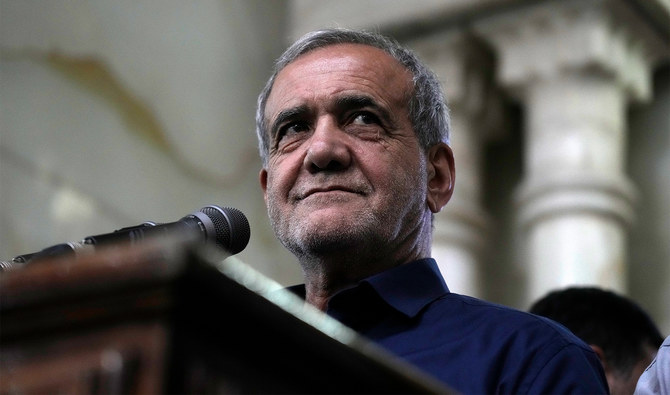
Iran's President-Elect Masoud Pezeshkian speaks during a meeting a day after the presidential election, at the shrine of the late revolutionary founder Ayatollah Khomeini, just outside Tehran, Iran, on July 6, 2024. (AP)
Short Url
Updated 09 July 2024
Follow

Pakistan PM discusses ways to enhance trade, investment cooperation with Iran’s president-elect 

  • PM Sharif congratulates Iran’s President-elect Masoud Pezeshkian on winning election in telephonic conversation
  • Pakistan, Iran have a shared vision for building a better future together for our people, says Pakistani PM 

ISLAMABAD: Pakistan’s Prime Minister Shehbaz Sharif congratulated Iran’s President-elect Masoud Pezeshkian on Monday for winning the recently held election in his country, as both leaders discussed opportunities to enhance cooperation in trade and investment, Sharif’s office said.

Masoud Pezeshkian, a relatively moderate candidate, secured 53.7 percent or 16.3 million votes in Iran’s presidential election held on Friday, defeating hard-liner Saeed Jalili’s 13.5 million votes. The reformist-backed candidate, who is 69 years old, will replace Ebrahim Raisi, who died in a plane crash last month. 

In a post on social media platform X, PM Sharif said he spoke to Pezeshkian over the phone to congratulate him on his victory. 

“We discussed ways to enhance cooperation, particularly in trade, commerce & investment, and foster a stronger partnership for regional stability,” Sharif wrote on X. “As brothers and neighbors, our two countries have a shared vision for building a better future together for our peoples.”

Pakistan and Iran agreed to enhance bilateral trade between the two countries to $10 billion in April when Raisi arrived in Islamabad. 

Both countries signed memorandum of understandings and agreements covering different fields including trade, science and technology, agriculture, health, culture, and judicial matters.

Pakistan and Iran have had a history of rocky relations despite a number of commercial pacts, with Islamabad being historically closer to Saudi Arabia and the United States. Their highest profile agreement is a stalled gas supply deal signed in 2010 to build a pipeline from Iran’s South Fars gas field to Pakistan’s southern provinces of Balochistan and Sindh.

The two countries are also often at odds over instability on their shared porous border, with both routinely trading blame for not rooting out militancy.

Tensions surged in January when Pakistan and Iran exchanged airstrikes, both claiming to target alleged militant hideouts in each other’s countries. Both sides have since then undertaken peace overtures and restored bilateral ties.


Pakistan, Afghanistan border clashes kill 5, officials say

Updated 06 December 2025
Follow

Pakistan, Afghanistan border clashes kill 5, officials say

  • Afghanistan and Pakistan trade blame for “unprovoked firing” along Chaman-Spin Boldak border
  • Exchange takes place nearly a week after a fresh round of peace talks between neighbors failed

KABUL: Pakistan and Afghanistan exchanged heavy fire along their border late on Friday, officials from both countries said, killing at least five people amid heightened tensions following failed peace talks last weekend.

Afghan Taliban spokesman Zabihullah Mujahid said Pakistani forces launched attacks in the Spin Boldak district of Kandahar province.

His deputy Hamdullah Fitra told Reuters that shelling by Pakistan killed five people, including a Taliban member.

A spokesman for Pakistan’s prime minister said Afghan forces carried out “unprovoked firing” along the Chaman border.

“Pakistan remains fully alert and committed to ensuring its territorial integrity and the safety of our citizens,” spokesman Mosharraf Zaidi said in a statement.

The exchange came nearly a week after a new round of peace talks between the South Asian neighbors ended without a breakthrough, although both sides agreed to continue their fragile ceasefire.

The talks in Saudi Arabia last weekend were the latest in a series of meetings hosted by Qatar, Turkiye and Saudi Arabia to cool tensions following deadly border clashes in October.

At the heart of the dispute, Islamabad says Afghan-based militants have carried out recent attacks in Pakistan, including suicide bombings involving Afghan nationals. Kabul denied the charge, saying it could not be held responsible for security inside Pakistan.

Dozens were killed in October’s clashes, the worst violence on the border since the Taliban took power in Afghanistan in 2021.