Pakistan announces $197 million project to solarize 27,000 tubewells in arid southwestern province

Prime Minister Shehbaz Sharif talking to the media after the signing of agreement to solarise agricultural tubewells of Balochistan in Quetta on July 8, 2024. (PMO)
Short Url
Updated 08 July 2024
Follow

Pakistan announces $197 million project to solarize 27,000 tubewells in arid southwestern province

  • Federal government to pay 70 percent cost of project, rest to be paid by provincial government 
  • Prime Minister Shehbaz Sharif was in Balochistan’s capital of Quetta on one-day visit

ISLAMABAD: Prime Minister Shehbaz Sharif announced an over $197 million project to solarize 27,000 tubewells in the country’s southwestern Balochistan province, an arid region with occasional rainfall which is one of the country’s most economically backward. 
The announcement, that Sharif described as “historic,” came during the premier’s one-day visit to Balochistan’s provincial capital of Quetta where he held separate meetings with the governor and chief minister to discuss power cuts and security threats, among other issues. 
Constituting almost 44 percent of the country’s total land mass, Balochistan is the largest province of Pakistan, with a population of around 12 million people. The region is also one of Pakistan’s poorest and battles poor security, rugged terrain, an unreliable water supply and restricted employment opportunities.
Despite being water scarce, agriculture and livestock remain the major sources of income for the majority of the highly dispersed population.
“Prime Minister Muhammad Shehbaz Sharif announces historic launch of solarization of all agricultural tube wells of Baluchistan,” the Prime Minister’s Office (PMO) said in a statement.
“27,000 tubewells that run on electricity, their electric connections will be terminated and they [farmers] will be provided solar connections.”
In the last ten years, Sharif told members of the Balochistan cabinet, the federal government had paid Rs500 billion ($1.8 billion) in electricity bills for Balochistan’s tubewells, lamenting that the center had to pay the hefty subsidies as the provincial government could not afford to pay the exorbitant bills:
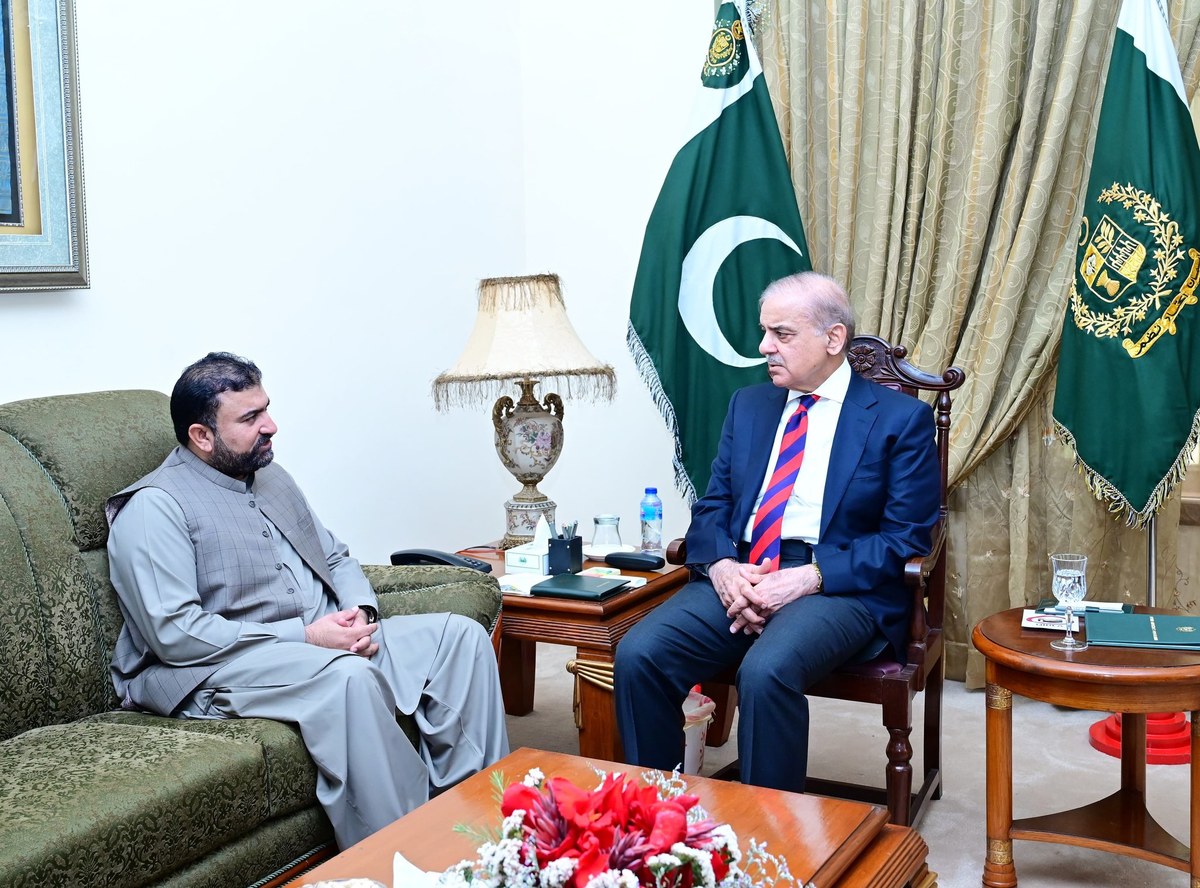


Pakistan Prime Minister Shehbaz Sharif (right) meets Chief Minister of Balochistan, Sarfraz Bugti, in Quetta, Pakistan on July 8, 2024. (PID)

“When these tubewells are run on solar energy, the [average] farmer will provide water to his land to make it fertile. And the electricity that is generated from solar power is very cheap, it is the cheapest in the world.”
The Pakistani prime minister said the tubewell project would cost around $197 million, of which the center would pay 70 percent while the remaining would be paid by the Balochistan government. 
Balochistan is also plagued by planned power cuts, known as loadshedding, that happen frequently due to fuel shortages and vary in length in different areas. In Balochistan, power outages are prolonged due to both electricity production deficits and unpaid bills by consumers that affect entire neighborhoods. Last week, hundreds of people in one of Pakistan’s hottest cities, Sibi in Balochistan, stormed a power station in protest against cuts lasting up to 20 hours a day.
The province was one of the worst hit by 2022 floods, killing 336 people out of around 1,700 who died nationwide. More than 500,000 heads of livestock perished as a consequence of the floods, at least 17,500 houses were destroyed, another 43,900 houses partially damaged and 1,230 km2 (304,000 acres) of crops lost.


Pakistan Air Force conducts ‘Exercise Golden Eagle’ to test combat readiness, agility

Updated 10 February 2026
Follow

Pakistan Air Force conducts ‘Exercise Golden Eagle’ to test combat readiness, agility

  • The exercise follows an intense, four-day Pakistan-India military conflict in May 2025
  • It focused on AI-enabled operations integrating disruptive technologies, military says

ISLAMABAD: The Pakistan Air Force (PAF) has conducted “Exercise Golden Eagle” that successfully validated its combat readiness and operational agility through synchronized employment of the PAF’s complete combat potential, the Pakistani military said on Tuesday.

It comes months after Pakistan’s four-day military conflict with India in May, with Islamabad claiming victory in the standoff after the PAF claimed to have shot down at least six Indian fighter aircraft, including the French-made Rafale. New Delhi acknowledged some losses but did not specify a number.

The exercise was conducted on a Two-Force construct, focusing on AI-enabled, net-centric operations while integrating indigenous niche, disruptive and smart technologies in line with evolving regional security dynamics, according to the Inter-Services Public Relations (ISPR), the Pakistani military’s media wing.

Operating within a robust Integrated Air Defense System, friendly forces shaped the battlespace through seamless fusion of kinetic operations with cyber, space and electro-magnetic spectrum operations.

“The kinetic phase featured First-Shoot, First-Kill swing-role combat aircraft equipped with long-range BVR air-to-air missiles, extended-range stand-off weapons and precision strike capabilities, supported by Airborne Early Warning & Control platforms and Air-to-Air Refuelers,” the ISPR said in a statement.

“A key highlight of the exercise was Manned–Unmanned Teaming, with deep-reach killer drones and loitering munitions operating in a highly contested, congested and degraded environment, validating PAF’s capability to conduct high-tempo operations in modern warfare.”

In recent months, many countries have stepped up defense engagement with Pakistan, while delegations from multiple nations have proposed learning from the PAF’s multi-domain air warfare capabilities that officials say were successfully employed during the May conflict.

“The successful conduct of Exercise Golden Eagle reaffirms Pakistan Air Force’s unwavering commitment to maintaining a high state of operational preparedness, leveraging indigenous innovation and effectively countering emerging and future security challenges,” the ISPR added.