Beryl downgraded after slamming Texas with deadly rains, wind

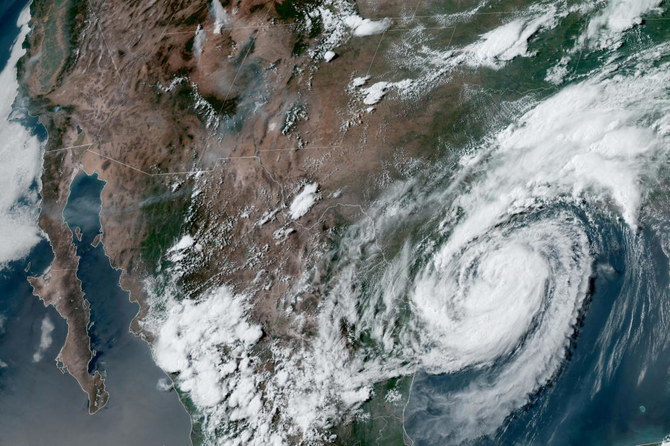
Tropical Storm Beryl approaches the Texas coast in the Gulf of Mexico in a composite satellite image on July 7, 2024. (NOAA handout via Reuters)
Short Url
Updated 09 July 2024
Follow

Beryl downgraded after slamming Texas with deadly rains, wind

  • Hurricane warning remains in effect for the Texas coast from Mesquite Bay north to Port Bolivar
  • People on the Texas coast boarded up windows and left beach towns under evacuation order

HOUSTON: Beryl was downgraded Monday evening to a tropical depression after slamming the southern US state of Texas as a Category 1 hurricane, killing at least four people and causing millions to lose power amid scorching summer heat.
The US National Hurricane Center (NHC) said Beryl made landfall Monday morning near the Gulf Coast town of Matagorda, and was losing strength as it moved inland but still packing flood-producing rains and strong winds.
“Considerable flash and urban flooding as well as minor to isolated major river flooding is expected,” the NHC said in its latest advisory, adding that “several tornadoes are possible through tonight across parts of east Texas, Louisiana, and Arkansas.”
The sprawling city of Houston, home to 2.3 million people, was badly battered early Monday by hurricane-strength winds and flooding, with authorities announcing at least four deaths related to the storm.
Harris County Sheriff Ed Gonzalez said on X that a 53-year-old man and 74-year-old woman had died in separate incidents of trees falling on houses.
Later, Houston Mayor John Whitmire told a press conference that one person died after a lightning strike possibly ignited a fire, while a police department employee died in floodwaters while on his way to work.
Some 2.6 million households in Texas were without electricity as of Monday evening, according to the poweroutage.us tracker, as temperatures were forecast to climb above 90 degrees Fahrenheit (32 degrees Celsius) over the next few days.
Rose Michalec, 51, told AFP that Beryl blew down fences in her south Houston neighborhood.
“For a Category 1 storm, it’s quite a bit of damage... It’s more than we expected,” she said.
In downtown Houston, several areas were completely inundated, including the park where 76-year-old Floyd Robinson usually walks.
“I’m seeing more of this kind of damaging water, than I’ve ever seen before,” the life-long Houston resident told AFP.
“This is just the beginning of July and for us to have a storm of this magnitude is very rare,” he added.
Along the Texas coastline, AFP journalists saw several waterfront homes and buildings with their roofs torn off in the wind.
Several communities in the area had issued voluntary or mandatory evacuation orders ahead of the storm.

Meanwhile in the neighboring state of Louisiana, one death was announced by the Bossier Parish sheriff’s office, also by a tree falling on a home.
The deaths on Monday raise the total toll from the storm — which began its tear across the Caribbean as a powerful hurricane over a week ago — to over a dozen.
Beryl first slammed Grenada, St. Vincent and the Grenadines as a Category 4 storm, before plowing past the Cayman Islands and Jamaica, and at one point strengthening to a highest-level Category 5.
It hit Mexico as a Category 2 hurricane on Friday, flattening trees and lampposts and ripping off roof tiles, although there were no reported deaths or injuries there.
Beryl is the first hurricane since NHC record-keeping began to reach the Category 4 level in June, and the earliest to hit the highest Category 5 in July.
It is also the earliest hurricane to make landfall in Texas in a decade, according to expert Michael Lowry.
It is extremely rare for such a powerful storm to form this early in the Atlantic hurricane season, which runs from early June to late November.
Scientists say climate change likely plays a role in the rapid intensification of storms such as Beryl because there is more energy in a warmer ocean for them to feed on.
North Atlantic waters are between two and five degrees Fahrenheit (one to three degrees Celsius) warmer than normal, according to the US National Oceanic and Atmospheric Administration.


Trump insists he struck Iran on his own terms

Updated 7 sec ago
Follow

Trump insists he struck Iran on his own terms

  • “We are now a nation divided between those who want to fight wars for Israel and those who just want peace and to be able to afford their bills and health insurance,” Marjorie Taylor Greene posted on X.
  • Rubio himself doubled down on Tuesday after meeting with US House and Senate members, while insisting that “No, I told you this had to happen anyway”

WASHINGTON, United States: President Donald Trump and his team scrambled Tuesday to reclaim the narrative on why he decided to attack Iran, after his top diplomat suggested the US struck only after learning of an imminent Israeli strike.
Secretary of State Marco Rubio alarmed Democrats — who say only Congress can declare war — as well as many of Trump’s MAGA supporters on Monday when he said: “We knew that there was going to be an Israeli action.”
“We knew that that would precipitate an attack against American forces, and we knew that if we didn’t pre-emptively go after them before they launched those attacks, we would suffer higher casualties,” Rubio told reporters.
Administration officials quickly backpedalled, insisting Trump authorized the strikes because Tehran was not seriously negotiating an accord on limiting its nuclear ambitions, and the United States needed to destroy Iran’s missile capabilities.
“No, Marco Rubio Didn’t Claim That Israel Dragged Trump into War with Iran,” White House Press Secretary Karoline Leavitt posted Tuesday on X.
At an Oval Office meeting later with Germany’s chancellor, Trump went further, saying that “Based on the way the negotiation was going, I think they (Iran) were going to attack first. And I didn’t want that to happen.”
“So, if anything, I might have forced Israel’s hand.”

- Had to happen? -

Rubio himself doubled down on Tuesday after meeting with US House and Senate members, while insisting that “No, I told you this had to happen anyway.”
“The president made a decision. The decision he made was that Iran was not going to be allowed to hide... behind this ability to conduct an attack.”
Critics seized on the muddied messaging to accuse Trump of precipitating the country into a war without a clear rationale, without informing Congress — and without a clear idea of how it might end.
They noted that just two weeks ago, Israel Prime Minister Benjamin Netanyahu pressed Trump again in Washington to take a hard line, in their seventh meeting since Trump’s return to power last year.
Some Republican allies rallied behind the president, with Senator Tom Cotton, chairman of the Senate Intelligence Committee, insisting that “No one pushes or drags Donald Trump anywhere.”
“He acts in the vital national security interest of the United States,” Cotton told the “Fox & Friends” morning show.
But as crucial US midterm elections approach that could see Republicans lose their congressional majority, Trump risks shedding supporters who had welcomed his pledge to end foreign military interventions.
“We are now a nation divided between those who want to fight wars for Israel and those who just want peace and to be able to afford their bills and health insurance,” Marjorie Taylor Greene, a top former Trump ally and a major figure in the populist and isolationist hard right, posted on X.