KINGSTON: Hurricane Beryl churned toward Jamaica Tuesday, with forecasters warning of potentially deadly winds and storm surge, after the storm killed at least seven people and caused widespread destruction across the southeastern Caribbean.
The powerful hurricane, which is rare so early in the Atlantic season, weakened Tuesday but was still an “extremely dangerous” Category 4 storm, and is expected to pass “near or over” Jamaica on Wednesday, meteorologists said.
Beryl is the first storm since US National Hurricane Center records began to reach the Category 4 level in June, and the earliest to reach Category 5 in July.
A hurricane warning was in place for the island nation, according to the NHC, which said rain and flash flooding was to be expected in addition to the life-threatening wind and high water levels.
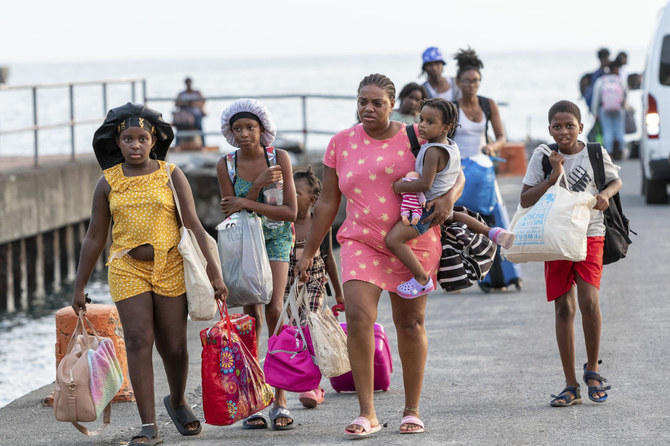
Across Jamaica, emergency response preparations were underway, with shelters stocking up on provisions, people safeguarding their homes and boats being pulled from the water.
“I urge all Jamaicans to stock up on food, batteries, candles, and water. Secure your critical documents and remove any trees or items that could endanger your property,” Prime Minister Andrew Holness said on X.
Hurricane warnings were also issued in the Cayman Islands, which Beryl is “expected to pass near or over” on Wednesday night or early Thursday, according to the NHC.
In the Dominican Republic, massive waves were seen crashing into the shore along Santo Domingo as the storm passed to the country’s south, AFP photographers reported.
Beryl has already left a trail of death in its wake with at least three people killed in Grenada, where Beryl made landfall Monday, as well as one in St. Vincent and the Grenadines and three in Venezuela, officials said.
Grenada’s Prime Minister Dickon Mitchell said the island of Carriacou, which was struck by the eye of the storm, has been all but cut off, with houses, telecommunications and fuel facilities there flattened.
“We’ve had virtually no communication with Carriacou in the last 12 hours except briefly this morning by satellite phone,” Mitchell told a news conference.
The 35-square kilometer island is home to around 9,000 people. At least two people there died, Mitchell said, with a third killed on the country’s main island of Grenada when a tree fell on a house.
In St. Vincent and the Grenadines, one person on the island of Bequia was reported dead from the storm, and a man died in Venezuela’s northeastern coastal state of Sucre when he was swept away by a flooded river, officials there said.
World Health Organization chief Tedros Adhanom Ghebreyesus expressed concern about the region, saying on X that his organization “stands ready to support the national authorities with any health needs.”
Experts say it is extremely rare for such a powerful storm to form this early in the Atlantic hurricane season, which runs from early June to late November.
Warm ocean temperatures are key for hurricanes, and North Atlantic waters are currently between two and five degrees Fahrenheit (1-3 degrees Celsius) warmer than normal, according to the US National Oceanic and Atmospheric Administration.
The World Meteorological Organization (WMO) said Beryl “sets an alarming precedent for what is expected to be a very active hurricane season.”
NOAA said in late May that it expects this year to be an “extraordinary” hurricane season, with up to seven storms of Category 3 or above.
UN climate chief Simon Stiell, who has family on the island of Carriacou, said climate change was “pushing disasters to record-breaking new levels of destruction.”
“Disasters on a scale that used to be the stuff of science fiction are becoming meteorological facts, and the climate crisis is the chief culprit,” he said Monday, reporting that his parents’ property was damaged.
As of 2300 GMT, Beryl had maximum sustained winds of 240 kilometers per hour as it headed toward Jamaica and the Cayman Islands on Tuesday, according to the NHC.
A hurricane watch and tropical storm warnings have also been issued for parts of Haiti.


![]()

Hurricane Beryl kills seven as it churns toward Jamaica
Short Url
https://arab.news/cgwu2
Hurricane Beryl kills seven as it churns toward Jamaica
- Beryl is the first storm since US National Hurricane Center records began to reach the Category 4 level in June
- Beryl had maximum sustained winds of 240 kilometers per hour as it headed toward Jamaica and the Cayman Islands on Tuesday


Latest updates


© 2026 SAUDI RESEARCH & PUBLISHING COMPANY, All Rights Reserved And subject to Terms of Use Agreement.