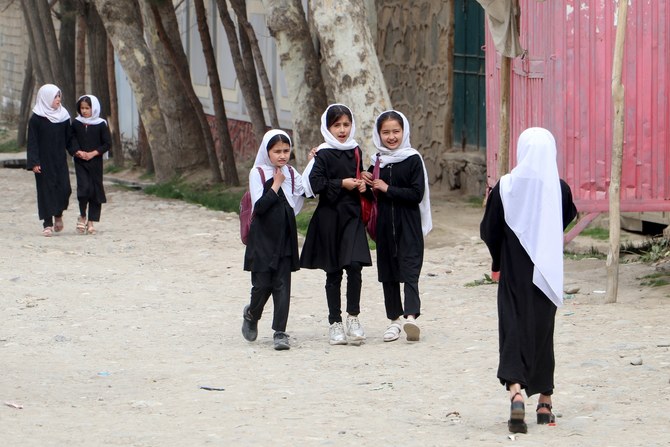
KABUL: When Salma was suddenly forced to stop her education in the eighth grade, she was left in limbo, every day waiting to return to the classroom. Almost three years later, the hope has faded not only for her, but also more than a million Afghan girls above the age of 13 who are no longer allowed to attend school.
Secondary schools for girls were suspended in September 2021, a month after the Taliban took control of Afghanistan. The ban resulted in about 1.1 million girls being denied access to formal education.
For Salma and her friends, it was an end to their dreams of the future.
“I used to go to school every day. Every morning felt very exciting. We would meet our friends and teachers. We used to play together, eat and, of course, study,” she said.
“Every time I sat with my classmates, we would talk about our dreams and plans. I always wanted to be a teacher, my friend wanted to become a doctor, another one wished to become a computer engineer ... Everything changed so suddenly.”
Neither appeals at home nor international pressure on the Taliban administration have since helped to lift the ban, which authorities have repeatedly said was an “internal matter.” The only education the Taliban have allowed for girls is at madrasas, Islamic schools that focus on religious training.
Some of Salma’s colleagues tried to continue their learning and took private lessons online.
“But they banned those classes as well,” she said. “We just pass days and nights without doing anything meaningful. Our lives have become purposeless.”
The ban was later extended to universities, with more than 100,000 female students blocked from finishing their degrees.
Testimonies of girls and young women such as Salma are now being collected under the “Iqra” campaign by Afghan activists trying to amplify their voices.
The word “iqra,” meaning “read” in Arabic, was the first word of the Qur’anic revelation, which is interpreted by many Muslims as emphasizing the importance of education in Islam.
The campaign is organized by Musawer and Rawadari, two civil society organizations working for children’s education and human rights.
“We started the Iqra campaign as we were getting closer to the 1,000 days of school closure for girls in Afghanistan. We were so saddened and really grieved by it because every day is a day that will never come back for these young women. They can never go back and be of the same age and go back to school,” Shaharzad Akbar, director of Rawadari, told Arab News.
Rawadari has been contacting girls across Afghanistan, asking how it feels to be out of school for so long, how it has affected them, and what was it that they wanted.
“Their main demand is the reopening of schools and universities so that they can continue their education. When you talk to an 11-12-year-old in other parts of the world, they will talk about personal ambitions. But for almost all of these girls, they are talking about serving their communities,” Akbar said.
“Almost every single person said I wanted to be educated so I can serve Afghanistan and my people. That was really moving. What a waste that they will not be able to serve in the ways that they want to serve because they are banned from education.”
Women activists and education experts say the ban on girls’ education has already damaged the entire social system.
Fazila Muruwat, former head of the Kunar Teachers’ Education College, said that the restriction is taking a toll on both students and educators.
“People are hopeless and sad,” she said. “Female teachers are also forgetting a lot of what they have learned and taught before.”
Mahbob Mowahed, principal of a private school in Kabul, highlighted the damaging psychological and social consequences of the ban.
“In order to have a progressive and independent country, it is imperative for everyone to have access to education, which means that men, women, boys and girls should have the opportunity to learn,” he said.
“Women are an important part of the society and we cannot keep them illiterate forever. Even religion cannot be properly learnt without education.”
Fears are growing that the prolonged denial of education is resulting in another lost generation in Afghanistan.
“An entire generation was thrown into darkness. This is such a loss that Afghanistan will not be able to compensate for it for decades. It is not just a problem of girls but it is a discussion of the survival of Afghanistan,” Shafiqa Khpalwak, director of Musawer, told Arab News.
“I don’t know what the society will be like if girls don’t go to school and remain illiterate ... This is a human disaster. This is a violation of human dignity.”


![]()

Testimonies of Afghan girls reveal grief, despair over Taliban school ban
Short Url
https://arab.news/yyb5a
Testimonies of Afghan girls reveal grief, despair over Taliban school ban
- Fears of ‘lost generation,’ as education experts say ban has damaged Afghanistan’s entire social system
- ‘Iqra’ campaign by Afghan activists gathers stories of young women denied access to formal schooling


Latest updates


© 2026 SAUDI RESEARCH & PUBLISHING COMPANY, All Rights Reserved And subject to Terms of Use Agreement.