India stampede: main organizer of religious event surrenders to police

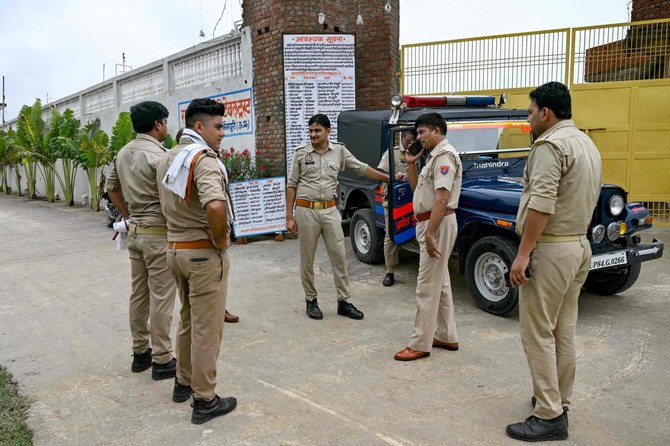
Policemen stand guard outside the ashram of former police constable-turned-Hindu preacher Bhole Baba at Bichhawan village in Mainpuri district, in India’s Uttar Pradesh state on July 4, 2024. (AFP)
Short Url
Updated 06 July 2024
Follow

India stampede: main organizer of religious event surrenders to police

NEW DELHI: The chief organizer of an Indian preacher’s event where a stampede killed 121 people this week surrendered to police on Friday, a lawyer for the preacher said, after police had launched a manhunt.
Devprakash Madhukar was named a key suspect in an initial report registered by police under charges including attempted culpable homicide. Police had announced a reward of 100,000 rupees ($1,200) for information leading to his arrest.
A.P. Singh, lawyer for self-styled godman Bhole Baba, said Madhukar was the main organizer of the Hindu religious event on Tuesday attended by about 250,000 people in a village in the northern state of Uttar Pradesh. District authorities had permitted an event of only 80,000 people.
“He has surrendered from Delhi. We are not seeking an anticipatory bail,” Singh told reporters. He denied any wrongdoing by the event’s organizers and said Devprakash was getting medical treatment in a hospital after the stampede.
The preacher said on Saturday he was saddened by the incident and his aides would help the injured and families of the deceased.
“I have faith that anyone who created the chaos will not be spared,” he told Indian news agency ANI, in which Reuters has a minority stake.
($1 = 83.47 Indian rupees)


WHO appeals for $1 bn for world’s worst health crises in 2026

Updated 58 min 6 sec ago
Follow

WHO appeals for $1 bn for world’s worst health crises in 2026

  • The UN health agency estimated 239 million people would need urgent humanitarian assistance this year and the money would keep essential health services going

GENEVA: The World Health Organization on Tuesday appealed for $1 billion to tackle health crises this year across the world’s 36 most severe emergencies, including in Gaza, Sudan, Haiti and the Democratic Republic of Congo.
The UN health agency estimated 239 million people would need urgent humanitarian assistance this year and the money would keep essential health services going.
WHO health emergencies chief Chikwe Ihekweazu told reporters in Geneva: “A quarter of a billion people are living through humanitarian crises that strip away the most basic protections: safety, shelter and access to health care.
“In these settings, health needs are surging, whether due to injuries, disease outbreaks, malnutrition or untreated chronic diseases,” he warned.
“Yet access to care is shrinking.”
The agency’s emergency request was significantly lower than in recent years, given the global funding crunch for aid operations.
Washington, traditionally the UN health agency’s biggest donor, has slashed foreign aid spending under President Donald Trump, who on his first day back in office in January 2025 handed the WHO his country’s one-year withdrawal notice.
Last year, WHO had appealed for $1.5 billion but Ihekweazu said that only $900 million was ultimately made available.
Unfortunately, he said, the agency had been “recognizing ... that the appetite for resource mobilization is much smaller than it was in previous years.”
“That’s one of the reasons that we’ve calibrated our ask a little bit more toward what is available realistically, understanding the situation around the world, the constraints that many countries have,” he said.
The WHO said in 2026 it was “hyper-prioritising the highest-impact services and scaling back lower?impact activities to maximize lives saved.”
Last year, global funding cuts forced 6,700 health facilities across 22 humanitarian settings to either close or reduce services, “cutting 53 million people off from health care.” Ihekweazu said.
“Families living on the edge face impossible decisions, such as whether to buy food or medicine,” he added, stressing that “people should never have to make these choices.”
“This is why today we are appealing to the better sense of countries, and of people, and asking them to invest in a healthier, safer world.”