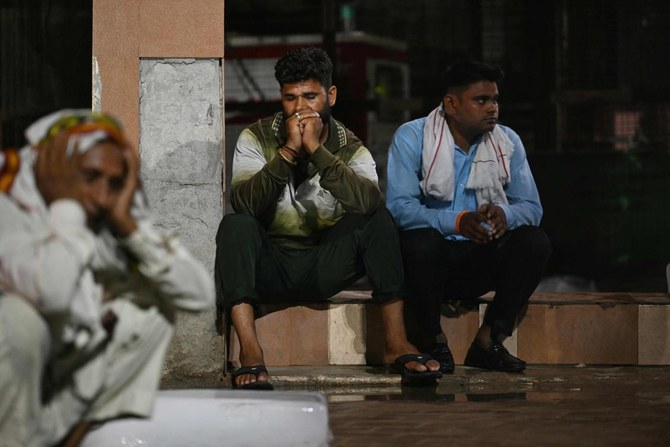
HATHRAS, India: Survivors of India’s deadliest stampede in more than a decade recalled on Wednesday the horror of being crushed at a vastly overcrowded Hindu religious gathering where 121 people were killed.
A police report said more than 250,000 people attended the event in northern India’s Uttar Pradesh state, more than triple the 80,000 for whom organizers had permission.
Discarded clothing and lost shoes were scattered across the muddy site, an open field alongside a highway, on Wednesday morning hours after the event.
People fell on top of each other as they tumbled down a slope into a water-logged ditch, witnesses said.
“Everyone — the entire crowd, including women and children — all left from the event site at once,” said police officer Sheela Maurya, 50, who had been on duty Tuesday as a popular Hindu preacher delivered a sermon.
“There wasn’t enough space, and everyone just fell on top of each other.”
Almost all the dead were women. Dozens more were injured.
Officials suggested the stampede was triggered when worshippers tried to gather soil from the footsteps of the preacher, while others blamed a dust storm for sparking panic.
Some fainted from the force of the crowd before falling and being trampled, unable to move.
Forensic officers scoured the site on Wednesday searching for evidence.
Uttar Pradesh’s state disaster management center, the Office of the Relief Commissioner, released a list of the dead on Wednesday morning.
It said 121 people had been killed.
Maurya, who had been on duty since early morning on Tuesday in the sweltering, humid heat at the preacher’s ceremony, was among the injured.
“I tried to help some women but even I fainted and was crushed under the crowd,” she told AFP.
“I don’t know, but someone pulled me out, and I don’t remember much.”
Deadly incidents are common at places of worship during major religious festivals in India, the biggest of which prompt millions of devotees to make pilgrimages to holy sites.
“The main highway next to the field was packed with people and vehicles for kilometers, there were far too many people here,” said Hori Lal, 45, who lives in Phulrai Mughalgadi village, near the site of the stampede.
“Once people started falling to the side and getting crushed, there was just chaos.”
Chaitra V., divisional commissioner of Aligarh city in Uttar Pradesh state, initially said panic began when “attendees were exiting the venue when a dust storm blinded their vision, leading to a melee.”
The initial police report into the deaths said it began when “followers started to collect earth” from the path of the preacher as he left the venue.
Maurya said she had worked at several political rallies and large events in the past but had “never seen such huge numbers.”
“It was very hot, even I fell there and I survived with great difficulty,” she added.
Four unidentified bodies lay on the floor of a makeshift morgue at the hospital in the nearby town of Hathras at dawn on Wednesday.
Ram Nivas, 35, a farmer, said he was searching for his sister-in-law Rumla, 54, who was missing after the crush.
“We haven’t been able to find her anywhere,” Nivas said after he had visited all the nearby hospitals throughout the night.
“We just hope she’s still alive,” he said quietly. “Maybe just lost.”
In the hospital’s emergency ward, Sandeep Kumar, 29, sat next to his injured sister, Shikha Kumar, 22.
“After the event ended, everyone wanted to exit quickly, and that is what led to the stampede,” Sandeep said.
“She saw people fainting, getting crushed.”
Prime Minister Narendra Modi announced compensation of $2,400 for the next of kin of those killed and $600 for those injured in the “tragic incident,” and the upper house of parliament observed a minute’s silence on Wednesday.
President Droupadi Murmu said the deaths were “heart-rending” and offered her “deepest condolences.”
Uttar Pradesh Chief Minister Yogi Adityanath, who is also a Hindu monk and was dressed in flowing saffron robes, flew in by helicopter to visit victim’s families.
Religious gatherings in India have a grim track record of deadly incidents caused by poor crowd management and safety lapses.
In 2008, 224 pilgrims were killed and more than 400 were injured in a stampede at a hilltop temple in the northern city of Jodhpur.

Terror, ‘chaos’ as India stampede kills 121
https://arab.news/ztrkp
Terror, ‘chaos’ as India stampede kills 121
- More than 250,000 people attended Hindu religious event in northern India’s Uttar Pradesh state
- Religious gatherings in India have a grim track record of deadly incidents caused by poor crowd management and safety lapses
UK veterans are ‘ticking time bomb’ after Iraq war chemical exposure
- Fifteen former RAF personnel were deployed to the Qarmat Ali water plant in 2003, which was contaminated with sodium dichromate
- Veterans say they were not screened or protected, and are now living with serious health conditions
LONDON: Fifteen British servicemen who worked on a carcinogen-contaminated water treatment site during the Iraq war say they were not offered biological screening despite official guidance saying they should have been.
The former Royal Air Force members, who have suffered from ailments including cancer, tumors and nosebleeds, told Sky News they were offered no medical assistance or subsequent treatment after having been exposed to toxic sodium dichromate at the Qarmat Ali water treatment plant in 2003.
The channel said it had seen a letter from the RAF’s medical authority stating that senior officers knew of the dangers posed by the substance.
Peter Lewis, 53, was one of 88 personnel deployed to guard the site, which was deemed vital for getting Iraq’s oil industry up and running. He told Sky: “I’ve had eight or nine operations to remove cancer.
“I’ve had so many lumps taken out of my neck, one on my face. This is something I’m literally fighting every year now. It’s constant.”
Qarmat Ali, the former troops say, was covered in ripped bags of bright orange sodium dichromate.
“We were never warned what the bags of chemicals were,” Jon Caunt, another former serviceman, said. “We were breathing this stuff in.”
His former comrade Tony Watters added: “I never thought about what it was. We were told the site is safe.”
Several months after deployment to the site, however, the servicemen were joined by two workers wearing protective gear who placed signs around it reading: “Warning. Chemical hazard. Full protective equipment and chemical respirator required. Sodium dichromate exposure.”
Watters said: “When you left the site, your uniform was contaminated, your webbing was contaminated.
“You went in your sleeping bag, and that was contaminated. And you were contaminating other people with it back at camp.”
Andy Tosh, who has led the group of veterans as they sought answers from the Ministry of Defence, said: “Even with the warning signs going up … they kept us there. They knowingly kept us exposed.”
The RAF gave some of the men a leaflet on their return to the UK, warning of the dangers of the substance, but not all were told.
The letter seen by Sky acknowledging the dangers posed to the veterans made a “strong” link to “increased risk of lung and nose cancer” as well as numerous other issues. It suggested personnel sent to Qarmat Ali should have their medical records altered to mention their exposure to sodium dichromate.
“Offer biological screening. This cannot be detailed until the numbers exposed are confirmed,” the letter also said.
An inquiry into US personnel deployed to Qarmat Ali found that 830 people were “unintentionally exposed” to sodium dichromate, giving them access to support from the US Department of Veterans Affairs. This came after the death of Lt. Col. James Gentry from cancer in 2009, which the US Army determined came “in line of duty for exposure to sodium dichromate.”
There has been no such inquiry by UK authorities despite British personnel being deployed at the site for longer than their American counterparts.
Thirteen of them have suffered from cancer and similar symptoms, including one who developed a brain tumor.
Jim Garth told Sky: “My skin cancer will never go away … It’s treatable, but when the treatment is finished, it comes back, so I’ve got that for life really.”
Lewis added: “I’m actually getting to the point now where I don’t care anymore … sooner or later, it’s going to do me.”
Caunt described his former colleagues’ conditions as a “ticking time bomb.”
He added: “We do not know what’s going to happen in the future."
The MoD insists medical screening was offered to personnel at the time, despite the men stating that it was not. In 2024, several met with Labour MPs about the issue. One, John Healey, who is now the UK defence secretary, said at the time the veterans should have “answers to their important questions.”
In a statement, the MoD said: “We take very seriously the concerns raised by veterans who were deployed to guard the Qarmat Ali Water Treatment Plant in 2003.
“As soon as we were alerted to the possible exposure of Sodium Dichromate, an environmental survey was conducted to evaluate typical exposure at Qarmat Ali. Results showed that the levels at the time were significantly below UK government guidance levels.”
A 2004 letter seen by Sky News suggested, however, that the MoD knew the levels of sodium dichromate were higher.
“Anyone who requires medical treatment can receive it through the Defence Medical Services and other appropriate services,” the MoD said.
“Veterans who believe they have suffered ill health due to service can apply for no-fault compensation under the War Pensions Scheme.”
Watters called on the government to hold an investigation into what happened at Qarmat Ali.
“We are the working class, we are ex-soldiers who have put our lives on the line and you’re turning a blind eye to us,” he said.
Garth added: “We felt let down at Qarmat Ali all those years ago, and we still feel let down now.”


