DUBAI: After the 2022 death of Mahsa Amini, Iranian lawmaker Masoud Pezeshkian wrote that it was “unacceptable in the Islamic Republic to arrest a girl for her hijab and then hand over her dead body to her family.”
Days later as nationwide protests and a bloody crackdown on all dissent took hold, he warned that those “insulting the supreme leader ... will create nothing except long-lasting anger and hatred in the society.”
The stances by Pezeshkian, now a 69-year-old candidate for Iran’s next president, highlight the dualities of being a reformist politician within Iran’s Shiite theocracy — always pushing for change but never radically challenging the system overseen by Supreme Leader Ayatollah Ali Khamenei.
After Iran’s June 28 presidential election saw the lowest turnout in history, Pezeshkian now must convince a public angered by years of economic pain and bloody crackdowns to go vote in a runoff poll on Friday — even though a majority of them earlier decided not to cast ballots at all.
“We are losing our backing in the society, because of our behavior, high prices, our treatment of girls and because we censor the Internet,” Pezeshkian said at a televised debate Monday night. “People are discontent with us because of our behavior.”
Pezeshkian will face the hard-line former nuclear negotiator Saeed Jalili in Friday’s election. Jalili already may hold an edge as another hard-liner knocked out in last week’s election, parliament Speaker Mohammad Bagher Qalibaf, urged his supporters to back him.
Pezeshkian has aligned himself with other moderate and reformist figures during his campaign to replace the late President Ebrahim Raisi, a hard-line protégé of Khamenei killed in a helicopter crash in May. His main advocate has been former Foreign Minister Mohammad Javad Zarif, who reached Iran’s 2015 nuclear deal with world powers that saw sanctions lifted in exchange for the atomic program being drastically curtailed.
Iranian rushed into the streets in a carnival-like expression of hope that the deal would finally see their country enter the international community. But in 2018, then-President Donald Trump unilaterally withdrew America from the accord, setting in motion a series of attacks across the wider Middle East. Iran now enriches uranium to near-weapons-grade levels while having a large enough stockpile to build several bombs if it chose.
That, coupled with the bloody crackdown on dissent that followed nationwide protests over Amini’s death and the mandatory hijab, have fueled voters’ disenchantment. Pezeshkian has offered comments suggesting he wants better relations with the West, a return to the atomic accord and less enforcement of the hijab law.
“The inclusion of the reformist Pezeshkian, who was likely qualified by authorities to boost voter turnout, failed to halt the trend of declining participation,” the geopolitical risk firm the Eurasia Group said in an analysis Tuesday. “Regardless of who wins the runoff, it is clear that the majority of Iranians have little faith in the governing system, regard elections to be sham affairs and are unlikely to participate even when an ostensible reformist is on the ballot.”
Pezeshkian was born Sept. 29, 1954, in Mahabad in northwestern Iran to an Azeri father and a Kurdish mother. He speaks Azeri and long has focused on the affairs of Iran’s vast minority ethnic groups. Like many, he served in the Iran-Iraq war, sending medical teams to the battlefront.
He became a heart surgeon and served as the head of the Tabriz University of Medical Sciences. However, personal tragedy shaped his life after a 1994 car crash killed his wife, Fatemeh Majidi, and a daughter. The doctor never remarried and raised his remaining two sons and a daughter alone.
Pezeshkian entered politics first as the country’s deputy health minister and later as the health minister under the administration of reformist President Mohammad Khatami.
Almost immediately, he found himself involved in the struggle between hard-liners and reformists, attending the autopsy of Zahra Kazemi, a freelance photographer who held both Canadian and Iranian citizenship. She was detained while taking pictures at a protest at Tehran’s notorious Evin prison, was tortured and died in custody.
In 2006, Pezeshkian was elected as a lawmaker representing Tabriz. He later served as a deputy parliament speaker and backed reformist and moderate causes, though analysts often described him more as an “independent” than allied with the voting blocs. That independent label also has been embraced by Pezeshkian in the campaign.
Yet Pezeshkian at the same time honored Iran’s paramilitary Revolutionary Guard, on one occasion wearing its uniform to parliament. He repeatedly criticized the United States and praised the Guard for shooting down an American drone in 2019, saying it “delivered a strong punch in the mouth of the Americans and proved to them that our country will not surrender.”
In 2011, Pezeshkian registered to run for president, but withdrew his candidacy. In 2021, he found himself and other prominent candidates barred from running by authorities, allowing an easy win for Raisi.
In this campaign, Pezeshkian’s advocates have sought to contrast him against the “Taliban” policies of Jalili. His campaign slogan is “For Iran,” a possible play on the popular song by the Grammy Awarding-winning Iranian singer-songwriter Shervin Hajjipour called “Baraye,” or “For” in English. Hajjipour has been sentenced to more than three years in prison over his anthem for the Amini protests.
Yet it remains unclear if he’ll get the votes this Friday after the low turnout last week, something the candidate has acknowledged.
“With all the noisy arguments between me and him, only 40 percent (of eligible voters) voted,” Pezeshkian acknowledged at his final televised debate with Jalili on Tuesday. “Sixty percent don’t accept us. So people have issues with us.”


![]()

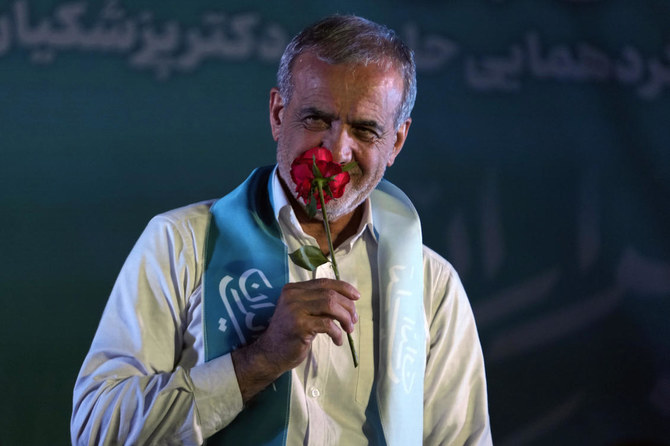
Masoud Pezeshkian, a heart surgeon who rose to power in parliament, runs to be Iran’s next president
Short Url
https://arab.news/rwaw9
Masoud Pezeshkian, a heart surgeon who rose to power in parliament, runs to be Iran’s next president


Latest updates


© 2026 SAUDI RESEARCH & PUBLISHING COMPANY, All Rights Reserved And subject to Terms of Use Agreement.