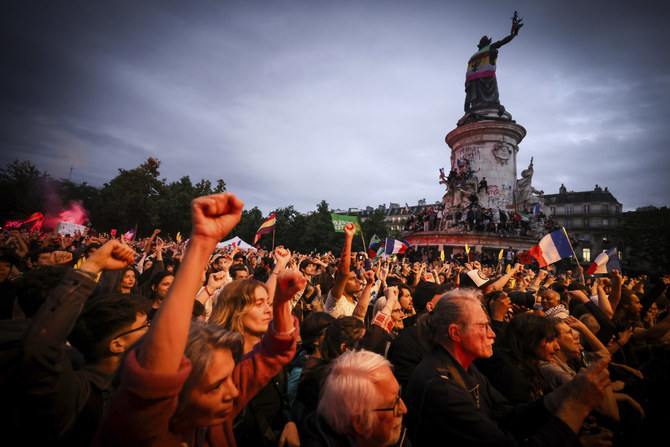

ARIS: France’s prime minister on Wednesday urged voters to form a united front to block the far right in legislative elections, warning that the anti-immigration party of Marine Le Pen was within reach of winning an absolute majority.
With four days to go until the second round in the vote, France’s political future remains up in the air as the far-right National Rally (RN) party seeks to take control of government for the first time.
The RN dominated the first round of voting, presenting the party of Le Pen with the prospect of forming a government and her protege Jordan Bardella, 28, taking the post of premier in a tense “cohabitation” with centrist President Emmanuel Macron.
But a poll by Toluna Harris Interactive published Wednesday forecast the RN winning just 190 to 220 seats in the 577-seat parliament, far less than the 289 needed for the far right to have an absolute majority and form a government on its own.
A left-wing alliance called the New Popular Front looked set to win between 159 and 183 seats, and the centrist presidential camp 110 to 135, it predicted.
The new polling forecast comes after more than 200 candidates from the left and the center this week dropped out of three-way races in the second round of the contest, aiming to prevent the RN winning the seats.
While the formation of this so-called “Republican Front” seems to have generally been a success for the government, the key question now is whether voters will respond to the pleas to block the RN.
“There is one bloc that is able to have an absolute majority and it’s the extreme right,” Prime Minister Gabriel Attal told France Inter radio.
“On Sunday evening, what’s at stake in the second round is to do everything so that the extreme right does not have an absolute majority,” he said.
“It’s not nice for many French to have to block (the RN)... by casting a vote they did not want to,” he added, but “it’s our responsibility to do this.”
In one extreme example of how the united front works, in a constituency in northern France the hard-left candidate pulled out to leave a straight contest between the far right and the tough-talking Interior Minister Gerald Darmanin — long a hated figure for some on the left.
Former prime minister Edouard Philippe, still an influential voice in the pro-Macron camp, told TF1 television he would be voting for a Communist candidate to stop the far right in his constituency.
Le Pen has said the RN would try to form a government, if it gets more than 270 seats, by winning over other lawmakers.
London-based risk analysis firm Eurasia Group said the RN’s hopes of an absolute majority had been “blunted” by the front against the far right.
But it added: “Sunday is an almost completely new election, with dynamics of its own. The turnout will be crucial.”
Janine Mossuz-Lavau, emeritus research director at the Cevipof institute in Paris, said that voters would “do what they liked” irrespective of the calls from politicians, and that turnout risked being lower than the 66.7 percent of the first round.
“There are those who will say ‘I will not choose between cholera and plague and I won’t vote’,” she told AFP.
One option that is the subject of increasing media attention is the possibility that rather than a far-right government, France could be ruled by a broad coalition of pro-Macron centrists, the traditional right, Socialists and Greens.
Philippe said that after the election he would support a new parliamentary majority that could span “the conservative right to the social democrats” but not include the hard-left France Unbowed (LFI).
His comments were also echoed by Xavier Bertrand, a heavyweight right-winger who served as a minister under president Nicolas Sarkozy. He called for a “provisional government” focused on “rebuilding our country.”
Le Pen meanwhile denounced the tactical moves and talk of alliances.
“The political class is giving an increasingly grotesque image of itself,” she wrote on X.
After controversy over some of the RN’s candidates, including one who withdrew after a photo emerged of her wearing a Nazi Luftwaffe cap, Bardella acknowledged there could be some “black sheep” but insisted he was not worried.
Macron has kept his distance from the final phase of voting, which will reveal the outcome of his election gamble that baffled even close colleagues.
He has not spoken in public since an EU summit last Thursday.
During to a cabinet meeting, he said there was “no question” that a post-election coalition could include the LFI, a participant told AFP.