

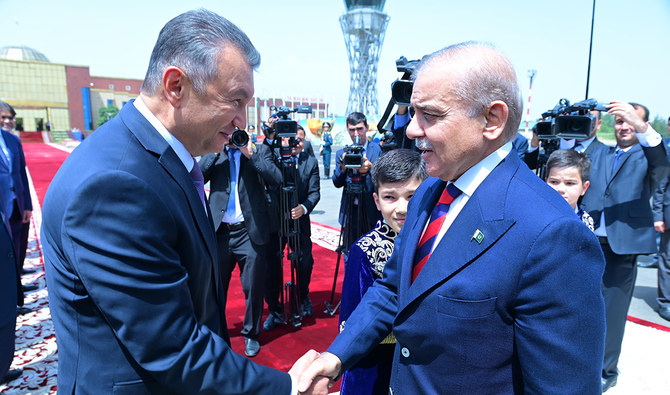

ISLAMABAD: Pakistani Prime Minister Shehbaz Sharif arrived on an official visit to Tajikistan on Tuesday, the foreign office said, which will be followed by a trip to Kazakhstan for twin summits of the Shanghai Cooperation Organization (SCO).
Pakistan is pushing to enhance its role as a pivotal trade and transit hub connecting the landlocked Central Asian states with the rest of the world, leveraging its strategic geographical position.
In recent weeks, there has been a flurry of visits, investment talks and economic activity between Pakistan and Central Asian states and last week, Sharif chaired a special meeting attended by senior government ministers on how to enhance relations with the region, particularly in the areas of economy and investment.
“At the invitation of President of Tajikistan, Emomali Rahmon, Prime Minister Muhammad Shehbaz Sharif will undertake an official visit to Dushanbe, Tajikistan from 2-3 July 2024,” the foreign office said.
“In Dushanbe, the Prime Minister will meet President Emomali Rahmon, Chairman of Majlisi Namoyandagon of Majlisi Oli Mahmadtoir Zoir Zokirzoda and Prime Minister Qohir Rasulzoda.”
The foreign office said the two sides would engage in “wide-ranging discussions on areas of mutual interest” to deepen cooperation, especially in the areas of regional connectivity, trade, people-to-people contacts and energy.
“The two sides will also sign agreements and MoUs in diverse areas of cooperation,” the foreign office added.
After Tajikistan, Sharif will travel to Kazakhstan for twin summits of the Shanghai Cooperation Organization (SCO) Council of Heads of State (CHS) and the SCO Plus from July 3-4 in Astana.
“At the SCO Council of Heads of Summit Meeting, the Prime Minister will share Pakistan’s perspective on important regional and global issues and underline the importance Pakistan accords to regional connectivity and cooperation with SCO member countries,” state-run APP reported.
The PM will also address the SCO Plus summit that brings together SCO member states as well as invited dialogue partners, observer states, guests of the chair and international organizations.
“He would share Pakistan’s perspective on important regional and global issues and underline the importance of strengthening the organization for the benefit of the peoples of the SCO region,” APP added.
On Monday, Sharif also received the ambassador of Kazakhstan to Pakistan, Yerzhan Kistafin, at his office in Islamabad.
“The Prime Minister conveyed his greetings to the President of Kazakhstan, H.E. Kassym-Jomart Tokayev and expressed his desire to strengthen the excellent bilateral relations between Pakistan and Kazakhstan,” the PM office said. “He said he was looking forward to his meeting with President Tokayev during his upcoming visit to Astana for the SCO Council of Heads of State meeting on 3-4 July, 2024.”
During the meeting, Sharif emphasized the “need to enhance trade and investment, while also focusing on regional connectivity and security.”
In May, Pakistan’s investment minister reaffirmed the country’s resolve to cooperate with Central Asian states as Islamabad pushes forward an ambitious agenda to bolster trade activities while grappling with a macroeconomic crisis.
“Pakistan has reaffirmed the resolve to cooperate with Central Asian countries to boost economic and trade activities in the region,” the state-run Radio Pakistan reported, quoting Pakistan’s Investment Minister Abdul Aleem Khan.
“He said Pakistan’s Port Qasim and Gwadar port are available for Central Asia’s trade routes.”
In April, Pakistan opened its trade gateway to Central Asia with the first potato shipment to Tajikistan.




