Dispute over death toll as Karachi’s second-longest heat wave ends after eight days

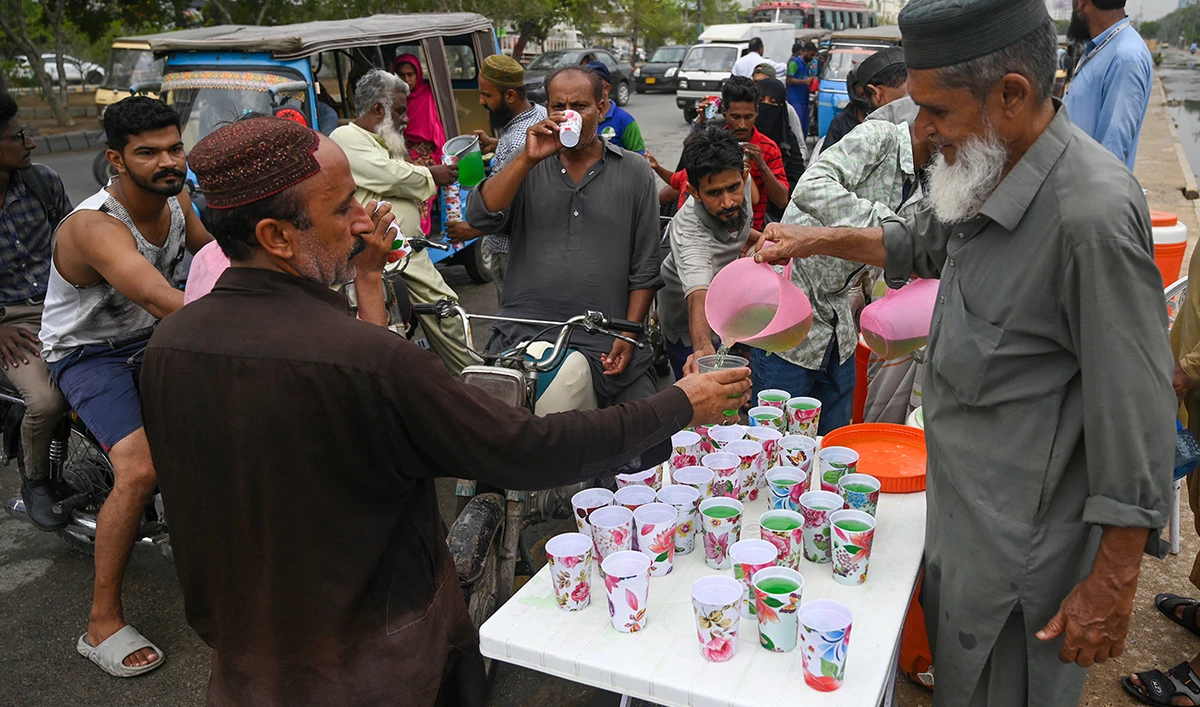
A man serves cold drinks to commuters along a street on a hot summer day in Karachi on June 27, 2024. (AFP/File)
Short Url
Updated 01 July 2024
Follow

Dispute over death toll as Karachi’s second-longest heat wave ends after eight days

  • Government reports 49 deaths, relief agencies claim morgues received three times more bodies than usual during heat wave
  • Chief Meteorologist says this year’s heat wave the longest since June 2015 when 2,000 people died from heat-induced causes 

KARACHI: Pakistan’s Chief Meteorologist Dr. Sardar Sarfaraz said on Monday an eight-day heat wave in Pakistan’s largest city of Karachi was over with at least 49 dead, while relief agencies and health experts disputed the government figures, saying the death toll was likely much higher.

Pakistan has been in the grips of a heat wave since May, with temperatures rising above 52 degrees Celsius (125.6 degrees Fahrenheit) in the southern province of Sindh, of which the port city of Karachi is the capital. For over a week now, Karachi has seen an unusual spike in temperatures, with the mercury rising above 40 °C (104 °F) throughout last weekend and reaching 47.2 °C (117 °F) on June 25.

“As of today, the sea breeze has been restored and the heat wave is over,” Dr. Sarfaraz told Arab News. “During four of the eight heat wave days, temperatures reached up to 42°C but felt like 54°C due to low-pressure formation over southeast Karachi.”

Dr. Sarfaraz noted that this heat wave was the longest in Karachi since June 2015 when a “killer” episode claimed over 2,000 lives. He said 49 people had died in Karachi during this heat wave. 

However, Muhammad Amin from the Edhi Foundation charity, one of the largest in Pakistan, estimated that the death toll from heat-induced causes was much higher given the number of bodies received at morgues. 

“We have received 1,309 dead bodies since June 19, which is a significant increase, almost three times higher, than our average during this period,” Amin said, although he was unable to confirm if all the bodies received by Edhi were of people who had died due to complications from the heat wave. 

Dr. Irfan Siddiqui, the head of emergency services at Jinnah Hospital, one of the biggest government-operated hospitals in Karachi, said the figures compiled by the government were authentic.

“We have reported these figures [49] after ascertaining the cause of death. One cannot attribute a death to a certain condition on mere speculations,” he said about the Edhi estimates.

However, Dr. Siddiqui acknowledged that some heat wave deaths may have gone unreported.

“While one cannot rely solely on figures from rescue services, the government’s data may also be inaccurate,” Dr. Abdullah Muttaqi, a senior health practitioner, told Arab News. “If morgues are receiving a large number of bodies during this period, heat likely played a role, but without medical confirmation of the cause, these figures cannot be cited.

“In the case of the government, figures are likely underreported, not properly documented, and inaccurately presented.”

Dr. Qaiser Sajjad, former general secretary of the Pakistan Medical Association, also said morgues had been receiving more bodies than usual and advised that the “government should sit with rescue services and rationalize its data.”

Pakistan is one of the countries most vulnerable to climate change. In 2022, devastating rains and floods killed 1,739 people, destroyed 2 million homes, and submerged as much as one-third of the country under water. The deluges also caused more than $30 billion in damages to Pakistan’s already cash-strapped economy.


Pakistan offers Kyrgyzstan Arabian Sea access as two states sign 15 cooperation accords

Updated 5 sec ago
Follow

Pakistan offers Kyrgyzstan Arabian Sea access as two states sign 15 cooperation accords

  • Pakistan and Kyrgyzstan sign MOUs spanning trade, energy, agriculture, ports, education, security cooperation
  • Kyrgyz president is on first visit to Pakistan in 20 years as both sides push connectivity and CASA-1000 power links

ISLAMABAD: Pakistan on Thursday offered Kyrgyzstan the shortest and most economical route to the Arabian Sea as the two countries signed 15 agreements and memoranda of understanding aimed at boosting cooperation across trade, energy, agriculture, education, customs data-sharing and port logistics.

The accords were signed during a visit to Islamabad by President Sadyr Zhaparov, the first by a Kyrgyz head of state to Pakistan in two decades, and part of Islamabad’s renewed push to link South Asia with landlocked Central Asian economies through ports, power corridors and transport routes.

For Pakistan, Kyrgyzstan offers access to hydropower through CASA-1000, a $1.2 billion regional electricity transmission project designed to carry surplus summer electricity from Kyrgyzstan and Tajikistan through Afghanistan into Pakistan. For Bishkek, Pakistan provides overland access to warm-water ports on the Arabian Sea, creating a shorter commercial route to global markets.

“President Asif Ali Zardari has reiterated Pakistan’s readiness to offer Kyrgyzstan the shortest and most economical route to the Arabian Sea,” Radio Pakistan reported after Zhaparov met the Pakistani president. 

The two leaders also discussed expanding direct flights to deepen business, tourism and people-to-people ties.

Zardari welcomed Kyrgyzstan’s completion of its segment of the CASA-1000 project and “reaffirmed Pakistan’s commitment to completing its part of the project, which is now at an advanced stage,” the state broadcaster said. 

Zhaparov thanked Islamabad for supporting Bishkek’s candidacy for a non-permanent UN Security Council seat and invited Zardari to visit Kyrgyzstan at a time of his convenience. Both sides expressed satisfaction with progress under the Quadrilateral Traffic in Transit Agreement, designed to facilitate road movement between Pakistan, Kyrgyzstan, Kazakhstan and China.

Earlier, both governments exchanged 15 sectoral cooperation documents covering commerce, mining, geosciences, power, agriculture, youth programs, the exchange of convicted persons, customs electronic data systems and a sister-city linkage between Islamabad and Bishkek.

According to APP, the MOUs were signed by ministers representing foreign affairs, commerce, economy, energy, power, railways, interior, culture, health and tourism. Agreements also covered cooperation between Pakistan’s Foreign Service Academy and the Diplomatic Academy of Kyrgyzstan, as well as collaboration between universities, youth ministries and cultural institutions.

“Our present mutual trade, comprising of about $15–16 million will be enhanced to $200 million in the next two years,” Prime Minister Shehbaz Sharif said after the agreements were signed, calling them “a framework for structured, result-oriented engagement and closer institutional linkages.”

Sharif said Pakistan was ready to serve as a maritime outlet for the landlocked Central Asian republic, offering access to Karachi, Port Qasim and Gwadar to help Kyrgyz goods reach regional and global markets.