

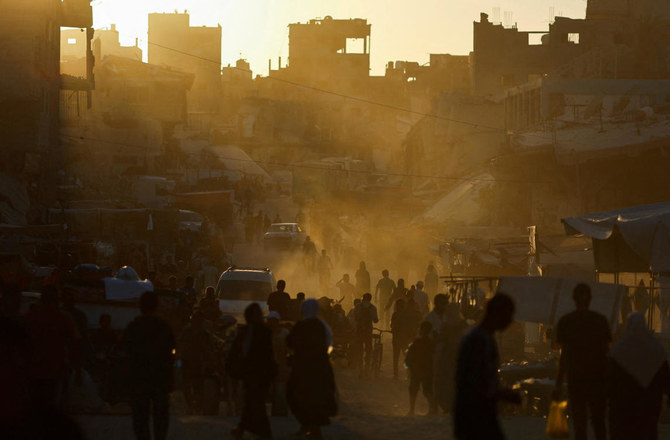

GAZA STRIP, Palestinian Territories: Israeli forces struck southern Gaza’s main city Monday after a rocket barrage claimed by militant group Islamic Jihad, and as shelling and fighting raged on across the besieged Palestinian territory.
A group of Palestinian detainees meanwhile returned to the Gaza Strip, including the director of its biggest hospital who recounted “severe torture” in Israeli custody.
The Israeli military said that about “20 projectiles were identified crossing from the area of Khan Yunis” in a rare salvo after nearly nine months of devastating conflict.
The rockets were aimed at Israeli communities near the Gaza border and were fired in retaliation for Israeli “crimes... against our Palestinian people,” said Al-Quds Brigades, the armed wing of Islamic Jihad which has fought alongside Hamas.
Most launches were intercepted, the Israeli military said, reporting no casualties and saying artillery was “striking the sources of the fire.”
Elsewhere in Gaza, witnesses and the civil defense agency reported Israeli air strikes including in the southern Rafah area and the central Nuseirat refugee camp.
Witnesses reported constant Israeli tank fire in Gaza City’s Shujaiya district where battles raged for a fifth day, after Prime Minister Benjamin Netanyahu acknowledged Israeli forces were engaged in a “difficult fight.”
The military said troops “eliminated numerous terrorists” in raids in Shujaiya, where air strikes also killed “approximately 20” militants.
Israeli forces were also operating in Rafah and in central Gaza, a statement added.
Netanyahu, who recently declared that the “intense phase” of the war was winding down, said on Sunday troops were “operating in Rafah, Shujaiya, everywhere in the Gaza Strip.”
“This is a difficult fight that is being waged above ground... and below ground” in tunnels.
The war started with Hamas’s October 7 attack on southern Israel which resulted in the deaths of 1,195 people, mostly civilians, according to an AFP tally based on Israeli figures.
The militants also seized 251 hostages, 116 of whom remain in Gaza including 42 the army says are dead.
Israel’s retaliatory offensive has killed at least 37,900 people, also mostly civilians, according to data from the health ministry in Hamas-run Gaza.
Months of on-and-off talks toward a truce and hostage release deal have made little progress, with Hamas saying Saturday there was “nothing new” in a revised plan US mediators presented late last month.
The United Nations and relief agencies have voiced alarm over the dire humanitarian crisis and threat of starvation the war and Israeli siege have brought for Gaza’s 2.4 million people.
Israel’s ground operation in Rafah since early May has led to the closure of a key aid crossing, and a US-built temporary pier meant to facilitate humanitarian shipments was again removed from the Gaza coast over the weekend because of high seas.
The war has also led to soaring tensions on Israel’s northern border with Lebanon, where the army has traded fire with the Hezbollah movement, an Iran-backed Hamas ally.
In a displacement camp in Gaza’s Deir Al-Balah, pharmacist Sami Hamid said skin infections were on the rise, particularly among children, “because of the hot weather and lack of clean water.”
“The number of skin infections has increased, especially scabies and chickenpox,” as have hepatitis cases probably linked to untreated sewage flowing right beside tents, said Hamid.
Wafaa Elwan, displaced from Gaza City, said “no clean water” or basic hygiene products were available at the tent city.
“We no longer wash our children as before” and “treatment is not widely available,” Elwan said.
“My son... can’t stop scratching.”


