

Britain’s Labour aims for closer EU ties without reopening Brexit wounds

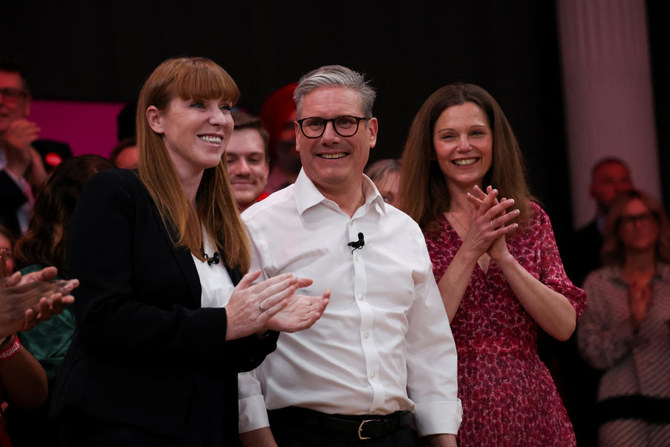
Starmer’s reward is polls that now predict him sweeping into Downing Street as prime minister at the end of this week, possibly with a historic majority. (REUTERS)
Short Url
Updated 01 July 2024
Follow

Britain’s Labour aims for closer EU ties without reopening Brexit wounds

  • Starmer’s reward is polls that now predict him sweeping into Downing Street as prime minister at the end of this week, possibly with a historic majority

LONDON: For a decade, leaving the European Union was the question that dominated British politics. These days it barely comes up. Which is clearly how Labour Party leader Keir Starmer likes it.
He has worked diligently to win back the support of working class voters, millions of whom were lured away five years ago by Conservative Boris Johnson’s promise to “get Brexit done,” when Labour campaigned to leave a path open to stay in the EU.
Starmer’s reward is polls that now predict him sweeping into Downing Street as prime minister at the end of this week, possibly with a historic majority. But if he does get there, he won’t be able to keep Brexit out of the news for long.
His mandate will be to spur economic growth. Businesses say that would require lifting some of the barriers that Britain’s exit from the EU has left in the path of their trade. And that, in turn, is likely to mean reopening contentious negotiations with Brussels.
Britain finally left the EU in January 2020 under Johnson. In its determination to turn the page on Brexit, Labour has ruled out rejoining the EU single market or customs union. But it says it is still possible to remove trade barriers with the 27-nation bloc, to help companies, particularly smaller ones, which have struggled with higher costs and paperwork.
Labour does not want to “reopen the wounds of the past,” said Jonathan Reynolds, the Labour lawmaker who is in line to become business secretary in a Starmer cabinet.
“Clearly, we need to get a better deal, and there are real improvements we could achieve,” he said at an event on Thursday hosted by the British Chambers of Commerce (BCC), the business lobby group which has said parties should stop “treading on eggshells” over EU ties.
A survey by accountancy firm Menzies showed that 1 in 3 British businesses want to reopen the Brexit deal reached under Johnson, and 1 in 5 want a new government to rejoin the single market, with 20 percent citing barriers as a result of Brexit as a factor limiting international expansion.

’LIKE-MINDED PARTNER’
One early pledge from Labour is to seek a veterinary agreement with the EU that would reduce border checks on animal products, a hindrance for British farmers and importers. It also wants the mutual recognition of certain professional qualifications, and easier access for artists on tour.
Labour has presented these as comparitively simple gains it can make without reopening the Brexit agreement reached under Johnson.
But even such small steps would require tough choices, said an EU source, speaking on condition of anonymity to discuss hypothetical future negotiations.
A veterinary agreement would require Britain to submit to resolving disputes through the European Court of Justice (ECJ) the EU source said. That is anathema to Brexit campaigners who consider it an infringement of British sovereignty.
“Working with a like-minded partner, friend and ally is what everybody wants,” said the EU source. “But the idea of having the same benefits you get as a member of the club becomes a little bit trickier.”
Anand Menon, a politics professor and director of the UK in a Changing Europe think tank, said Labour might be misjudging how enthusiastic the EU would be about renegotiating after years of clashing with British governments.
The bloc already has a lot on its plate, he said. And while Britain may want to improve technical issues on areas like food, Brussels would want to talk about mobility — making it easier for people to live and work in Britain, especially young people.
“I think we’ll have a massive change in style, and a bit of tinkering in substance,” Menon said.
The Conservatives say Labour’s policies would “unravel Brexit,” including by making Britain again subject to rulings from the ECJ.
Prime Minister Rishi Sunak in a debate this week accused Labour of planning to accept a return to free movement of people under its plans to strike a better Brexit deal with the EU. Starmer said he would reject any deal with the EU that increases immigration.
Labour’s Reynolds said he wanted to improve the trade situation while offering benefits to the bloc: “It’s not necessarily easy, but there’s a negotiation, there’s a process I can see delivering those things.”


Ireland’s defense gaps exposed as EU presidency nears

Cathal Berry, former Irish army special forces member, on The Curragh plain. (AFP)
Updated 58 min 36 sec ago
Follow

Ireland’s defense gaps exposed as EU presidency nears

  • Militarily neutral Ireland is not a NATO member, yet its waters — seven times its landmass — account for around 16 percent of the EU’s total

THE CURRAGH: Sheep amble around steel fences skirting Ireland’s largest military base on a grassy plain west of Dublin, a bucolic scene masking an underfunded defense force struggling with outdated equipment.

Ireland’s threadbare military and its long-standing policy of neutrality are under heightened scrutiny as the country prepares to assume the rotating EU presidency from July.

“Ireland is the only EU country with no primary radar system, nor have we sonar or anti-drone detection equipment — let alone the ability to disable drones,” said former Irish special forces member Cathal Berry.

“We can’t even monitor the airspace over our capital city and main airport,” he said as he surveyed Ireland’s main military base at The Curragh.

Militarily neutral Ireland is not a NATO member, yet its waters — seven times its landmass — account for around 16 percent of the EU’s total.

Nearly three-quarters of transatlantic subsea cables run close to or beneath them.

But the Irish army numbers only a few thousand troops, is focused largely on UN peacekeeping missions and has neither a combat air force nor a sizeable navy.

Ireland’s annual defense spending of roughly €1.2 billion is the lowest in Europe at around 0.2 percent of the GDP, well below the EU average of 1.3.

“Neutrality itself is actually a fine policy. If you want to have it, it must be defended,” said retired Irish army colonel Dorcha Lee.

“That’s the whole point. Undefended neutrality is absolutely definitely not the way to go.”

Berry points to a long-standing “complacency” about defense in Ireland that has fueled a vacuum in debate over neutrality and military spending.

“If you wanted to squeeze the EU without any risk of NATO retaliation, Ireland is where you’d come,” he said, adding that also applied to US interests in Europe.

US tech giants like Google, Apple and Meta have their European headquarters in Ireland, supported by vast data centers that analysts say are vulnerable to cyberattacks.

European Council President Antonio Costa said he was still “confident” Ireland could protect EU summits during its presidency.

Defense Minister Helen McEntee has pledged that new counter-drone technology will be in place by then.

Speaking in front of a row of aging army vehicles at the Curragh military site, she also announced a broader increase in military spending, although the actual details remain unclear.

On Dec. 17, the Irish government said it plans to buy a military radar system from France at a reported cost of between €300 and €500 million (around $350-$585 million).

For Paul Murphy, a left-wing opposition member of parliament, “scaremongering over allegedly Russian drones with concrete evidence still unprovided” is

giving the government cover to steer Ireland away from neutrality toward NATO.

“But it’s more important than ever that we’re genuinely neutral in a world that is increasingly dangerous,” he told AFP.

Ireland has historically prioritized economic and social spending over defense investment, he said.

“Joining an arms race that Ireland cannot compete in would waste money that should be spent on real priorities like climate change,” he added.

Pro-neutrality sentiment still holds sway among the Irish public, with an Irish Times/Ipsos poll earlier this year finding 63 percent of voters remained in favor of it.

And very few voices in Ireland are calling to join NATO.

Left-winger Catherine Connolly, who won Ireland’s presidential election in October by a landslide, is seen as a pacifist.

“I will be a voice for peace, a voice that builds on our policy of neutrality,” she said in her victory speech.