KABUL: Taliban authorities said on Saturday that demands over women’s rights were “Afghanistan’s issues” to solve, ahead of United Nations-led engagement talks where the exclusion of Afghan women has sparked outcry.
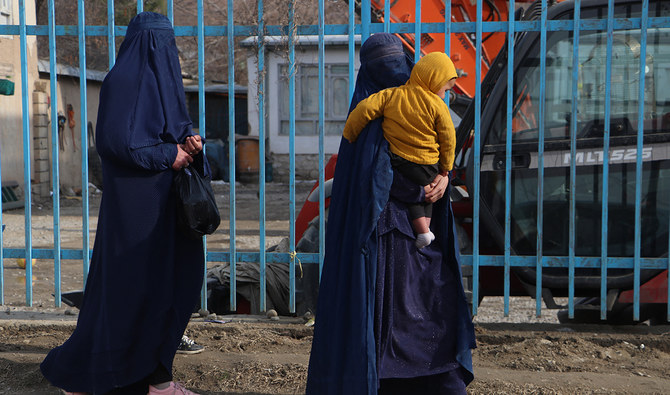
The Taliban government, which has imposed restrictions on women since seizing power in 2021 that the UN has described as “gender apartheid,” will send its first delegation to the third round of talks starting in Qatar on Sunday.
Civil society representatives, including from women’s rights groups, will attend meetings with the international envoys and UN officials on Tuesday, after the official talks.
Rights groups have condemned the exclusion of Afghan women from the main meetings and the lack of human rights issues on the agenda.
The Taliban authorities “acknowledge the issues about women,” government spokesman Zabihullah Mujahid told a news conference in Kabul on the eve of the latest talks.
“But these issues are Afghanistan’s issues,” said Mujahid, who will lead the delegation.
“We are working to find a logical path toward solutions inside Afghanistan so that, God forbid, our country doesn’t again fall into conflict and discord.”
He said the Taliban government would represent all of Afghanistan at the meetings and, given their authority, should be the only Afghans at the table.
“If Afghans participate through several channels, it means we are still scattered, our nation is still not unified,” he said.
The talks were launched by the UN in May 2023 and aim to increase international coordination on engagement with the Taliban authorities, who ousted a Western-backed government when they swept to power.
The Taliban government has not been officially recognized by any state and the international community has wrestled with its approach to Afghanistan’s new rulers, with women’s rights issues a sticking point for many countries.
Taliban authorities were not invited to the first talks in Doha last year and refused to attend the second conference, demanding that they be the sole Afghan representatives to the exclusion of invited civil society groups.
That condition has been met for the third round.
Mujahid reiterated that the Taliban government sought positive relations with all countries.
However, he added that “no major or key discussions” would take place in Doha and that the meeting was an opportunity to exchange views, particularly with Western countries.
The agenda will include combating narcotics and economic issues, key topics for authorities in the impoverished country.
“We have hurdles blocking economic development, which should be removed,” Mujahid said.
“If the economy were fine, then all other issues could be solved.”

Afghan women’s rights an internal issue, Taliban government says before talks in Qatar
Short Url
https://arab.news/9edzs
Afghan women’s rights an internal issue, Taliban government says before talks in Qatar
- The Taliban government imposed restrictions on women since seizing power in 2021, prompting the UN to call it ‘gender apartheid’
- The UN launched the talks in Qatar in May 2023 to increase international coordination on engagement with the Taliban authorities
Cuba defends military drills as deterrent against US aggression
HAVANA: Cuban President Miguel Diaz-Canel defended his country’s military preparedness exercises on Saturday as a deterrent against potential aggression from the United States.
US President Donald Trump this month warned that Cuba “is ready to fall” and told Havana to “make a deal” or pay a price similar to Venezuela, whose ousted leader Nicolas Maduro was taken to America by US forces in a January 3 bombing raid that killed dozens of people.
Venezuela was a key ally of Cuba and a critical supplier of oil and money, which Trump has vowed to cut off.
Diaz-Canel on Saturday supervised military exercises that included a tank unit from Cuba’s armed forces.
He was accompanied by Cuban General Alvaro Lopez Miera, who is the minister of the armed forces, and other high-ranking military officials.
“The best way to prevent aggression is for imperialism to have to calculate the price of attacking our country,” Diaz-Canel said in remarks broadcast on Cuban television.
“And that has a lot to do with our preparation for this type of military action... This takes on significant importance in the current circumstances,” he added.
Cuba’s National Defense Council, which is led by Diaz-Canel, recently met “with the objective of increasing and improving the level of preparedness and cohesion” among the country’s leadership, according to an official government statement.
The council met to “analyze and approve the plans and measures for transitioning to a State of War,” the statement added, without providing further details.
These military exercises are part of the country’s preparation “under the strategic concept of the War of the Entire People,” a term used by authorities for the mobilization of civilians in the event of armed conflict.
US President Donald Trump this month warned that Cuba “is ready to fall” and told Havana to “make a deal” or pay a price similar to Venezuela, whose ousted leader Nicolas Maduro was taken to America by US forces in a January 3 bombing raid that killed dozens of people.
Venezuela was a key ally of Cuba and a critical supplier of oil and money, which Trump has vowed to cut off.
Diaz-Canel on Saturday supervised military exercises that included a tank unit from Cuba’s armed forces.
He was accompanied by Cuban General Alvaro Lopez Miera, who is the minister of the armed forces, and other high-ranking military officials.
“The best way to prevent aggression is for imperialism to have to calculate the price of attacking our country,” Diaz-Canel said in remarks broadcast on Cuban television.
“And that has a lot to do with our preparation for this type of military action... This takes on significant importance in the current circumstances,” he added.
Cuba’s National Defense Council, which is led by Diaz-Canel, recently met “with the objective of increasing and improving the level of preparedness and cohesion” among the country’s leadership, according to an official government statement.
The council met to “analyze and approve the plans and measures for transitioning to a State of War,” the statement added, without providing further details.
These military exercises are part of the country’s preparation “under the strategic concept of the War of the Entire People,” a term used by authorities for the mobilization of civilians in the event of armed conflict.
© 2026 SAUDI RESEARCH & PUBLISHING COMPANY, All Rights Reserved And subject to Terms of Use Agreement.


