ISLAMABAD: Pakistan’s federal and provincial authorities have completed arrangements under dengue action plans to prevent the spread of the mosquito-borne disease and keep people safe during the monsoon season starting next week, officials confirmed on Saturday.
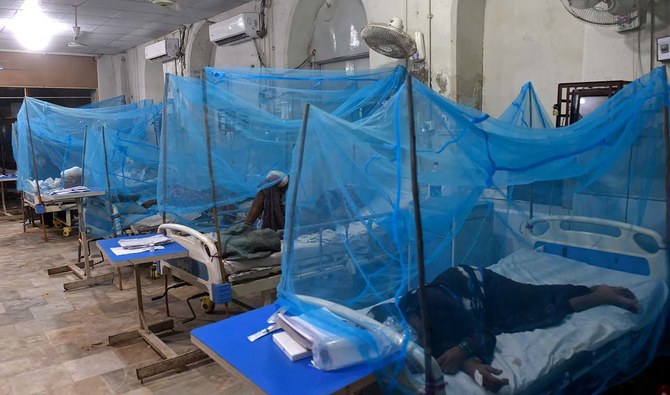
There is currently no cure or vaccine for dengue fever, which can lead to death in its most severe form. Dengue fever often results in intense flu-like symptoms, severe headaches, pain behind the eyes, full-body aches, high fever, nausea, vomiting, swollen glands and rashes.
Dengue fever is endemic to Pakistan, which experiences year-round transmission with seasonal peaks. This year’s first dengue-related death was reported on June 3 in Pakistan’s southern Sindh province.
Federal Interior Minister Mohsin Naqvi has ordered the relevant authorities to “strictly” implement the dengue prevention standard operating procedures after about nine cases were reported in Pakistan’s capital.
“The anti-dengue plan formulated should be implemented diligently,” he was quoted in a statement as telling the chairman of the Capital Development Authority (CDA) and the Islamabad chief commissioner earlier today. “Ensure rapid drainage of rainwater from low-lying areas.”
The CDA chairman informed Naqvi an anti-dengue working group had been established in Islamabad’s peripheries along with neighboring Rawalpindi, adding the administrations of the two cities would work “as a team” to ensure the prevention of the disease.
“The federal health ministry along with the Capital Development Authority and district administration have already started implementing preventive measures in Islamabad and its surrounding areas,” Ahmed Shah, a health ministry spokesperson, told Arab News.
He said teams were working in the field, and awareness campaigns were prepared to sensitize the public about the issue.
Similar measures have been taken by authorities in the four provinces of the country.
STEPS TAKEN BY PROVINCES
Dr. Somia Iqtadar, Secretary General Dengue Expert Advisory Group of Punjab, said the provincial dengue control program had started working on disposing of water storage places, conducting house-to-house visits, early larvaE detection, and giving special attention to hotspots such as junkyards, construction sites and graveyards.
“These areas have been categorized into high-risk and low-risk zones,” she told Arab News.
“If a case is reported in a hospital, a surveillance system ensures teams check 12 houses on each side of the affected person’s residence to identify additional cases and prevent further spread by isolating affected individuals,” she said, adding that all districts were following the same protocol and were instructed to complete their preparations under the district health officers and district administrations.
“The Punjab Information Technology Board has prepared a dashboard, where every case from the province is reported and weekly analyzes are conducted to develop future strategies,” she added.
Dr. Syed Mushtaq Ahmed Shah, deputy director general vector-borne diseases of the Sindh government, said 2,880 public and private hospitals were prepared to handle influx of dengue patients in the province.
“So far, only one death of a 75-year-old has occurred who had already multiple health issues,” he told Arab News.
Shah added all districts and municipal administrations had been instructed to remove open water storage and display banners in public places to sensitize people.
Additionally, he said around 550 students were educated about the subject before summer vacation to help prevent the spread of dengue in their households.
“A plan for mass spraying in hotspots across different districts, headed by deputy commissioners, has also been prepared,” he added.
Discussing the measures taken by Khyber Pakhtunkhwa, the provincial health ministry spokesperson, Attaullah Khan, said the authorities had held extensive trainings for the purpose.
“The dengue action program, approved in March, included training across all provincial districts, removing open water storage in public places, chemical and mechanical sweeping and indoor residual spraying (IRS),” Attaullah Khan, a Khyber Pakhtunkhwa (KP) health ministry spokesperson, told Arab News.
To prevent the spread of the disease, he said a multi-sectoral approach had been adopted, focusing on timely disposal of dengue larvae and enhancing public health services.
“The Integrated Disease Surveillance and Response System will monitor the outbreak, and a Dengue Control Room will be established under the Directorate General Health Services,” he said, adding that District Rapid Response Teams had been trained, communities sensitized and awareness materials prepared.
“All district headquarters hospitals have been instructed to prepare separate dengue wards to handle any patient influx,” he added.
Dr. Fahim Afridi, additional director general of health in Balochistan, said the provincial administration had prepared its dengue action plan with the help of all stakeholders, including municipal committees, livestock department and district administrations.
He said authorities were working on a multipronged strategy, and implementation was underway.
“Our districts of Kech, Gwadar and Lasbella are dengue-prone areas, and we have conducted interventions in all of these places,” he told Arab News.
“Our teams have carried out door-to-door campaigns, taken water samples and eliminated larvae wherever they were found,” he said, adding the health ministry had also provided nets to the district administration for distribution among people.
An advisory published by Pakistan’s National Institute of Health last year said a total of 52,929 cases and 224 deaths from dengue were reported in the country in 2021, while there were approximately 79,007 confirmed cases of dengue with 149 deaths in 2022, with the surge in cases following unprecedented flooding that began in mid-June 2022. In 2023, Pakistan reported 3,019 suspected cases and 8 deaths from dengue.
The virus has been surging worldwide, helped by climate change. In barely six months, countries in North and South America have already broken calendar-year records for dengue cases.
The World Health Organization declared an emergency in December, and Puerto Rico declared a public health emergency in March.
Dengue remains less common in the continental United States, but in the 50 states so far this year there have been three times more cases than at the same point last year.


![]()

Pakistan ramps up dengue prevention efforts ahead of monsoon season
Short Url
https://arab.news/r59kc
Pakistan ramps up dengue prevention efforts ahead of monsoon season
- First dengue-related death was reported in Pakistan’s southern Sindh province in the first week of June
- Authorities are trying to control the disease by ensuring rapid rainwater drainage from low-lying areas
Latest updates


© 2026 SAUDI RESEARCH & PUBLISHING COMPANY, All Rights Reserved And subject to Terms of Use Agreement.