

Trump says inflation is ‘killing our country’ under Biden

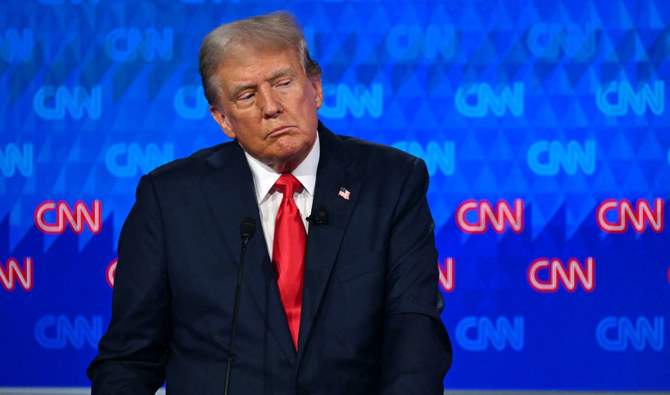
Former US President and Republican presidential candidate Donald Trump looks on as he participates in the first presidential debate of the 2024 elections with US President Joe Biden at CNN's studios in Atlanta, Georgia, on June 27, 2024. (AFP)
Short Url
Updated 28 June 2024
Follow

Trump says inflation is ‘killing our country’ under Biden

ATLANTA: Donald Trump accused Joe Biden on Thursday of doing a “poor job” on the US economy and of presiding over a disastrous rise in inflation — reflecting how rising prices and the cost of living have become key issues ahead of November’s presidential election.

“He has not done a good job. He’s done a poor job,” Trump said during CNN’s head-to-head debate with Biden in Atlanta, Georgia. “And inflation is killing our country. It is absolutely killing us.

“I gave him a country with essentially no inflation. It was perfect. It was so good, all he had to do is leave it alone.” he added. “He destroyed it“

In response to Trump’s attacks on his record, Biden said Trump had “absolutely decimated” the US economy when he was president.

“There was no inflation when I became president. You know why? The economy was flat on its back,” he said, adding that his administration had helped create “millions” of new jobs, including in minority communities.

Americans have named inflation or the cost of living as “the most important financial problem facing their family,” in each of the last three years, according to a recent poll from the Washington-based firm Gallup.

Perhaps more worryingly for Biden, 46 percent of adults in the United States said they have “a great deal” or “a fair amount” of confidence in Trump to do or recommend the right thing for the economy, while just 38 percent said the same thing about the current president, according to another Gallup poll.

While it is true that US consumer inflation jumped sharply after Biden took office, hitting a multi-decade high in 2022, the rise was largely fueled by a post-pandemic supply crunch and by Russia’s invasion of Ukraine.

In response, the US Federal Reserve hiked its key lending rate from almost zero to a two-decade high of between 5.25 and 5.50 percent — where it has remained for the past year.

Higher interest rates cool down the economy by raising borrowing costs for consumers and businesses, indirectly impacting everything from mortgage rates to auto loans.

Inflation has eased sharply since the Fed started hiking rates, but remains stuck stubbornly above its long-term target of two percent — keeping the US central bank on pause as it waits for more positive data.

Because inflation has remained high for a number of years, consumer prices have now risen by around 20 percent since January 2021, when Biden took office, according to the Labor Department’s consumer price index (CPI) inflation calculator.

In contrast, consumer prices rose by less than six percent during the same timeframe under Trump.

Although Congress has given the Fed the mandate to tackle inflation on its own, it is still a difficult topic for Biden, who has looked to talk up his economic record ahead of November’s election.

The Fed expects inflation will continue to ease this year and next, before hitting its long-term target of two percent in 2026.

But the path to two percent will likely depend on who becomes president in November — and which parties will control the House of Representatives and the Senate.

Trump has suggested that, if he wins the election, he will look to extend a series of tax cuts made under his leadership, severely restrict immigration, deport some foreign-born illegal immigrants and slap tariffs on all US imports.

These policies would all “likely be inflationary,” by putting up prices, placing upward pressure on wages and boosting adding to the nation’s debt, JP Morgan economists wrote in a recent note to clients.

As things stand, Republican control of the House, Senate and the White House is not the most likely scenario come November, Oxford Economics lead US economist Bernard Yaros wrote in a recent note to clients.

“If Biden is reelected but presides over a divided government, the upside risk potential to the economy from fiscal policy is limited,” he said.

“If Trump returns to the White House with a divided government, he will have a tougher time enacting his fiscal agenda,” he added.


Venezuela says oil exports continue normally despite Trump blockade

Updated 9 sec ago
Follow

Venezuela says oil exports continue normally despite Trump blockade

  • Trump warned “Venezuela is completely surrounded by the largest Armada ever assembled in the History of South America”
  • Oil prices surged in early trading Wednesday in London on news of the blockade, which comes a week after US troops seized a sanctioned oil tanker

CARACAS: Venezuela struck a defiant note Wednesday, insisting that its crude oil exports were not impacted by US President Donald Trump’s announcement of a potentially crippling blockade.
Trump’s declaration on Tuesday marked a new escalation in his months-long campaign of military and economic pressure on Venezuela’s leftist authoritarian President Nicolas Maduro.
Venezuela, which has the world’s largest proven oil reserves, shrugged off the threat of more pain, insisting that it was proceeding with business as usual.
“Export operations for crude and byproducts continue normally. Oil tankers linked to PDVSA operations continue to sail with full security,” state oil company Petroleos de Venezuela (PDVSA) said.
Trump said Tuesday he was imposing “A TOTAL AND COMPLETE BLOCKADE OF ALL SANCTIONED OIL TANKERS going into, and out of, Venezuela.”
Referring to the heavy US military presence in the Caribbean — including the world’s largest aircraft carrier — he warned “Venezuela is completely surrounded by the largest Armada ever assembled in the History of South America.”
Oil prices surged in early trading Wednesday in London on news of the blockade, which comes a week after US troops seized a sanctioned oil tanker that had just left Venezuela with over 1 million barrels of crude.
Maduro held telephone talks with UN Secretary-General Antonio Guterres to discuss what he called the “escalation of threats” from Washington and their “implications for regional peace.”
Guterres’s spokesman said the UN chief was working to avoid “further escalation.”

- ‘We are not intimidated’ -

Venezuela’s economy, which has been in freefall over the last decade of increasingly hard-line rule by Maduro, relies heavily on petroleum exports.
Trump’s campaign appears aimed at undermining domestic support for Maduro but the Venezuelan military said Wednesday it was “not intimidated” by the threats.
The foreign minister of China, the main market for Venezuelan oil, defended Caracas in a phone call with his Venezuelan counterpart Yvan Gi against the US “bullying.”
“China opposes all unilateral bullying and supports all countries in defending their sovereignty and national dignity,” he said.
Last week’s seizure of the M/T Skipper, in a dramatic raid involving US forces rappelling from a helicopter, marked a shift in Trump’s offensive against Maduro.
In August, the US leader ordered the biggest military deployment in the Caribbean Sea since the 1989 US invasion of Panama — purportedly to combat drug trafficking, but taking particular aim at Venezuela, a minnow in the global drug trade.
US strikes on alleged drug-smuggling boats in the Caribbean and eastern Pacific have left at least 95 people dead since.
Caracas believes that the anti-narcotics operations are a cover for a bid to topple Maduro and steal Venezuelan oil.
The escalating tensions have raised fears of a potential US intervention to dislodge Maduro.
Mexican President Claudia Sheinbaum waded into the dispute on Wednesday, declaring that the United Nations was “nowhere to be seen” and asked that it step up to “prevent any bloodshed.”

- Oil lifeline -

The US blockade threatens major pain for Venezuela’s crumbling economy.
Venezuela has been under a US oil embargo since 2019, forcing it to sell its production on the black market at significantly lower prices, primarily to Asian countries.
The country produces one million barrels of oil per day, down from more than three million in the early 2000s.
Capital Economics analysts predicted that the blockade “would cut off a key lifeline for Venezuela’s economy” in the short term.
“The medium-term impact will hinge largely on how tensions with the US evolve — and what the US administration’s goals are in Venezuela.”