
GAZA STRIP: Palestinians fled eastern Gaza City on Thursday under heavy bombardment as the Israeli military issued an evacuation order for the area it had previously declared clear of Hamas militants.
The flare-up in the northern Gaza Strip’s Shujaiya district, which witnesses and medics said caused numerous casualties, comes as fears grow of a wider regional conflagration involving Israel and Lebanese Hezbollah, a Hamas ally.
Defense Minister Yoav Gallant, on a visit to Washington to discuss the Gaza crisis and ways to avoid broader conflict in the Middle East, said Israel did not want war but warned fighting on a massive scale would send Lebanon “back to the Stone Age.”
In Gaza, fighting has ground on despite comments Sunday by Israeli Prime Minister Benjamin Netanyahu that the “intense phase” of the war — now nearing its 10th month — was winding down.
Officials and medics in the Hamas-run territory said Israeli strikes overnight and early Thursday killed at least six people in northern Gaza, and the Israeli military said it had “attacked terrorists” in Khan Yunis,” in the south.
In Gaza City, a witness in Shujaiya who declined to be named told AFP the situation was “frightening” as Israeli military vehicles approached amid air strikes and shelling.
“Residents are running through the streets in terror... wounded and martyrs lie in the streets.”
The military’s Arabic-language spokesman, Avichay Adraee, told residents and displaced Gazans in the Shujaiya area to leave “for your safety,” in a message posted on social media.
They were asked to head south, to a declared “humanitarian zone” about 25 kilometers (15 miles) away.
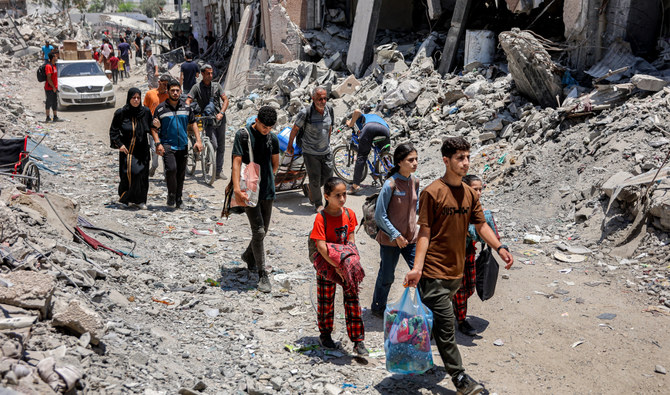
An AFP photographer saw many leaving on foot, carrying their belongings as they walked through rubble-strewn streets.
Hamas in a statement said Israeli forces were “starting a ground incursion,” reporting “several” dead as “thousands flee under relentless bombing.”
Muhammad Ghurab, a doctor at Gaza City’s Al-Ahli hospital, said the facility had received seven “martyrs including four children” and dozens who were wounded “as the Israeli forces advanced to the east of Shujaiya neighborhood.”
Shujaiya resident Omar Sukar said he saw strikes as Gazans were collecting drinking water, which has been in limited supply due to an Israeli siege.
“The water truck had just arrived when the shelling began,” he told AFP.
A displaced Gazan woman, who asked not to be named, told AFP she was “devastated” by the violence and destruction.
“We lost our children and homes, and we keep fleeing from place to another.”
Beyond the evacuation order announced by Adraee, the military declined to comment on the fighting.
The war started with Hamas’s October 7 attack on southern Israel, which resulted in the deaths of 1,195 people, mostly civilians, according to an AFP tally based on Israeli figures.
The militants also seized 251 hostages, 116 of whom remain in Gaza although the army says 42 are dead.
Israel’s retaliatory offensive has killed at least 37,765 people, also mostly civilians, according to data from Gaza’s health ministry.
Israel in early January announced it had dismantled “Hamas’s military framework” in Gaza’s north, which saw the most intense fighting in the early stages of the war, but militants have since regrouped.
The war and siege have triggered a dire humanitarian crisis, with Gaza hospitals struggling to function, and basic supplies hard to come by as the vast majority of the territory’s 2.4 million people have been displaced.
UNICEF announced Thursday an agreement with Israel to restart a power line that could return a key water desalination plant in Khan Yunis to full operating capacity.
“This is an important milestone, and we are very much looking forward to seeing it implemented,” said Jonathan Crickx, spokesman for the United Nations children’s fund.
In a rare medical evacuation from Gaza, 21 cancer patients left through the Kerem Shalom crossing on the Israeli border, a medical source in Egypt said.
It was the first evacuation since the closure of the Rafah border crossing — a key conduit for aid into Gaza — when Israeli forces took over its Palestinian side in early May.
Months of talks toward a truce and hostage release deal have so far failed as Israel has rejected Hamas demands for a permanent end to fighting and full troop withdrawal.
Israeli protesters have piled pressure on Netanyahu’s government,with thousands gathering in front of Netanyahu’s residence in Jerusalem on Thursday to call for a hostage release deal, according to an AFP reporter.
US officials have voiced hope a Gaza ceasefire could also lead to a reduction in hostilities between Israel and Iran-backed Hezbollah, which have traded near daily cross-border fire since early October.
Tensions have surged as Israel said this month that its war plans were ready, sparking threats from Hezbollah that, in the event of all-out war, none of Israel would be safe.
Germany and Canada have advised citizens in Lebanon to leave.
In the latest clashes on Thursday, Hezbollah said it fired rockets at an Israeli military base and sent drones in retaliation for Israeli strikes on Lebanon, one of which killed a fighter.
Israel said its air defenses “intercepted most of the launches,” reporting no casualties.
Israel meanwhile dismissed a UN-backed report that said nearly half a million Gazans faced “catastrophic” hunger.
Government spokesman David Mencer said “claims regarding starvation” were designed to “exert pressure on Israel.”