

Philippines hosts Asia-Pacific’s first UN forum on gastronomy tourism

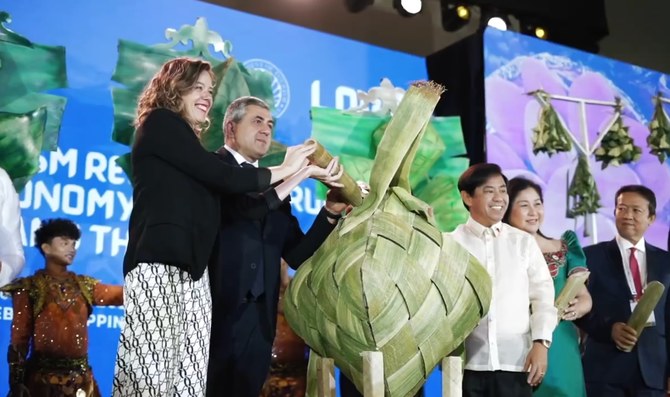
UN Tourism Secretary-General Zurab Pololikashvili launches the UN Tourism Regional Forum on Gastronomy Tourism for Asia and the Pacific in Lapu-Lapu city, Philippines, on June 26, 2024. (UN Tourism)
Short Url
Updated 27 June 2024
Follow

Philippines hosts Asia-Pacific’s first UN forum on gastronomy tourism

  • Event co-organized by Spain-based Basque Culinary Center, one of the world’s top gastronomy schools
  • UN Tourism chief announces plan to establish an educational gastronomy center in the Philippines

Manila: The Philippines is hosting the UN’s first regional forum on gastronomy in Cebu, in conjunction with UN Tourism’s annual joint meeting of the Commission for East Asia and the Pacific and the Commission for South Asia.

Organized by the government of the Philippines, UN Tourism and its Spain-based affiliate Basque Culinary Center — one of the world’s top gastronomy and nutrition schools — the event on June 26-27 is focused on policies to advance culinary tourism in the region, preserving local traditions and protecting the land and products for the sector’s sustainability, and initiatives to help address climate change.

“Food tourism is of course a growing and dynamic sector, offering enormous potential for economic growth and advancement and cultural exchange among nations,” Philippine Tourism Secretary Christina Frasco said as she welcomed the forum’s participants in the Cebu province’s Lapu-Lapu city.

“We join you in our shared aspirations to advance tourism and gastronomy in the Asia Pacific region and beyond.”

The UN Tourism Regional Forum on Gastronomy Tourism for Asia and the Pacific started with the ceremonial pouring of rice into a giant puso — a Filipino cake made by boiling rice in a rectangular woven pouch of palm leaves, which is a culinary pride of the Cebu province.

“By showcasing our local flavors and culinary traditions, we invite the rest of the world to experience the heart and soul of the Filipino, the heart of the Philippines,” Frasco said, narrating the country’s culinary history, where indigenous and Malay heritage meets Spanish, Chinese, and American influences.

“Filipino cuisine is a diverse tapestry of flavors, reflecting regional characteristics from across our beautiful archipelago of 7,641 islands, from the globally renowned Cebu lechon and the comforting tastes of adobo and sinigang to Mindanao’s distinctive dishes like curacha, pastil, our culinary heritage is rich and varied ... Through our food, we tell the story of the Filipino. We narrate the victories of our people, our homeland, our history.”

Since Asia and the Pacific’s status as a gastronomy tourism destination has been growing, UN Tourism Secretary-General Zurab Pololikashvili announced he wanted to establish an educational gastronomy center in the Philippines.

“We know that education is the top priority for your tourists, and we will support this initiative to help the progress of UN Tourism,” Pololikashvili said.

“Food is at the heart of every tourist experience, and gastronomy tourism delivers many social and economic benefits.”

The event produced the Cebu Call to Action on Gastronomy Tourism for public and private sector leaders to integrate gastronomy tourism into policy and practice.

“It urges the creation of governance mechanisms uniting stakeholders under a shared vision, fostering cooperation across sectors such as agriculture and culture, and supporting small businesses to enhance their market position,” UN Tourism said in a statement.

“Emphasis was placed on empowering local communities through training and financing, promoting unique culinary experiences, and advocating for sustainable practices that protect local cultures and the environment.”


Nigeria signals more strikes likely in ‘joint’ US operations

Updated 5 sec ago
Follow

Nigeria signals more strikes likely in ‘joint’ US operations

  • vNigeria on Friday signalled more strikes against jihadist groups were expected after a Christmas Day bombardment by US forces against militants in the north of the country
LAGOS: Nigeria on Friday signalled more strikes against jihadist groups were expected after a Christmas Day bombardment by US forces against militants in the north of the country.
The west African country faces multiple interlinked security crises in its north, where jihadists have been waging an insurgency in the northeast since 2009 and armed “bandit” gangs raid villages and stage kidnappings in the northwest.
The US strikes come after Abuja and Washington were locked in a diplomatic dispute over what Trump characterised as the mass killing of Christians amid Nigeria’s myriad armed conflicts.
Washington’s framing of the violence as amounting to Christian “persecution” is rejected by the Nigerian government and independent analysts, but has nonetheless resulted in increased security coordination.
“It’s Nigeria that provided the intelligence,” the country’s foreign minister, Yusuf Tuggar, told broadcaster Channels TV, saying he was on the phone with US State Secretary Marco Rubio ahead of the bombardment.
Asked if there would be more strikes, Tuggar said: “It is an ongoing thing, and we are working with the US. We are working with other countries as well.”
- Targets unclear -
The Department of Defense’s US Africa Command, using an acronym for the Daesh group, said “multiple Daesh terrorists” were killed in an attack in the northwestern state of Sokoto.
US defense officials later posted video of what appeared to be the nighttime launch of a missile from the deck of a battleship flying the US flag.
Which of Nigeria’s myriad armed groups were targeted remains unclear.
Nigeria’s jihadist groups are mostly concentrated in the northeast of the country, but have made inroads into the northwest.
Researchers have recently linked some members from an armed group known as Lakurawa — the main jihadist group located in Sokoto State — to Islamic State Sahel Province (ISSP), which is mostly active in neighboring Niger and Mali.
Other analysts have disputed those links, though research on Lakurawa is complicated as the term has been used to describe various armed fighters in the northwest.
Those described as Lakurawa also reportedly have links to Al-Qaeda affiliated group for the Support of Islam and Muslims (JNIM), a rival group to ISSP.
While Abuja has welcomed the strikes, “I think Trump would not have accepted a ‘No’ from Nigeria,” said Malik Samuel, an Abuja-based researcher for Good Governance Africa, an NGO.
Amid the diplomatic pressure, Nigerian authorities are keen to be seen as cooperating with the US, Samuel told AFP, even though “both the perpetrators and the victims in the northwest are overwhelmingly Muslim.”
Tuggar said that Nigerian President Bola Tinubu “gave the go-ahead” for the strikes.
The foreign minister added: “It must be made clear that it is a joint operation, and it is not targeting any religion nor simply in the name of one religion or the other.”