

Pakistan eyes $50 billion Chinese exports in 10 years, greenlights joint venture for industry relocation

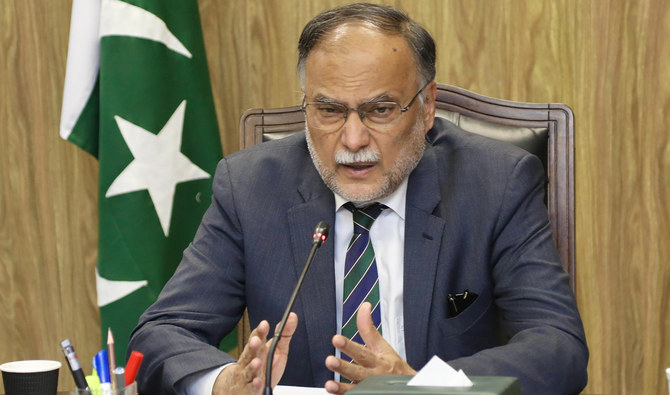
Pakistan Planning Minister Ahsan Iqbal is chairing a meeting in Islamabad on June 22, 2024, to develop a roadmap ahead of the visit of Chinese experts at the end of June. (@PlanComPakistan/X)
Short Url
Updated 26 June 2024
Follow

Pakistan eyes $50 billion Chinese exports in 10 years, greenlights joint venture for industry relocation

  • Chinese experts scheduled to visit Pakistan this month “to foster innovation, technology transfer, capacity building”
  • Earlier this month, Prime Minister Shehbaz Sharif was on a five-day visit to China in which dozens of MoUs were signed 

ISLAMABAD: The Pakistan planning ministry said this week it planned to increase exports to China to $50 billion in the next ten years, as the Prime Minister on Wednesday greenlit a joint venture project to relocate Chinese industries to Pakistan.

Earlier this month, Prime Minister Shehbaz Sharif went on a five-day visit to China that included meetings with top political and business leaders with the aim of upgrading the China-Pakistan Economic Corridor (CPEC), a flagship of the Belt and Road Initiative (BRI), through which Beijing has pledged over $60 billion to Pakistan. Dozens of MoUs were also signed during the visit. 

“The Planning Minister highlighted the goal of exporting fifty billion dollars to the Chinese market. The aim is to increase Pakistan’s exports from 30 billion dollars to 150 billion dollars in the next 10 years,” the ministry said in a statement, emphasizing the importance of learning from China’s experience and know-how.

“A delegation of Chinese experts from various fields is scheduled to visit Pakistan at the end of this month, aiming to foster innovation, technology transfer, and capacity building,” the statement added. 

“The focus will be on capacity building of Pakistani experts through training and knowledge sharing, learning from China’s experience in innovation and technological advancements, adapting innovative solutions to Pakistan’s specific needs, and skill development in key sectors.”

While chairing a meeting to prepare for the Chinese delegation’s visit, Planning Minister Ahsan Iqbal directed line ministries to be “selective and strategic” and focus on areas where China had experience that could be shared with Pakistani professionals. 

“He noted that China has 2.7 trillion dollars in imports, and Pakistan must focus on areas through which it could enhance exports and secure a share in Chinese imports,” Iqbal said, emphasizing the need for Pakistan to learn from China’s strategic advancements in knowledge and technology. 

“The visit aims to transfer Chinese expertise to promote innovation and technology across various sectors in Pakistan, with a focus on mutual cooperation and knowledge sharing.”

Separately on Wednesday, Sharif chaired a meeting of the Board of Investment (BoI) to discuss promoting both local and foreign investment in Pakistan.

“There was significant potential for relocating China’s textile, leather, footwear, and other industries to Pakistan,” state-run APP said in a report, quoting the PM, who okayed a joint venture project to relocate Chinese industries to Pakistan.


Pakistani president arrives in Iraq to deepen trade, energy cooperation

Updated 20 December 2025
Follow

Pakistani president arrives in Iraq to deepen trade, energy cooperation

  • Visit follows recent high-level contacts as Islamabad seeks to expand limited commercial ties with Baghdad
  • Talks are expected to cover investment, manpower and facilitation of Pakistani pilgrims visiting holy sites in Iraq

ISLAMABAD: President Asif Ali Zardari arrived in Iraq on Saturday on an official visit aimed at expanding cooperation in trade, energy and investment, as Pakistan seeks to deepen ties with Baghdad after years of limited engagement.

Pakistan and Iraq established diplomatic relations in 1947 and have traditionally maintained cordial ties, though commercial links remain modest, with officials and business groups identifying scope for cooperation in construction services, pharmaceuticals, manpower and agricultural exports.

“President Asif Ali Zardari arrived in Baghdad on a four-day official visit to Iraq,” his office said in a post on X. “He was received by Culture Minister Dr. Ahmed Fakkak Al-Badrani. During the visit, meetings with senior Iraqi leadership are expected to advance cooperation and further strengthen Pakistan-Iraq relations.”

Zardari’s visit follows a series of recent high-level contacts between the two countries, reflecting efforts to broaden bilateral engagement beyond traditional diplomatic ties and explore collaboration across economic, political and people-to-people domains.

According to Pakistan’s foreign office, the president is expected to hold meetings with Iraq’s senior leadership to discuss cooperation in various areas such as trade and investment, energy, technology, education and manpower.

He is also expected to discuss regional and international issues with Iraqi officials.

Earlier this month, Pakistan’s Interior Minister Mohsin Naqvi met his Iraqi counterpart, Abdul Ameer Al-Shammari, on the sidelines of meetings in Brussels, where both sides agreed to enhance cooperation on security and facilitate travel for Pakistani Shia pilgrims to Najaf and Karbala.

The two officials discussed measures to ensure the smoother movement of these pilgrims and their compliance with visa regulations.