

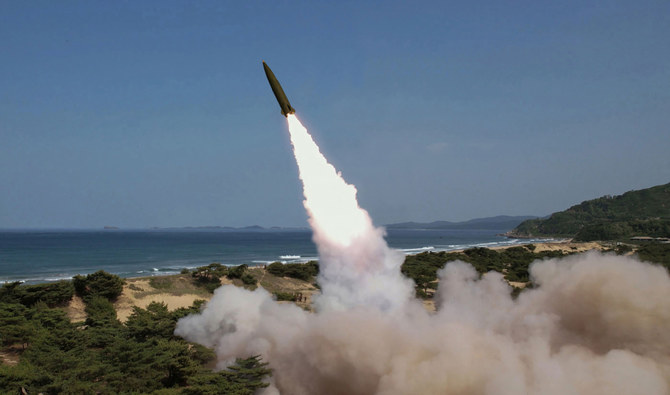
North Korea fires ballistic missile into sea: South Korean military

South Korea’s Joint Chiefs of Staff said it detected the launch but gave no details, saying an analysis is under way. (AFP/File)
Short Url
Updated 02 July 2024
Follow

North Korea fires ballistic missile into sea: South Korean military

SEOUL: North Korea fired a ballistic missile toward the sea on Wednesday, the South Korean military said, according to the Yonhap news agency.

South Korea’s Joint Chiefs of Staff said it detected the launch but gave no details, saying an analysis is under way.

The office of Japanese Prime Minister Fumio Kishida confirmed on social media platform X that North Korea launched a suspected ballistic missile.

“The suspected ballistic missile from North Korea is not expected to reach Japan,” it said of the projectile filed toward the East Sea, also known as the Sea of Japan.

This launch comes amid increased cross-border tension as the reclusive communist state has been sending balloons carrying garbage into South Korea.

North Korea’s last missile launch prior to this one came on May 30, when Seoul accused Pyongyang of firing a volley of around 10 short-range ballistic missiles.

One day later, North Korean state media released images of leader Kim Jong Un supervising tests of a multiple rocket launcher system.

Analysts have suggested the nuclear-armed North could be testing and ramping up production of artillery and cruise missiles before sending them to Russia for use in Ukraine.

In a report last month, the Pentagon said it had confirmed this behavior.

North Korea has sent more trash-filled balloons southward this week, Seoul’s military said Tuesday, the latest in a series of border barrages that have sparked a tit-for-tat propaganda campaign.

Pyongyang has already sent more than a thousand balloons carrying trash in what it says is retaliation for balloons carrying propaganda criticizing Kim’s rule floated north by activists.

In response, Seoul has fully suspended a tension-reducing military deal and restarted some propaganda broadcasts from loudspeakers along the border.

Kim Jong Un’s sister and key government spokeswoman Kim Yo Jong warned this month that Seoul would “undoubtedly witness the new counteraction of the DPRK” if the leaflet drops and loudspeaker broadcasts continued.


Interoceanic Train derails in southern Mexico, killing at least 13 and injuring dozens

Updated 4 sec ago
Follow

Interoceanic Train derails in southern Mexico, killing at least 13 and injuring dozens

  • he Interoceanic Train linking the states of Oaxaca and Veracruz went off the rails Sunday as it passed a curve near the town of Nizanda
  • Mexican President Claudia Sheinbaum says 13 people died and another 98 people were injured when a train derailed
MEXICO CITY: Officials said a train accident in southern Mexico killed at least 13 people and injured dozens, halting traffic along a rail line connecting the Pacific Ocean with the Gulf of Mexico.
The Interoceanic Train linking the states of Oaxaca and Veracruz went off the rails Sunday as it passed a curve near the town of Nizanda.
“The Mexican Navy has informed me that, tragically, 13 people died in the Interoceanic Train accident,” Mexican President Claudia Sheinbaum posted on X, adding that 98 people are injured, five of them seriously.
She said she instructed the secretary of the navy and the undersecretary of human rights of the Ministry of the Interior to travel to the site and personally assist the families.
In a message on X Sunday, Oaxaca state Gov. Salomon Jara said several government agencies had reached the site of the accident to assist the injured.
Officials said that 241 passengers and nine crew members were on the train when the accident occurred.
The Interoceanic Train was inaugurated in 2023 by then President Andres Manuel Lopez Obrador. The rail service is part of a broader push to boost train travel in southern Mexico, and develop infrastructure along the isthmus of Tehuantepec, a narrow stretch of land between the Pacific Ocean and the Gulf of Mexico.
The Mexican government plans to turn the isthmus into a strategic corridor for international trade, with ports and rail lines that can connect the Atlantic and Pacific Oceans. The Interoceanic train currently runs from the port of Salina Cruz on the Pacific Ocean to Coatzacoalcos, covering a distance of approximately 180 miles (290 kilometers).