GABORONE, Botswana: Violent extremist groups linked to Al-Qaeda and the Daesh group are growing in size and influence across Africa, fueling worries that as they improve their tactics, they could attack the US or Western allies.
US defense and military officials described the threats and their concerns about growing instability in Africa, where a number of coups have put ruling juntas in control, leading to the ouster of American troops and a decline in US intelligence gathering.
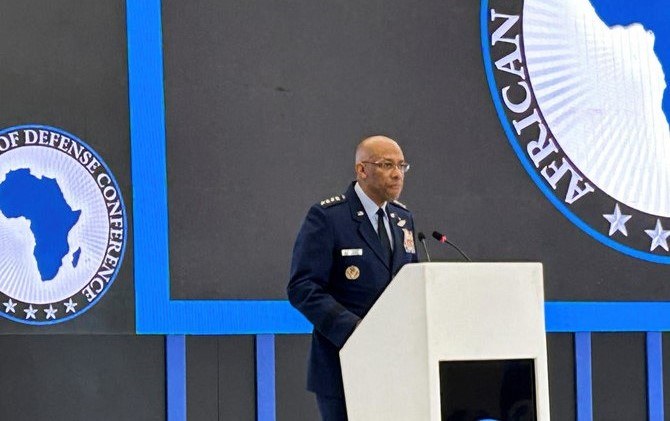
“Threats like Wagner, terrorist groups and transnational criminal organizations continue to sow instability in multiple regions,” Air Force Gen. CQ Brown, chairman of the Joint Chiefs of Staff, said in opening remarks Tuesday at a conference of African chiefs of defense in Botswana. “I think we can all agree, what happens in one part of the world, does not stay in one part of the world.”
Wagner is the Russian mercenary group that has gone into African nations to provide security as Western forces, including from the US and France, have been pushed out. The group is known for its brutality, and human rights organizations have accused its members of raping and killing civilians.
While Brown only touched briefly on the terror threat in the region, it was a key topic among others at the conference and spurred questions from military chiefs in the audience after his speech. They wanted to know what the US could do to help stem the spread of insurgents in West Africa, the Gulf of Guinea and the Sahel.
This is the first time that the chiefs of defense conference has been held on African soil. And it is the first time the US joint chiefs chairman has visited a sub-Saharan country since 1994, when Gen. John Shalikashvili visited Rwanda and Zaire.
A senior US defense official said Al-Qaeda linked groups — such as Al-Shabab in Somalia and Jama’a Nusrat ul-Islam wa Al-Muslimin, known as JNIM, in the Sahel region — are the largest and most financially viable insurgencies. JNIM is active in Mali, Burkina Faso and Niger and is looking to expand into Benin and Togo, which it uses as hubs to rest, recuperate, get financing and gather weapons but also has increased attacks there.
At the same time, the Daesh group has key cells in West Africa and in the Sahel. The defense official, who spoke on condition of anonymity to discuss a threat assessment, said the Daesh cells were getting increasing direction from the group’s leadership that relocated to northern Somalia. That has included how to kidnap Westerners for ransom, how to learn better military tactics, how to hide from drones and how to build their own small quadcopters.
A US military airstrike in Somalia on May 31 targeted Daesh militants and killed three, according to US Africa Command. US officials have said the strike targeted the group’s leader, but the defense official said Monday that it’s still unclear if he was killed.
Roughly 200 Daesh insurgents are in Somalia, so they are vastly outnumbered by Al-Shabab, which has grown in size to between 10,000 and 12,000.
The growth of the insurgent groups within Africa signals the belief by both Al-Qaeda and the Daesh group that the continent is a ripe location for extremism, where extremist ideology can take root and expand, the official said.
And it comes as the US was ordered to pull out its 1,000 troops from Niger in the wake of last July’s coup and also about 75 from Chad. Those troop cuts, which shut down a critical US counterterrorism and drone base at Agadez, hamper intelligence gathering in Niger, said Gen. Michael Langley, head of US Africa Command.
Surveillance operations before the coup gave the US a greater ability to get intelligence on insurgent movements. Now, he said, the key goal is a safe and secure withdrawal of personnel and equipment from both Agadez and a smaller US facility near the airport.
Langley met with Niger’s top military chief, Brig. Gen. Moussa Salaou Barmou, during the conference, and said military-to-military communications continue but that it’s yet to be determined how much the new transitional government will deal with the US
Currently, he said, there are about 400 troops still at Agadez and 200 near the airport.
But, he added that “as we’re in transition and resetting, we need to maintain capabilities to get enough intelligence to identify warnings of a threat out there.”
Langley said the US is still trying to assess the militant groups’ capabilities as they grow.
“Yes, they’ve been growing in number. Have they been growing in capability where they can do what we call external ops attacks on the homeland and attacks on allies, whether we’re talking about Europe or anyone? That’s what we closely watch,” he said. “I’d say it has the potential as they grow in numbers.”
Both Langley and Brown spoke more extensively about the need for the US and African nations to communicate more effectively and work together to solve security and other problems.
And Brown acknowledged that the US needs to “do better at understanding the perspectives of others, ensuring their voices and expertise don’t get drowned out.”
The US has struggled to maintain relations with African nations as many foster growing ties to Russia and China.
Some African countries have expressed frustration with the US for forcing issues, such as democracy and human rights, that many see as hypocrisy, given Washington’s close ties to some autocratic leaders elsewhere. Meanwhile, Russia offers security assistance without interfering in politics, making it an appealing partner for military juntas that seized power in places like Mali, Niger and Burkina Faso in recent years.


Expanding extremist groups in Africa fuel worries that they could attack the US or Western allies
https://arab.news/bm2m6
Expanding extremist groups in Africa fuel worries that they could attack the US or Western allies

- Gen. CQ Brown: ‘Threats like Wagner, terrorist groups and transnational criminal organizations continue to sow instability in multiple regions’
- Brown: ‘I think we can all agree, what happens in one part of the world, does not stay in one part of the world’


End of US-Russia nuclear pact a ‘grave moment’: UN chief
- Guterres urged Washington and Moscow “to return to the negotiating table without delay and to agree upon a successor framework”
UNITED NATIONS, United States: UN chief Antonio Guterres on Wednesday urged the United States and Russia to quickly sign a new nuclear deal, as the existing treaty was set to expire in a “grave moment for international peace and security.”
The New START agreement will end Thursday, formally releasing both Moscow and Washington from a raft of restrictions on their nuclear arsenals.
“For the first time in more than half a century, we face a world without any binding limits on the strategic nuclear arsenals of the Russian Federation and the United States of America,” Guterres said in a statement.
The UN secretary-general added that New START and other arms control treaties had “drastically improved the security of all peoples.”
“This dissolution of decades of achievement could not come at a worse time — the risk of a nuclear weapon being used is the highest in decades,” he said, without giving more details.
Guterres urged Washington and Moscow “to return to the negotiating table without delay and to agree upon a successor framework.”
Russia and the United States together control more than 80 percent of the world’s nuclear warheads but arms agreements have been withering away.
New START, first signed in 2010, limited each side’s nuclear arsenal to 1,550 deployed strategic warheads — a reduction of nearly 30 percent from the previous limit set in 2002.
It also allowed each side to conduct on-site inspections of the other’s nuclear arsenal, although these were suspended during the Covid-19 pandemic and have not resumed since.


