

EU sanctions 19 Chinese firms over links to Russian war effort

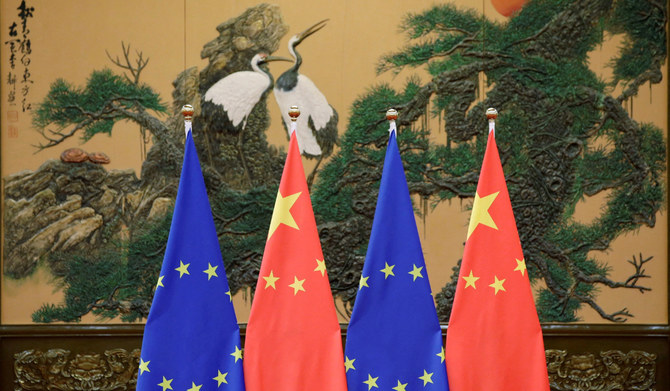
Flags of European Union and China are pictured during the China-EU summit at the Great Hall of the People in Beijing, China, July 12, 2016. (REUTERS)
Short Url
Updated 25 June 2024
Follow

EU sanctions 19 Chinese firms over links to Russian war effort

  • These companies are now subject to drastic restrictions over sales of “dual-use goods and technology” that could be used for the “enhancement of Russia’s defense and security sector”

BRUSSELS, Belgium: The European Union Monday imposed sanctions on 19 Chinese companies aimed at punishing what the West believes is Beijing’s support for Russia’s war in Ukraine.
A list published in the EU’s Official Journal includes several companies located in Hong Kong as well as two global satellite giants.
The 14th package of sanctions against Russia added 61 new companies to the list of entities accused of directly “supporting Russia’s military-industrial complex” in the war in Ukraine, bringing the total to 675 firms.
These companies are now subject to drastic restrictions over sales of “dual-use goods and technology” that could be used for the “enhancement of Russia’s defense and security sector.”
China denies Western accusations that it is supporting Russia’s military campaign.
Among the newly added companies are two major players in the Chinese satellite industry involved in the sale of satellites and satellite imagery to Russia’s Wagner mercenary group.
In October, an AFP investigation revealed that Wagner in 2022 signed a contract worth more than $30 million with Chinese firm Beijing Yunze Technology Co. Ltd. to acquire two satellites and use their images.
The contract was signed in November 2022, over half a year into Moscow’s invasion of Ukraine in which the Wagner group under its founder Yevgeny Prigozhin was playing a key role on the battlefield.
The two high-resolution satellites belonged to Chang Guang Satellite Technology, a leading global satellite company which was the unit to be added to the EU’s sanctions list.
Another company named Monday was Head Aerospace Technology, which sells satellite images and was placed on a US sanctions list in 2023 for supplying the Wagner Group.
Even if China does not deliver weapons directly to Russia, the United States and Europe accuse it of selling components and equipment to Moscow’s military industry.
Chinese foreign ministry spokesman Lin Jian has dismissed the claims as “false information.”
Russian-based companies make up about half of the 61 entities added to the EU’s list Monday.
In addition to the 19 Chinese companies, it also added nine from Turkiye, two in Kyrgyzstan, one in India, one in Kazakhstan, and one in the United Arab Emirates.


Homeless Muslims in southern Philippines observe Ramadan as month of trial

Updated 4 sec ago
Follow

Homeless Muslims in southern Philippines observe Ramadan as month of trial

  • Thousands lost their homes when parts of Bongao in Tawi-Tawi were burnt to ashes
  • Many trying to fully observe the fasting month say they are grateful to be alive

Manila: As Annalexis Abdulla Dabbang was looking forward to observing the month of Ramadan with her family, just days before it began they lost everything when an enormous fire tore through whole neighborhoods of their city in the southernmost province of the Philippines.

Bongao is the capital of Tawi-Tawi, an island province, forming part of the country’s Muslim minority heartland in the Bangsamoro region. The city experienced its worst fire in years in early February, when flames swept through the coastal community, leaving more than 5,000 people homeless.

“We were swimming for our lives. We had to swim to escape from the fire ... We swam in darkness, and (even) the sea was already hot because of the fire,” Dabbang, a 27-year-old teacher, told Arab News.

“Everything we owned was gone in just a few hours — our home, our memories, the things we worked hard for, everything turned to ashes.”

Trying to save their 2-year-old daughter and themselves, she and her husband left everything behind — as did hundreds of other families that together with them have since taken shelter at the Mindanao State University gymnasium — one of the evacuation centers.

Unable to secure a tent, Dabbang’s family has been sleeping on the bleachers, sharing a single mat as their bed. When Ramadan arrived a few days after they moved to the makeshift shelter, they welcomed it in a different, more solemn way. There is no family privacy for suhoor, no room or means to welcome guests for iftar.

“Ramadan feels different now. It’s painful but at the same time more real. When we lost our home, we began to understand what sacrifice really means. When you sleep in an evacuation center, you understand hunger, discomfort in a deeper way,” Dabbang said.

“We don’t prepare special dishes. We prepare our hearts.”

While she and thousands of others have lost everything they have ever owned, she has not lost her faith.

“Our dreams may have turned to ashes, but our prayers are still alive,” she said.

“This Ramadan my prayers are more emotional than ever. I pray for strength, not just for myself, but for my family and for every neighbor who also lost their family home. I pray for healing from the trauma of fire. I pray that Allah will replace what we lost with something better. I pray for the chance to rebuild not just our house, but our sense of security.”

Juraij Dayan Hussin, a volunteer helping the Bongao fire victims, observed that many of them were traumatized and the need to cleanse the heart and mind during Ramadan was what kept many of them going, because they are “thankful that even though they lost their property, they are still alive.”

But the religious observance related to the fasting month is not easy in a cramped shelter.

“It’s hard for Muslims to perform their prayers when they do not have their proper attire because they usually have specific clothes for prayer,” he said. “Sanitation in the area is also an issue ... when you fast and when you pray, cleanliness is essential.”

For Abdulkail Jani, who is staying at a basketball court with his brother and more than 70 other families, this Ramadan will be spent apart from their parents, whom they managed to move to relatives.

“The month of Ramadan this year is a month of trial ... there will be a huge change from how we observed Ramadan in the past, but we will adjust to it and try to comfort ourselves and our family. The most important thing is that we can perform the fasting,” he told Arab News.

“Despite our situation now, despite everything, as long as we’re alive, we will observe Ramadan. We’ll try to observe it well, without missing anything.”