Jordanian king, French president discuss war on Gaza

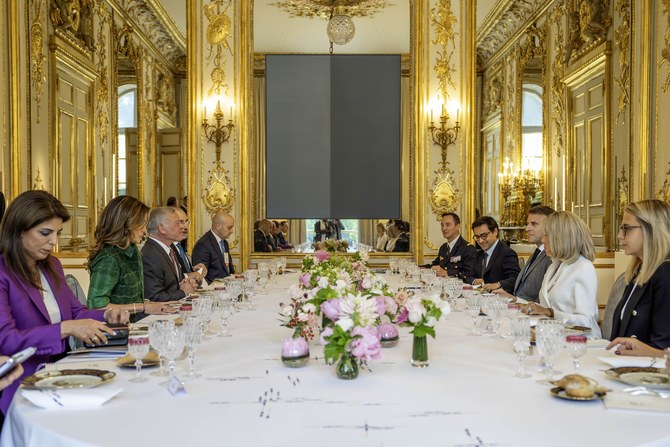
Jordan’s King Abdullah and French President Emmanuel Macron met on Monday in Paris. (Petra)
Short Url
Updated 24 June 2024
Follow

Jordanian king, French president discuss war on Gaza

  • Leaders urged the international community to intensify efforts to deliver humanitarian aid to Gaza

AMMAN: Jordan’s King Abdullah and French President Emmanuel Macron met on Monday in Paris to discuss the dangerous developments in Gaza and the severe humanitarian plight resulting from Israel’s war on the Strip, Jordan News Agency reported.

During their meeting at the Elysee Palace, the leaders urged the international community to intensify efforts to deliver humanitarian aid to Gaza by all available means.

They reiterated their commitment to providing continued assistance to the region.

More than 37,500 Palestinians have been killed in Israel’s war on Gaza, the majority of them women and children, according to Gaza’s Health Ministry.

King Abdullah and Macron underscored the urgent need for a ceasefire and emphasized the protection of civilians. The discussions, attended by Queen Rania and Brigitte Macron, also touched upon broader regional issues.

The king expressed concern about the potential spillover of the conflict, which poses a threat to international security. He reiterated that the two-state solution remains the sole pathway to achieving a just and comprehensive peace.

The two leaders highlighted the importance of maintaining Lebanon’s stability and security while King Abdullah cautioned against the persistent targeting of relief organizations in Gaza and praised France’s support for UNRWA, which plays a crucial role in delivering essential services to nearly 2 million Palestinians in the region.

Addressing the situation in the West Bank, King Abdullah condemned the violence by extremist Israeli settlers against Palestinians and warned against any unilateral actions that violate the historical and legal status of Jerusalem’s Islamic and Christian holy sites.

The meeting was also attended by Jordanian Foreign Minister Ayman Safadi and the Jordanian ambassador to France, Leena Al-Hadid.


Russian forces begin pulling out of bases in northeast Syria

Updated 4 sec ago
Follow

Russian forces begin pulling out of bases in northeast Syria

  • Despite having been on opposite sides of the battle lines during the civil war, the new rulers in Damascus have taken a pragmatic approach to relations with Moscow

QAMISHLI, Syria: Russian forces have begun pulling out of positions in northeast Syria in an area still controlled by the Kurdish-led Syrian Democratic Forces after the group lost most of its territory in an offensive by government forces.
Associated Press journalists visited one base next to the Qamishli airport Tuesday and found it guarded by SDF fighters who said the Russians had begun moving their equipment out in recent days.
Inside what had been living quarters for the soldiers was largely empty, with scattered items left behind, including workout equipment, protein powder and some clothing.
Ahmed Ali, an SDF fighter deployed at the facility, said the Russian forces began evacuating their positions around the airport five or six days ago, withdrawing their equipment via a cargo plane.
“We don’t know if its destination was Russia or the Hmeimim air base,” he said, referring to the main Russian base on Syria’s coast. “They still have a presence in Qamishli and have been evacuating bit by bit.”
A UN humanitarian convoy from Damascus reached Qamishli on Tuesday, UN spokesman Stéphane Dujarric said.
“It delivered food, warm clothes and blankets, among other supplies,” he told UN reporters. “More convoys are planned in the coming days.”
Dujarric said the UN is also continuing to distribute food, bread and cash elsewhere including displacement sites.
There has been no official statement from Russia about the withdrawal of its forces from Qamishli.
Russia has built relations with the new central Syrian government in Damascus since former President Bashar Assad was ousted in December 2024 in a rebel offensive led by now-interim President Ahmad Al-Sharaa — despite the fact that Moscow was a close ally of Assad.
Moscow’s scorched-earth intervention in support of Assad a decade ago turned the tide of Syria’s civil war at the time, keeping Assad in his seat. Russia didn’t try to counter the rebel offensive in late 2024 but gave asylum to Assad after he fled the country.
Despite having been on opposite sides of the battle lines during the civil war, the new rulers in Damascus have taken a pragmatic approach to relations with Moscow. Russia has retained a presence at its air and naval bases on the Syrian coast.
Al-Sharaa is expected to visit Moscow on Wednesday and meet with Putin.
Fighting broke out early this month between the SDF and government forces after negotiations over a deal to merge their forces together broke down. A ceasefire is now in place and has been largely holding.
After the expiration of a four-day truce Saturday, the two sides announced the ceasefire had been extended by another 15 days.
Syria’s defense ministry said in a statement that the extension was in support of an operation by US forces to transfer accused Daesh militants who had been held in prisons in northeastern Syria to detention centers in Iraq.