

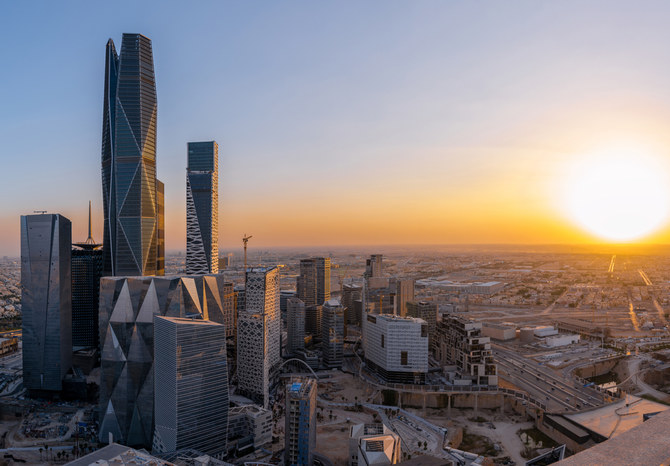

RIYADH: Saudi Arabia attracted $65.1 billion in foreign direct investment in the three years post-pandemic until 2023, placing it among West Asia’s top recipients, according to new data.
According to the latest World Investment Report by the UN Conference on Trade and Development, the Kingdom's FDI outflows totaled $73.1 billion over the same period, with $16 billion recorded last year alone. This places Saudi Arabia among the top 20 economies globally for FDI outflows, ranking 16th.
In accordance with the goals set out in the National Investment Strategy and Vision 2030 targets, Saudi Arabia has enacted substantial legal, economic, and social reforms aimed at stimulating inflows of foreign direct investment.
Launched in 2021, NIS looks to develop comprehensive investment plans across various sectors such as manufacturing, renewable energy, transport and logistics, tourism, digital infrastructure, and healthcare.
Furthermore, it aims to increase annual FDI flows to over $103 billion and boost annual domestic investment to more than $453 billion by 2030.
The UN report also noted a 55 percent annual increase in the value of international project finance deals in Saudi Arabia in 2023, reaching $22 billion.
Last year, the nation witnessed 19 deals, marking a 90 percent growth compared to the previous year.
Additionally, Saudi Arabia saw 389 announced greenfield projects in 2023, totaling $29 billion, reflecting a 108 percent annual increase in value.
On a global level, FDI experienced a marginal yearly decline of 2 percent in 2023, dropping to $1.3 trillion.
The analysis highlighted that the overall figure was significantly influenced by substantial financial flows through a few European conduit economies.
Excluding the impact of these conduits, global FDI flows were more than 10 percent lower than in 2022.
Conduit economies refer to countries that act as intermediaries for financial flows, especially foreign direct investment.
These economies attract multinational corporations with favorable tax laws and regulatory environments, allowing funds to pass through on their way to final investment destinations, often for tax optimization and regulatory benefits. Examples include the Netherlands, Luxembourg, and Switzerland, as well as Cyprus and Ireland.
The challenges
UNCTAD stated that the global landscape for international investment remains challenging in 2024. Factors such as declining growth prospects, economic fragmentation, and trade and geopolitical tensions are influencing FDI patterns. Industrial policies and the diversification of supply chains also present limitations.
These factors have prompted many multinational enterprises to adopt a cautious approach to overseas expansion.
“However, MNE profit levels remain high, financing conditions are easing and increased greenfield project announcements in 2023 will positively affect FDI. Modest growth for the full year appears possible,” the report stated.
International project finance and cross-border mergers and acquisitions were particularly weak in 2023.
M&As, which predominantly impact FDI in developed countries, fell in value by 46 percent, while project finance, a crucial factor for infrastructure investment, was down 26 percent.
According to the report, the principal causes of this decline included tighter financing conditions, investor uncertainty, volatility in financial markets, and increased regulatory scrutiny for M&As.
In developed countries, the 2023 trend was significantly influenced by MNE financial transactions, partly driven by efforts to implement a minimum tax on the largest MNEs.
Regional deep dive
Due to volatility in conduit economies, FDI flows in Europe shifted dramatically from negative $106 billion in 2022 to positive $16 billion in 2023.
Inflows to the rest of Europe declined by 14 percent, while inflows in other developed countries stagnated, with a 5 percent decline in North America and significant decreases elsewhere.
FDI flows to developing countries fell by 7 percent to $867 billion, primarily due to an 8 percent decrease in developing Asia.
Flows fell by 3 percent in Africa and 1 percent in Latin America and the Caribbean. The number of international project finance deals dropped by a quarter.
Although greenfield project announcements in developing countries increased by over 1,000, these initiatives were highly concentrated in specific regions.
Greenfield project announcements refer to the initiation of new investment undertakings where companies build operations from scratch on undeveloped land, leading to the construction of new facilities and infrastructure.
South-East Asia accounted for almost half of these projects, West Asia for a quarter, while Africa saw a small increase, and Latin America and the Caribbean attracted fewer initiatives.
FDI inflows to Africa declined by 3 percent in 2023 to $53 billion. Despite several megaproject announcements, including Mauritania’s largest worldwide green hydrogen project, international project finance in Africa fell by a quarter in the number of deals and half in value, negatively affecting infrastructure investment prospects.
In developing Asia, FDI fell by 8 percent to $621 billion. China, the world’s second-largest FDI recipient, experienced a rare decline in inflows, with significant decreases recorded in India and West and Central Asia.
The report stated that only South-East Asia held steady, with industrial investment remaining buoyant despite the global downturn in project finance.
FDI flows to Latin America and the Caribbean were down 1 percent to $193 billion.
The number of international project finance and greenfield investment announcements fell, but the value of greenfield projects increased due to large investments in commodity sectors, critical minerals and renewable energy as well as green hydrogen, and green ammonia.
Conversely, FDI flows to structurally weak and vulnerable economies increased. FDI inflows to least developed countries rose to $31 billion, accounting for 2.4 percent of global FDI flows, the report stated.
“Landlocked developing countries and small island developing states also saw increased FDI. In all three groups, FDI remains concentrated among a few countries,” the report added.
The global downturn in international project finance disproportionately affected the poorest countries, where such finance is relatively more important.
Industry trends showed lower investment in infrastructure and the digital economy but strong growth in global value chain-intensive sectors such as manufacturing and critical minerals.
Weak project finance markets negatively impacted infrastructure investment, and digital economy sectors continued to slow down after the boom ended in 2022.
The report further stated that global value chain-intensive sectors, including automotive, electronics, and machinery industries, grew strongly, driven by supply chain restructuring pressures. Investment in critical minerals extraction and processing nearly doubled in project numbers and values.


