

Pakistan’s Punjab warns of urban flooding as 35 percent more rains expected this monsoon season

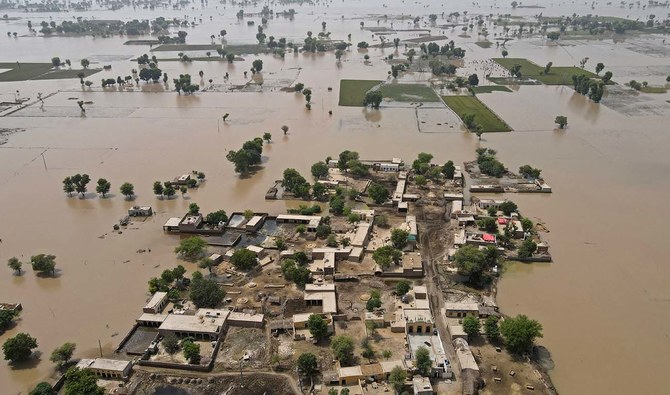
This photograph shows an aerial view of a village wrecked by floods in the Okara district of Punjab province on August 28, 2023. (AFP/File)
Short Url
Updated 23 June 2024
Follow

Pakistan’s Punjab warns of urban flooding as 35 percent more rains expected this monsoon season

  • Large swathes of the South Asian country were submerged in 2022 due to extremely heavy monsoon rains
  • Pakistan has also been in grips of heat wave since last month, with temperatures in some regions rising adobe 50°C

ISLAMABAD: The Punjab Disaster Management Authority on Sunday warned of urban flooding in parts of the province next month as monsoon rains start from July 1, with 35 percent more downpours expected this year in a country considered one of the most vulnerable to climate change impacts.

Large swathes of the South Asian nation were submerged in 2022 due to extremely heavy monsoon rains and melting glaciers, a phenomenon linked to climate change that damaged crops and infrastructure and killed at least 1,700 people, displaced millions and inflicted billions of dollars in losses.

“Heavy rains with thundershowers are expected in Upper Punjab, Central Punjab and South Punjab,” the PDMA said in a statement, announcing that the monsoons would begin in the province from July 1 and 35 percent rain more rain was expected this year compared to previous years. “Monsoon rains in July threaten urban flooding and hill torrents in South Punjab.”

The PDMA called on the district administration to ensure safety measures were put in place before the rains began. 

“Complete cleaning of rivers and drainage arrangements should be made as soon as possible,” the statement said. “Protection of life and property of citizens is the first priority and there is no room for negligence or irresponsibility.”

In 2010, the worst floods in memory affected 20 million people in Pakistan, with damage to infrastructure running into billions of dollars and huge swathes of crops destroyed as one fifth of the country was inundated.

Pakistan has also been in the grips of a heat wave since last month, with temperatures in some regions rising to above 50 degrees Celsius. 


Pakistani, Bangladeshi officials discuss trade, investment and aviation as ties thaw

Updated 28 December 2025
Follow

Pakistani, Bangladeshi officials discuss trade, investment and aviation as ties thaw

  • Pakistan and Bangladesh were once one nation, but they split in 1971 as a result of a bloody civil war
  • Ties between Pakistan, Bangladesh have warmed up since last year and both nations have resumed sea trade

ISLAMABAD: Pakistan's High Commissioner to Bangladesh Imran Haider on Sunday met Chief Adviser Muhammad Yunus in Dhaka, the latter's office said on, with the two figures discussing trade, investment and aviation.

Pakistan and Bangladesh were once one nation, but they split in 1971 as a result of a bloody civil war, which saw the part previously referred to as East Pakistan seceding to form the independent nation of Bangladesh.

Ties between Pakistan and Bangladesh have warmed up since former prime minister Sheikh Hasina’s ouster as a result of a student-led uprising in August 2024. Relations remain frosty between Dhaka and New Delhi over India’s decision to grant asylum to Hasina.

Pakistan has attempted to forge closer ties with Bangladesh in recent months and both South Asian nations last year began sea trade, followed by efforts to expand government-to-government commerce.

"During the meeting, both sides discussed ways to expand cooperation in trade, investment, and aviation as well as scaling up cultural, educational and medical exchanges to further strengthen bilateral relations between the two South Asian nations," Yunus's office said in a statement on X.

In 2023-24 Pakistan exported goods worth $661 million to Bangladesh, while its imports were only $57 million, according to the Trade Development Authority of Pakistan. In Aug. this year, the Pakistani and Bangladeshi commerce ministries signed a memorandum of understanding to establish a Joint Working Group on Trade, aiming to raise their bilateral trade volume to $1 billion in the financial year that began in July.

The Pakistani high commissioner noted that bilateral trade has recorded a 20 percent growth compared to last year, with business communities from both countries actively exploring new investment opportunities, according to the statement.

He highlighted a significant increase in cultural exchanges, adding that Bangladeshi students have shown strong interest in higher education opportunities in Pakistan, particularly in medical sciences, nanotechnology, and artificial intelligence. Haider also said that Dhaka-Karachi direct flights are expected to start in January.

"Chief Adviser Professor Muhammad Yunus welcomed the growing interactions between the two countries and emphasized the importance of increased visits as well as cultural, educational and people-to-people exchanges among SAARC (South Asian Association for Regional Cooperation) member states," the statement read.

"Professor Yunus also underscored the need to further boost Bangladesh–Pakistan trade and expressed hope that during Mr. Haider’s tenure, both countries would explore new avenues for investment and joint venture businesses."