

Trump proposes green cards for foreign grads of US colleges, departing from anti-immigrant rhetoric

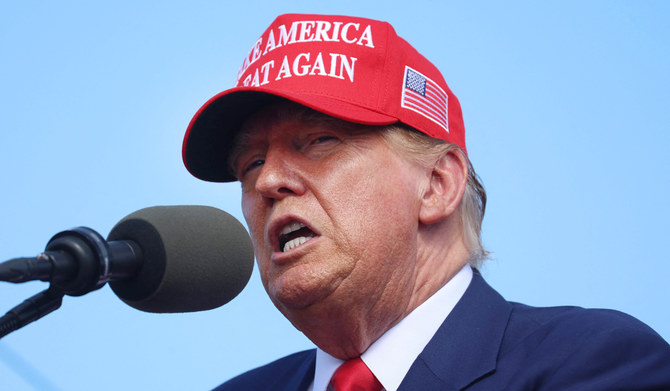
Republican presidential candidate former President Donald Trump speaks during a rally at Festival Park on June 18, 2024 in Racine, Wisconsin. (AFP)
Short Url
Updated 21 June 2024
Follow

Trump proposes green cards for foreign grads of US colleges, departing from anti-immigrant rhetoric

  • A green card, also known as a permanent resident card, allows individuals to live and work permanently in the United States and is a path to citizenship

MIAMI: Former President Donald Trump said in an interview posted on Thursday he wants to give automatic green cards to foreign students who graduate from US colleges, a sharp departure from the anti-immigrant rhetoric he typically uses on the campaign trail.
Trump was asked about plans for companies to be able to import the “best and brightest” in a podcast taped Wednesday with venture capitalists and tech investors called the “All-In.”
“What I want to do and what I will do is you graduate from a college, I think you should get automatically as part of your diploma a green card to be able to stay in this country. And that includes junior colleges too, anybody graduates from a college. You go there for two years or four years,” he said, vowing to address this concern on day one.
Immigration has been Trump’s signature issue during his 2024 bid to return to the White House. His suggestion that he would offer green cards — documents that confer a pathway to US citizenship — to potentially hundreds of thousands of foreign graduates would represent a sweeping expansion of America’s immigration system that sharply diverges from his most common messages on foreigners.
Trump has blamed immigrants who are in the country illegally for committing crimes, stealing jobs and government resources, and suggested that they are “poisoning the blood of our country.” He has promised to carry out the largest deportation operation in US history if elected.
Trump and his allies often say they distinguish between people entering illegally versus legally. But during his administration, Trump also proposed curbs on legal immigration such as family-based visas and the visa lottery program.
Right after taking office in 2017, he issued his “Buy American and Hire American” executive order, directing Cabinet members to suggest reforms to ensure that business visas were only awarded to the highest-paid or most-skilled applicants to protect American workers.
He has previously said the H1-B program commonly used by companies to hire foreign workers temporarily — a program he has used in the past — was “very bad” and used by tech companies to get foreign workers for lower pay.
During the conversation with “All-In,” Trump blamed the coronavirus pandemic for being unable to implement these measures while he was president. He said he knows of stories of people who graduate from top colleges and want to stay in the US but can’t secure visas to do so, forcing them to return to their native countries, specifically naming India and China. He said they go on and become multibillionaires, employing thousands of workers.
“You need a pool of people to work for your company,” Trump said. “And they have to be smart people. Not everybody can be less than smart. You need brilliant people.”


Philippine VP Sara Duterte impeachment case moves forward

Updated 5 sec ago
Follow

Philippine VP Sara Duterte impeachment case moves forward

  • A Philippine congressional committee agreed overwhelmingly on Wednesday to advance the impeachment case against Vice President Sara Duterte
MANILA: A Philippine congressional committee agreed overwhelmingly on Wednesday to advance the impeachment case against Vice President Sara Duterte, setting the stage for a potential vote that could decide her political future.
The daughter of former president Rodrigo Duterte, who in February announced a 2028 presidential bid, was impeached last year, only for the Supreme Court to toss the case out over procedural issues.
Under the Philippine constitution, an impeachment by the House of Representatives triggers a Senate trial, where a guilty verdict would ban Duterte from elected office for life.
The new complaints, ruled “sufficient in substance” by a vote of 54-1 on Wednesday, accuse her of graft and corruption while in office and of making a death threat against former ally President Ferdinand Marcos.
She will now have 10 days to respond before the start of a hearing of probable cause necessary to move the complaints to a House vote.
“Our vote today is not a verdict of guilt nor an act of condemnation. It’s simply a decision on whether the constitutional process should move forward,” Representative Ferdinand Hernandez said minutes before the vote.
The vice president’s legal team said Wednesday they would not comment on specific allegations.
“For now, we will refrain from discussing the substance of the case in the media and will instead address these matters through the proper constitutional processes,” lawyer Michael Poa said in a statement.
The alleged death threat against Marcos stems from a late-night press briefing in which she claimed to have hired an assassin to kill the president and members of his family should he have her cut down first.
Analysts have warned that Duterte’s presidential announcement will weigh heavily on lawmakers forced to gauge the repercussions of a vote against someone who may yet hold the country’s highest office.
While she later said the comments were misinterpreted, lawmaker Gerville Luistro said Wednesday that the alleged threats could destabilize institutions.
“They carry weight. They create fear,” she said.
Duterte and Marcos have been engaged in a high-stakes political brawl that erupted within weeks of their 2022 win in the presidential election, when the vice president was denied her favored cabinet portfolios and instead named education secretary.
The justice committee last month tossed out a pair of impeachment complaints against Marcos, ruling that allegations of corruption over a scandal involving bogus flood control projects lacked substance.