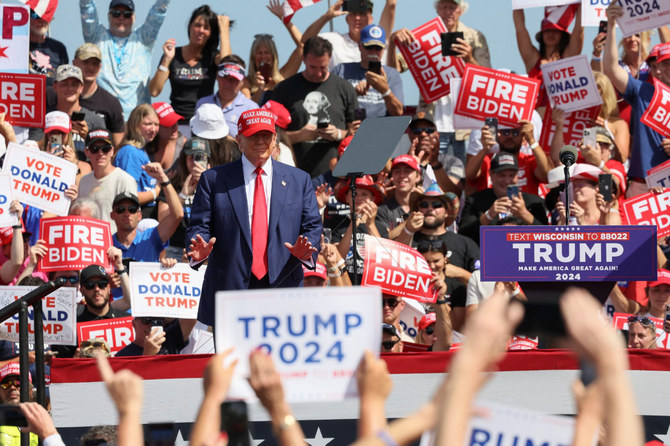
RACINE, Wisconsin: Donald Trump holds a rally in Racine, Wisconsin, on Tuesday, where he will slam Democratic President Joe Biden’s handling of the economy, even as a major local factory that Trump broke ground on six years ago has proven to be a flop.
The Republican former president was in this largely working-class, lakeside city in 2018 to celebrate what was expected to be a $10 billion investment by Taiwanese technology group Foxconn. During his 2017 to 2021 term, Trump touted the facility, designed to produce TVs, as an example of how his “America First” policies had rejuvenated American manufacturing.
But while Foxconn originally forecast 13,000 new jobs at the factory, the company now expects to create only about 1,500 positions. Vacant fields west of downtown Racine, threaded by empty roadways, serve as a local symbol of unmet promises.
The company, which did not respond to a request for comment, previously said that it changed its plans due to a reduction in projected demand for the factory’s products.
“I think people look at it as a joke,” said Nancy Anderson, a 67-year-old retired teacher, while having breakfast at a local cafe.
Trump is expected to speak to supporters at a lakeside park at 3 p.m. local time (2000 GMT). Among the topics he will address, according to the campaign, is how high inflation under Biden has hurt Wisconsin residents.
Foxconn’s underwhelming debut has opened up a line of attack for local and national Democrats who say Trump failed to live up to his economic promises. They are hoping that message resonates in Wisconsin, one of just a handful of states expected to be competitive in the Nov. 5 election.
According to an average of surveys maintained by polling website FiveThirtyEight, Trump leads Biden in Wisconsin by 0.2 percentage points, despite having lost the state in 2020.
The two candidates are competing furiously for every vote. Biden was in Racine last month to tout the construction of a $3.3 billion Microsoft data center in a location where Foxconn was supposed to build part of its manufacturing campus.
“Foxconn turned out to be just that — a con,” Biden told supporters at Gateway Technical College’s Sturtevant campus.
Still, Trump has a solid base of support, with many voters willing to move past Foxconn and some officials publicly saying they are happy that any jobs at all were created.
Anthony Eckman, a 28-year-old who is unemployed, said he was disappointed when a warehouse position he planned to apply for at Foxconn failed to materialize.
But he said his personal finances have worsened under Biden, and he will likely vote for Trump this year, despite sitting out the last election.
“I wish we had better candidates this year, but Biden showed no signs of improving this country in my opinion,” Eckman said. “I think I’m gonna be voting for Trump this year.”
The Trump campaign did not immediately respond to a request for comment.
Racine is about 40 miles south of Milwaukee, and it is considered politically competitive even by Wisconsin standards. Trump beat the Democratic nominee in both 2016 and 2020 by about 4 percentage points, while former Democratic President Barack Obama narrowly won the county in 2008 and 2012.
Last week, Trump called Milwaukee, where the Republican National Convention will take place next month, a “horrible city” during a meeting with Republicans in the US House of Representatives.
His campaign said he was referring to violent crime and alleged election security issues in the city when he made that comment.


![]()

Trump holds rally in Wisconsin city where his promises of new jobs fell short
Short Url
https://arab.news/9hk86
Trump holds rally in Wisconsin city where his promises of new jobs fell short
- Still, Trump has a solid base of support, with many voters willing to move past Foxconn and some officials publicly saying they are happy that any jobs at all were created


Latest updates





© 2026 SAUDI RESEARCH & PUBLISHING COMPANY, All Rights Reserved And subject to Terms of Use Agreement.