

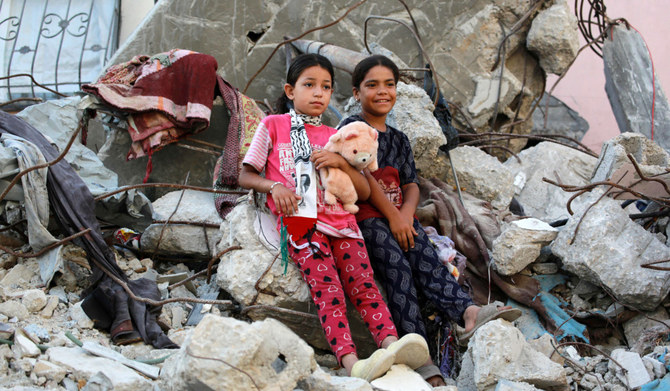

GAZA STRIP: In tents in the stifling heat and bombed-out mosques, Gazans on Sunday marked the start of the Eid Al-Adha holiday, devoid of the usual cheer as the Israel-Hamas war raged on.
“There is no joy. We have been robbed of it,” said Malakiya Salman, a 57-year-old displaced woman now living in a tent in Khan Younis City in the southern Gaza Strip.
Gazans, like Muslims the world over, would usually slaughter sheep for the holiday — whose Arabic name means “feast of the sacrifice” — and share the meat with the needy.
Parents would also give their children new clothes and money for the celebration.
But this year, after more than eight months of a devastating Israeli campaign that has flattened much of Gaza, displaced most of the besieged territory’s 2.4 million people, and sparked repeated warnings of famine, the Eid is a day of misery for many.
“I hope the world will put pressure to end the war on us because we are truly dying, and our children are broken,” said Salman.
Her family was displaced from the far-southern city of Rafah, a recent focus of the fighting which began after Hamas’s Oct. 7 attack on southern Israel.
The military on Sunday morning announced a “tactical pause of military activity” around a Rafah-area route to facilitate the delivery of desperately needed humanitarian aid to Gazans.
AFP correspondents said there were no reports of strikes or shelling since dawn, though the Israeli military stressed there was “no cessation of hostilities in the southern Gaza Strip.”
The brief respite in fighting allowed worshippers a rare moment of calm on holiday.
Many gathered for the Eid Al-Adha morning prayer in the courtyard of Gaza City’s historic Omari Mosque, which was heavily damaged in Israeli bombardment, placing down their frayed prayer mats next to mounds of rubble.
The sound of prayers traveled down some of the city’s destroyed and abandoned streets.
“Since this morning, we’ve felt a sudden calm with no gunfire or bombings ... It’s strange,” said 30-year-old Haitham Al-Ghura from Gaza City.
He hoped the pause meant a permanent ceasefire was near, though truce mediation efforts have stalled for months.
In several areas of the war-battered territory, especially in Gaza City, young boys were seen manning roadside shops selling perfumes, lotions, and other items against the backdrop of piles of rubble from destroyed buildings and homes.
Many vendors used umbrellas to protect themselves from the scorching sun as they sold household items on Gaza City’s main market street. But there were few buyers.
Food and other goods can reach four or five times their usual price, but those who cling to the holiday traditions can still afford them.
In Khan Younis, displaced man Majdi Abdul Raouf spent 4,500 shekels ($1,200) — a small fortune for most Gazans — on a sheep to sacrifice.
“I was determined to buy it despite the high prices, to perform these rituals and bring some joy and happiness to the children in the displacement camp,” said the 60-year-old, who fled his home in Rafah.
“There is sadness, severe pain, and suffering, but I insisted on having a different kind of day.”
The deadliest-ever Gaza war began after Hamas’s unprecedented Oct. 7 attack.
Israel’s retaliatory offensive has killed at least 37,337 people in Gaza, also mostly civilians, according to the Health Ministry in the territory.
For many, a halt in fighting can never bring back what has been lost.
“We’ve lost many people, there’s a lot of destruction,” said Umm Mohammed Al-Katri from Jabalia refugee camp in northern Gaza.
“This Eid is completely different,” she said, with many Gazans forced to spend the holiday without their loved ones killed or displaced during the war.
Grieving families on Sunday flocked to cemeteries and other makeshift burial sites, where wooden planks marked the graves.
“I feel comfort here,” said Khalil Diab Essbiah at the cemetery where his two children are buried.
Even with the constant buzzing of Israeli drones overhead, visitors at the cemetery “can feel relieved of the genocide we are in and the death and destruction,” he said.
Hanaa Abu Jazar, 11, also displaced from Rafah to the tent city in Khan Yunis, said: “We see the (Israeli) occupation killing children, women and the elderly.”
“How can we celebrate?” asked the girl.


