

Hajj reaches its pinnacle; number of pilgrims placed at 1.83 million

1 / 3
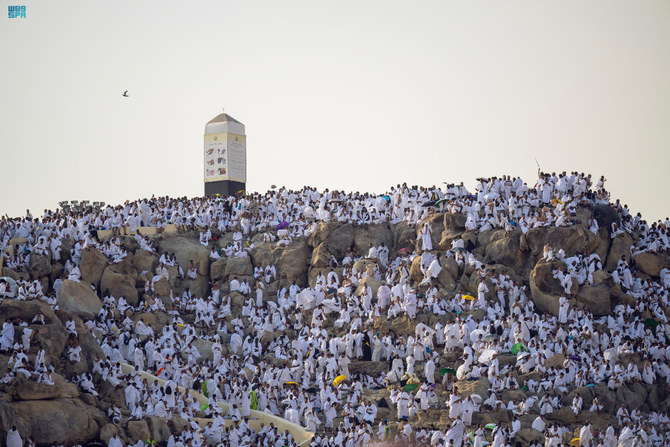
On the slopes of Mt. Arafat and the surrounding plains, many pilgrims raised hands in worship with tears streaming down their faces. (SPA photo)
2 / 3
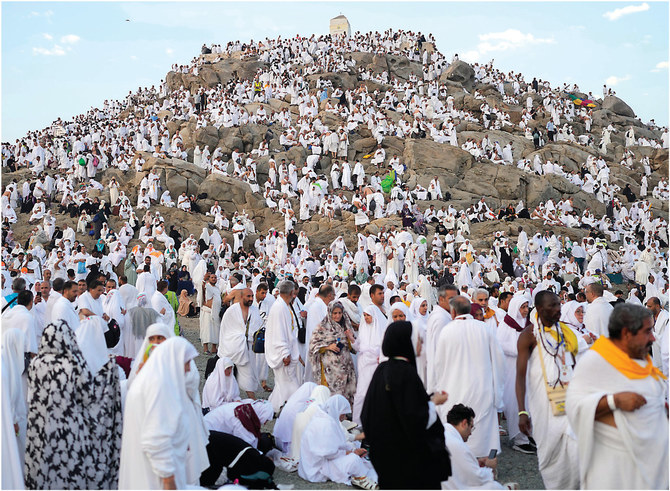
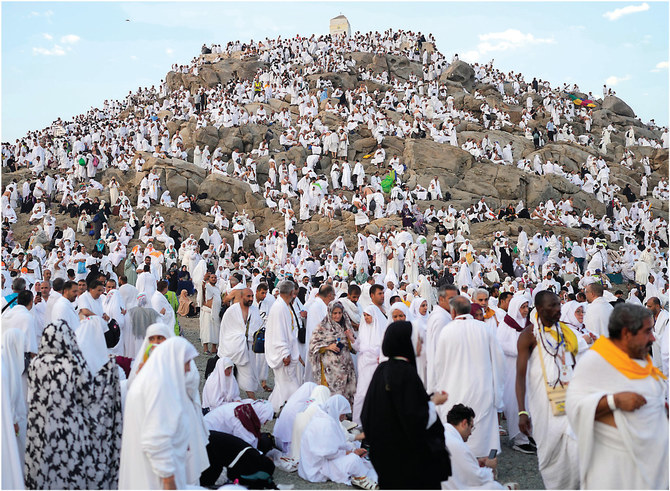
On the slopes of Mt. Arafat and the surrounding plains, many pilgrims raised hands in worship with tears streaming down their faces. (AFP photo)
3 / 3
Short Url
Updated 16 June 2024
Follow

Hajj reaches its pinnacle; number of pilgrims placed at 1.83 million

  • 150 treated for heat exhaustion
  • Sermon includes prayer for war-hit Palestinians
  • ‘Stoning the devil’ ritual begins today

JEDDAH: Muslims from around the world congregated on Saturday at a sacred hill in Saudi Arabia for worship and reflection amid sweltering heat.

The ritual at Mount Arafat, known as the hill of mercy, is considered the peak of the Hajj pilgrimage. It is often the most memorable for pilgrims, who stand together asking God for mercy, blessings, prosperity and good health.

Thousands of pilgrims walked here through the predawn darkness. They recited “Labbaik Allahumma Labbaik” (O Lord, here I am answering your call) and verses from the Holy Qur’an.
According to the Saudi Press Agency, the number of pilgrims reached 1,833,164.
This year’s Hajj came against the backdrop of the Israel-Hamas war, which pushed the Middle East to the brink of a regional conflict.


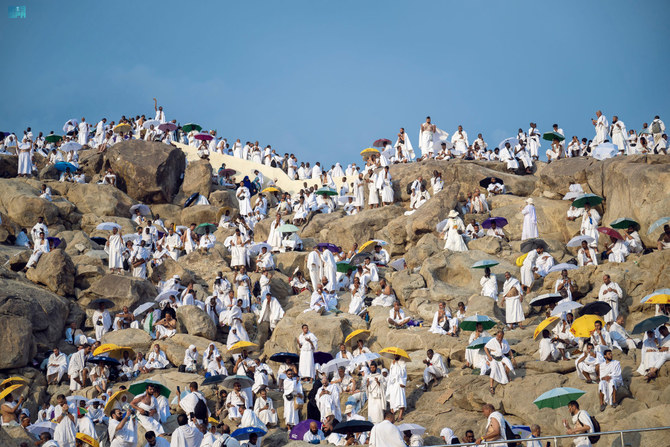
On the slopes of Mt. Arafat and the surrounding plains, many pilgrims raised hands in worship with tears streaming down their faces. (SPA photo)

In his sermon at the Namira Mosque in Arafat, imam Maher bin Hamad Al-Mu’wiqly, urged pilgrims to pray for the Palestinians who have been “harmed and hurt by their enemy” that killed them, and “deprived them of what they need from food, medicine and clothing.” 
Most of the pilgrims at Mount Arafat carried umbrellas, while others sat in the shade. Many were seen splashing water on their faces and bodies. 
Saudi Health Minister Fahd bin Abdurrahman Al-Jalajel said more than 150 pilgrims have been treated for heat exhaustion. 
He urged pilgrims to drink water and carry umbrellas as they perform Hajj’s rituals.
At sunset on Saturday, pilgrims left Mount Arafat, heading to a nearby site known as Muzdalifah to collect pebbles they will use in the symbolic stoning of pillars representing the devil back in Mina. Pilgrims then return to Mina for three days, coinciding with the festive Eid Al-Adha holiday. Afterward, they return to Makkah for a final circumambulation, known as Farewell Tawaf. Once the Hajj is over, men shave their heads, and women snip a lock of hair in a sign of renewal.


Saudi reserve given ‘dark sky’ listing in boost to astrotourism ambitions 

Updated 15 December 2025
Follow

Saudi reserve given ‘dark sky’ listing in boost to astrotourism ambitions 

  • Imam Turki bin Abdullah Royal Reserve Development Authority announced on Monday that the desert received official accreditation from DarkSky International

RIYADH: Saudi Arabia’s Nafud Desert has been listed as one of more than 250 Dark Sky Sites worldwide, which authorities say marks a commitment to protecting the environment from light pollution. 

Imam Turki bin Abdullah Royal Reserve Development Authority announced on Monday that the desert received official accreditation from DarkSky International, the global body committed to tackling light pollution in urban and rural areas. 

Welcoming the accreditation, Ahmed Al-Qarni, official spokesperson at the royal reserve, told Arab News: “It’s a new achievement in the journey of protecting nature and astronomy in Saudi Arabia. 

“The adoption of the Great Nafud Desert in Imam Turki bin Abdullah Royal Reserve by the International DarkSky Association, as the largest site in the Middle East, (represents) a culmination of a precise scientific path, and another step that enhances the Kingdom’s position as a leading destination in sustainability, nature protection, and astronomical tourism.” 

Abouazza El-Mhamdi, associate professor in the physics and astronomy department at King Saud University’s College of Science, said that the announcement is a “a major achievement for both science and tourism. 

“This accreditation protects the pristine night sky from light pollution, creating an invaluable natural laboratory for astronomers,” he added. 

“It provides an ideal Saudi location for adequate Earth-based telescopes and is a prime candidate for detailed site surveys, enabling sensitive observations of stars and galaxies. 

“At the same time, it establishes the reserve as a premier global destination for stargazing and astrotourism, supporting sustainable economic growth.” 

The reserve development authority also posted on X: “Away from the clamor of the lights ... there is a darkness that shines. 

“We are proud of the adoption of the Great Nafud Desert within the Imam Turki bin Abdullah Royal Reserve as one of the dark sky places certified by the DarkSky International.” 

Located within the reserve east of the Hail-Al Jawf road, the Great Nafud Desert covers an area of about 13,416 sq. km, making it one of the largest accredited Dark Sky Sites in the region and one of the least light-polluted sites in the Kingdom, the Saudi Press Agency reported. 

Fulfilling the organization’s criteria was the result of comprehensive scientific work that included field studies, precise astronomical observations, advanced nighttime analyses, and the implementation of specialized engineering practices for managing nighttime lighting and controlling light pollution sources. 

These efforts, undertaken by the authority, are part of its commitment to protecting the desert’s natural nighttime landscapes, enhancing the sustainability of ecosystems and preparing the site to serve as a global model for preserving the natural sky. 

CEO of the Imam Turki bin Abdullah Royal Reserve Development Authority, Engineer Mohammed Al-Shaalan, said in a statement that the accreditation is a culmination of the interest of the country’s leadership in the environment and the protection of natural sites. 

It also reflects the support of Prince Turki bin Mohammed bin Fahd bin Abdulaziz, chairman of the authority’s board of directors, he added. 

Al-Shaalan said that the accreditation represents a significant step that enhances the reserve’s presence on the international map and contributes to the development of astronomical tourism, scientific research, and specialized environmental experiments. 

The area provides visitors and researchers with unique opportunities to observe the night sky and to monitor astronomical phenomena in a natural environment with low light pollution. 

He added that the authority has developed tourism facilities in the desert such as “The Leaf” camp located near the dark sky zone.