Hajj pilgrims arrive in Arafat, attend annual sermon

1 / 4
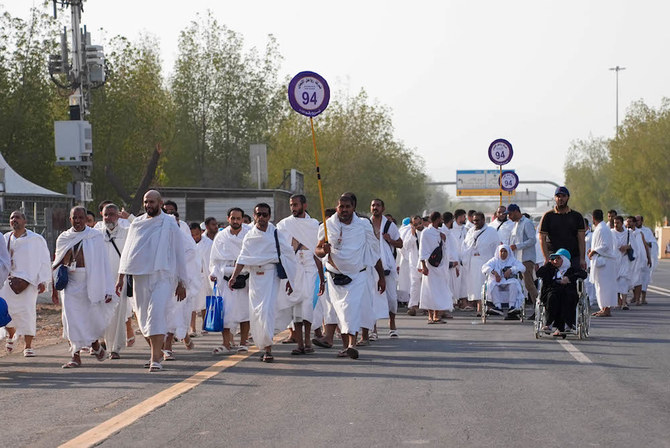
Amid strict security and health measures, this year’s Hajj pilgrims arrived in Arafat early Saturday morning, the ninth day of Dul Hijjah, and attended the annual Hajj sermon at Namirah Mosque. (AN Photo/Huda Bashatah)
2 / 4
Amid strict security and health measures, this year’s Hajj pilgrims arrived in Arafat early Saturday morning, the ninth day of Dul Hijjah, and attended the annual Hajj sermon at Namirah Mosque. (AN Photo/Huda Bashatah)
3 / 4
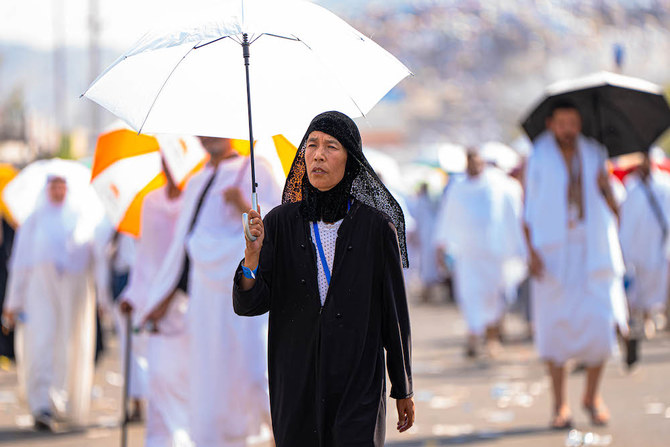
Amid strict security and health measures, this year’s Hajj pilgrims arrived in Arafat early Saturday morning, the ninth day of Dul Hijjah, and attended the annual Hajj sermon at Namirah Mosque. (AN Photo/Huda Bashatah)
4 / 4
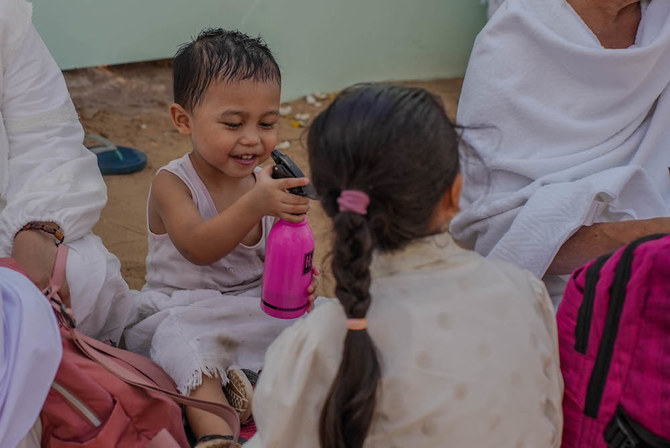
Amid strict security and health measures, this year’s Hajj pilgrims arrived in Arafat early Saturday morning, the ninth day of Dul Hijjah, and attended the annual Hajj sermon at Namirah Mosque. (AN Photo/Huda Bashatah)
Short Url
Updated 15 June 2024
Follow

Hajj pilgrims arrive in Arafat, attend annual sermon

  • Arafat is where Prophet Muhammad gave his final sermon more than 144 decades ago

ARAFAT: Amid strict security and health measures, this year’s Hajj pilgrims arrived in Arafat early Saturday morning, the ninth day of Dul Hijjah, and attended the annual Hajj sermon at Namirah Mosque.

As the sun rose, pilgrims camping in the tent city of Mina performed dawn prayers, then began their journey to Arafat, where Prophet Muhammad gave his final sermon more than 144 decades ago. On Saturday, one could hear nothing louder than the crowd chanting supplications.

Ansarul-Haq Rasheed, a 63-year-old Indonesian pilgrim, expressed a heartfelt desire to pray to Allah for as long as possible.

“I wish time could pause so I could continue praying to Allah with all my heart,” he told Arab News. “These moments are unforgettable. I want to lay bare all my emotions to my creator, who knows everything. I seek His blessings for my needs in this life and the hereafter.”


Reflecting on the pilgrimage experience, he expressed gratitude for the services provided to pilgrims. He compared it with stories he had been told of his late father’s Hajj, some 45 years ago. “My mother shared the hardships my father faced during Hajj; I wish he could see how much more comfortable Hajj has become,” Rasheed said. 

Meanwhile, 49-year-old Khadija Yakoubi, a Moroccan pilgrim, anticipated a transformative experience from his pilgrimage.

“When all sins are forgiven, life inevitably changes for the better, leading to a renewed enjoyment. This feeling motivates pilgrims to continue doing good throughout their lives,” Yakoubi said, adding that the services pilgrims have received at the holy sites have been “exemplary.”

The Day of Arafat is the most important part of the Hajj — one of Islam’s five pillars; without it, a pilgrimage is not valid. Pilgrims typically combine and shorten the Dhuhr and Asr prayers before staying in Arafat until sunset. They then move on to Muzdalifah before returning to their tents in Mina.

Sheikh Maher bin Hamad Al-Muaiqly, one of the imams of the Grand Mosque, who delivered this year’s sermon, described Hajj as a “sincere act of worship for Allah.”


He urged pilgrims to seize “the great blessings” during their time in Arafat, reminding them that “in this honorable place and virtuous time, the Almighty multiplies his rewards” for their good deeds and forgives their sins.

In his sermon, Al-Muaiqly emphasized that Islam is a religion of peace and that Shariah “mandates justice, noble ethics, and kindness to parents, along with the importance of maintaining family ties, truthfulness in speech, and safeguarding rights to ensure they are rightfully upheld. It also emphasizes respect for contracts and encourages obedience to rightful authorities.”

He added that Shariah also emphasizes the obligation to obey the five central religious laws: safeguarding religion, and protecting the soul, the mind, one’s possessions, and one’s dignity — all important principles in Islamic jurisprudence and ethics, and, he said, guiding principles for the well-being and growth of individuals and society.

“Indeed, Shariah considers any transgression against these basics a crime deserving punishment. Furthermore, safeguarding these essentials is a path to entering paradise and attaining Allah’s satisfaction. It also serves as a key to stability, happiness, progress, and advancement in this world,” the imam said.


Saudi reserve given ‘dark sky’ listing in boost to astrotourism ambitions 

Updated 15 December 2025
Follow

Saudi reserve given ‘dark sky’ listing in boost to astrotourism ambitions 

  • Imam Turki bin Abdullah Royal Reserve Development Authority announced on Monday that the desert received official accreditation from DarkSky International

RIYADH: Saudi Arabia’s Nafud Desert has been listed as one of more than 250 Dark Sky Sites worldwide, which authorities say marks a commitment to protecting the environment from light pollution. 

Imam Turki bin Abdullah Royal Reserve Development Authority announced on Monday that the desert received official accreditation from DarkSky International, the global body committed to tackling light pollution in urban and rural areas. 

Welcoming the accreditation, Ahmed Al-Qarni, official spokesperson at the royal reserve, told Arab News: “It’s a new achievement in the journey of protecting nature and astronomy in Saudi Arabia. 

“The adoption of the Great Nafud Desert in Imam Turki bin Abdullah Royal Reserve by the International DarkSky Association, as the largest site in the Middle East, (represents) a culmination of a precise scientific path, and another step that enhances the Kingdom’s position as a leading destination in sustainability, nature protection, and astronomical tourism.” 

Abouazza El-Mhamdi, associate professor in the physics and astronomy department at King Saud University’s College of Science, said that the announcement is a “a major achievement for both science and tourism. 

“This accreditation protects the pristine night sky from light pollution, creating an invaluable natural laboratory for astronomers,” he added. 

“It provides an ideal Saudi location for adequate Earth-based telescopes and is a prime candidate for detailed site surveys, enabling sensitive observations of stars and galaxies. 

“At the same time, it establishes the reserve as a premier global destination for stargazing and astrotourism, supporting sustainable economic growth.” 

The reserve development authority also posted on X: “Away from the clamor of the lights ... there is a darkness that shines. 

“We are proud of the adoption of the Great Nafud Desert within the Imam Turki bin Abdullah Royal Reserve as one of the dark sky places certified by the DarkSky International.” 

Located within the reserve east of the Hail-Al Jawf road, the Great Nafud Desert covers an area of about 13,416 sq. km, making it one of the largest accredited Dark Sky Sites in the region and one of the least light-polluted sites in the Kingdom, the Saudi Press Agency reported. 

Fulfilling the organization’s criteria was the result of comprehensive scientific work that included field studies, precise astronomical observations, advanced nighttime analyses, and the implementation of specialized engineering practices for managing nighttime lighting and controlling light pollution sources. 

These efforts, undertaken by the authority, are part of its commitment to protecting the desert’s natural nighttime landscapes, enhancing the sustainability of ecosystems and preparing the site to serve as a global model for preserving the natural sky. 

CEO of the Imam Turki bin Abdullah Royal Reserve Development Authority, Engineer Mohammed Al-Shaalan, said in a statement that the accreditation is a culmination of the interest of the country’s leadership in the environment and the protection of natural sites. 

It also reflects the support of Prince Turki bin Mohammed bin Fahd bin Abdulaziz, chairman of the authority’s board of directors, he added. 

Al-Shaalan said that the accreditation represents a significant step that enhances the reserve’s presence on the international map and contributes to the development of astronomical tourism, scientific research, and specialized environmental experiments. 

The area provides visitors and researchers with unique opportunities to observe the night sky and to monitor astronomical phenomena in a natural environment with low light pollution. 

He added that the authority has developed tourism facilities in the desert such as “The Leaf” camp located near the dark sky zone.