

CNN rules for first US presidential debate: no props, muted microphones

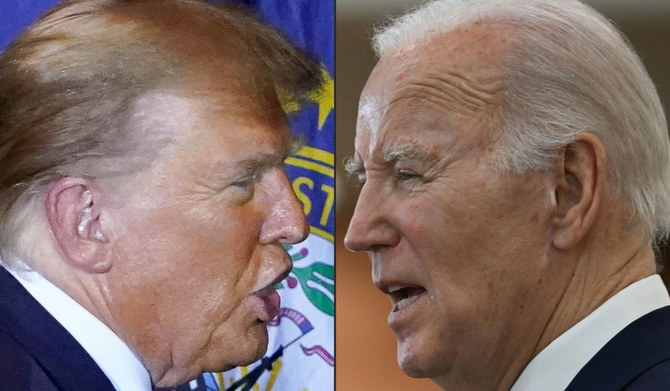
US Republican presidential hopeful and former US President Donald Trump in Concord, New Hampshire, on January 19, 2024; and US President Joe Biden in Culver City, California, on February 21, 2024. (AFP)
Short Url
Updated 16 June 2024
Follow

CNN rules for first US presidential debate: no props, muted microphones

  • CNN said candidates eligible to participate must appear on a sufficient number of state ballots to reach the 270 electoral vote threshold needed to win and receive at least 15 percent in four separate national polls

WASHINGTON: The first US presidential debate between incumbent Joe Biden and Republican rival Donald Trump on June 27 will include two commercial breaks, no props and muted microphones except when recognized to speak, CNN said Saturday. In May, the candidates agreed to face off in two debates including one this month that will be moderated by CNN anchors Jake Tapper and Dana Bash in Atlanta, while the other on Sept. 10 will be hosted by ABC.
CNN said Saturday both candidates will appear at a uniform podium during the 90-minute debate, podium positions will be determined by a coin flip and candidates will be given a pen, a pad of paper and a bottle of water but cannot use props.
“Microphones will be muted throughout the debate except for the candidate whose turn it is to speak,” CNN said.
CNN, a division of Warner Bros Discovery, said the moderators “will use all tools at their disposal to enforce timing and ensure a civilized discussion.”
During the two commercial breaks, campaign staff may not interact with their candidate, and there will be no studio audience.
CNN said candidates eligible to participate must appear on a sufficient number of state ballots to reach the 270 electoral vote threshold needed to win and receive at least 15 percent in four separate national polls. CNN said it is “not impossible” Robert F. Kennedy Jr., who is running as an independent, could qualify, saying he has received at least 15 percent in three qualifying polls to date and has qualified for the ballot in six states, making him eligible for 89 electoral college votes.
Debates, which will draw a US live television audience in the tens of millions, are fraught with risks for both candidates, who face a close race. Biden has three preferred debate topics, according to a campaign memo viewed by Reuters: abortion rights, the state of democracy and the economy.
Trump refused to debate his rivals during the Republican nominating race. His team has pointed to immigration, public safety and inflation as key issues ahead of the debate.


Israel extends foreign media ban law until end of 2027

Updated 23 December 2025
Follow

Israel extends foreign media ban law until end of 2027

  • Order replaces temporary emergency legislation that allowed authorization of so-called ‘Al Jazeera bill’
  • Extension of temporary order empowers Communications Ministry to restrict foreign channels deemed to cause ‘real harm to state security’

LONDON: Israel’s Knesset approved late Monday an extension of the temporary order empowering the Communications Ministry to shut down foreign media outlets, pushing the measure through until Dec. 31, 2027.

The bill, proposed by Likud lawmaker Ariel Kallner, passed its second and third readings by a 22-10 vote, replacing wartime emergency legislation known as the “Al Jazeera Law.”

Under the extended order, the communications minister — with prime ministerial approval and security cabinet or government ratification — can restrict foreign channels deemed to cause “real harm to state security,” even outside states of emergency.

Measures include suspending broadcasts, closing offices, seizing equipment, blocking websites, and directing the defense minister to block satellite signals, including in the West Bank, without disrupting other channels.

Administrative orders last 90 days, with possible extensions. Unlike the temporary measure, the new law does not require court approval to shut down a media outlet.

The move has drawn sharp criticism from human rights and media groups, who warn it entrenches restrictions on Arab and foreign outlets amid a broader erosion of press freedoms.

“Israel is openly waging a battle against media outlets, both local and foreign, that criticize the government’s narrative; that is typical behavior of authoritarian regimes,” International Federation of Journalists General Secretary Anthony Bellanger said in November after the bill’s first reading.

“We are deeply concerned about the Israeli parliament passing this controversial bill, as it would be a serious blow to free speech and media freedom, and a direct attack on the public’s right to know.”

In a parallel development, the Israeli Cabinet unanimously approved on Monday the shutdown of Army Radio (Galei Tzahal) after 75 years, with operations ceasing on March 1, 2026.

In a statement, Attorney General Gali Baharav-Miara warned the decision “undermines public broadcasting in Israel and restricts freedom of expression,” lacking a legal basis.