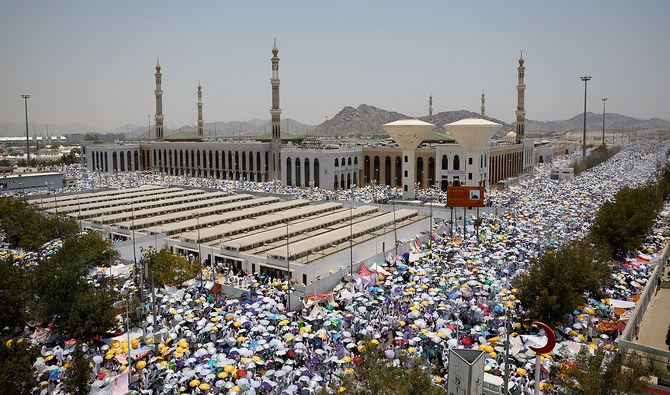
ISLAMABAD: Pakistani pilgrims began moving to Muzdalifah on Saturday evening after spending the day in Arafat, where they had gathered in the morning to attend the annual Hajj sermon and engage in prayers and self-reflection, as confirmed by the country’s Ministry of Religious Affairs.
The Day of Arafat holds tremendous significance as it commemorates the moment more than 1,400 years ago when Prophet Muhammad (PBUH) delivered his Farewell Sermon, calling for unity, equality and justice among Muslims.
After spending a reflective night under the starry sky in Muzdalifah, pilgrims will move to Mina in the morning to perform the symbolic stoning of the devil at Jamarat, an act signifying the rejection of evil.
“After completing the standing at Arafat, all Pakistani government Hajj pilgrims, along with other pilgrims, set off toward Muzdalifah,” the ministry said in a statement. “The Pakistani pilgrims departed for Muzdalifah under the guidance of their sector representatives.”
“The pilgrims seemed satisfied with the arrangements made by the Saudi authorities, and they continued to congratulate each other happily after completing their stay in Arafat,” the statement added.
Earlier, pilgrims from across the world attended the Hajj sermon delivered by one of the prayer leaders of the Grand Mosque in Makkah, Sheikh Maher bin Hamad Al-Muaiqly, who urged them to pray for the Palestinians who had been “harmed and hurt by their enemy.”
He noted the people of Palestine had been deprived of “food, medicine and clothing.”
Asked about their Hajj experience, Pakistani pilgrims said they were fortunate to be in Arafat to perform one of the greatest rituals in Islam.
“The experience in Mina and Arafat has remained very good,” Ilyas Kabir from DG Khan said in a video circulated by the ministry. “It is a great blessing to have the opportunity to perform Hajj. I urge the pilgrims to be patient.”
An elderly woman in a wheelchair, who said she had been performing Hajj with her son, informed that she had been praying for the entire Muslim world.
“I pray for all Muslims,” she said. “Good wishes, good intentions, especially for Palestine. May there be peace and tranquility. May Allah grant them freedom.”
The stoning ritual at Jamarat in the morning will be followed by the traditional animal sacrifice, leading to Eid Al-Adha celebrations across the world.
With input from AP


![]()

Pakistani pilgrims transition from Arafat to Muzdalifah, marking key rituals of Hajj journey
Short Url
https://arab.news/vxyqh
Pakistani pilgrims transition from Arafat to Muzdalifah, marking key rituals of Hajj journey
- Pilgrims attended the annual Hajj sermon in Arafat where they were urged to pray for people of Palestine
- After spending the night in Muzdalifah, pilgrims will perform symbolic stoning of the devil in the morning
Latest updates




Recommended


© 2026 SAUDI RESEARCH & PUBLISHING COMPANY, All Rights Reserved And subject to Terms of Use Agreement.