

UNICEF warns 600,000 children face ‘catastrophe’ in Rafah

1 / 3
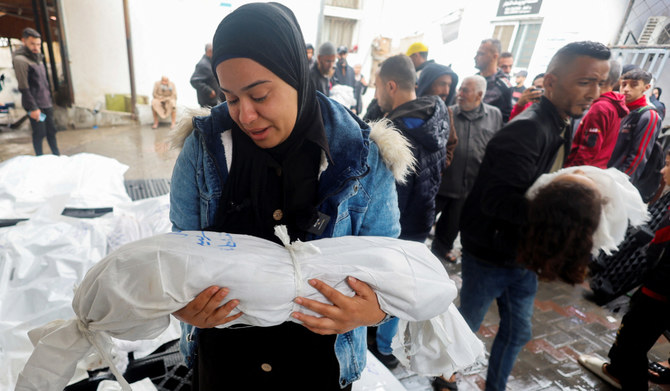
A mourner reacts holding the body of a Palestinian child killed in an Israeli strike, amid the ongoing conflict between Israel and the Palestinian Islamist group Hamas, at Abu Yousef al-Najjar hospital in Rafah, in the southern Gaza Strip, May 6, 2024. (REUTERS)
2 / 3
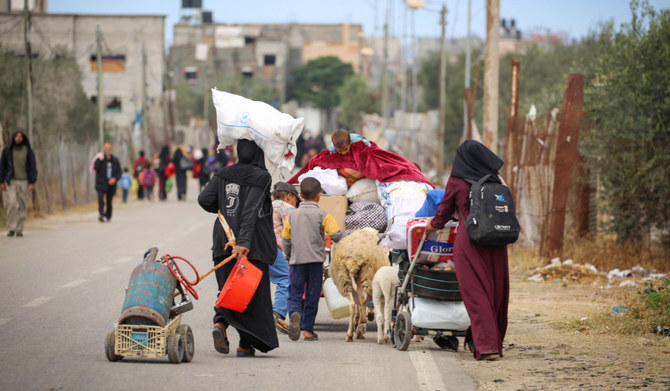
Displaced Palestinians in Rafah in the southern Gaza Strip carry their belongings as they leave following an evacuation order by the Israeli army on May 6, 2024, amid the ongoing conflict between Israel and the Palestinian Hamas movement. (AFP)
3 / 3
People flee the eastern parts of Rafah after the Israeli military began evacuating Palestinian civilians ahead of a threatened assault on the southern Gazan city, amid the ongoing conflict between Israel and Hamas, in Rafah, in the southern Gaza Strip May 6, 2024. (REUTERS)
Short Url
Updated 06 May 2024
Follow

UNICEF warns 600,000 children face ‘catastrophe’ in Rafah

  • Calling again for a ceasefire and safe access for humanitarian organizations, the agency highlighted there are some 78,000 infants under age two sheltering in the city, along with 175,000 children under five who are affected by infectious disease
  • Israel has killed more than 34,000 Palestinians in Gaza, mostly women and children, according to the health ministry in the Hamas-run territory

NEW YORK: Some 600,000 children packed into Gaza’s Rafah city face “further catastrophe,” UNICEF warned on Monday, urging against their forced relocation after Israel ordered an evacuation ahead of its long-threatened ground invasion.
“Given the high concentration of children in Rafah ... UNICEF is warning of a further catastrophe for children, with military operations resulting in very high civilian casualties and the few remaining basic services and infrastructure they need to survive being totally destroyed,” the UN children’s agency said in a statement.
It said Gaza’s youth were already “on the edge of survival,” with many in Rafah — where the agency said the population has soared to 1.2 million people, half of them children — already displaced multiple times and with nowhere else to go.
“More than 200 days of war have taken an unimaginable toll on the lives of children,” said UNICEF Executive Director Catherine Russell.
“Rafah is now a city of children, who have nowhere safe to go in Gaza,” she said, warning that a large-scale military operation by Israel would bring “chaos and panic, and at a time where (children’s) physical and mental states are already weakened.”
UNICEF estimates that Rafah’s population has swelled to nearly five times its normal figure of 250,000 residents.
Calling again for a ceasefire and safe access for humanitarian organizations, the agency highlighted there are some 78,000 infants under age two sheltering in the city, along with 175,000 children under five who are affected by infectious disease.
Gaza’s bloodiest-ever war began following Hamas’s unprecedented Oct. 7 attack on Israel.
Israel has conducted a retaliatory offensive that has killed at least 34,735 people in Gaza, according to the Hamas-run
territory’s Health Ministry.
Of that toll, more than 14,000 are children, the ministry has said.
Israeli Prime Minister Benjamin Netanyahu has vowed to send ground troops into Rafah regardless of any truce, despite concerns from the US, other countries, and aid groups.
Hamas official Izzat Al-Rashiq said in a statement that any Israeli operation in Rafah would put the truce talks in jeopardy.
Senior Hamas official Sami Abu Zuhri said the evacuation order was a “dangerous escalation” that would have consequences.
“The US administration, alongside the occupation, bears responsibility for this terrorism,” the official said.
Hamas said later in a statement that any offensive in Rafah would not be a “picnic” for Israeli forces and said it was fully prepared to defend Palestinians there.
Aid agencies have warned that the evacuation order will lead to an even worse humanitarian disaster in the crowded coastal enclave of 2.3 million people reeling from seven months of war.
“Forcing 1 million displaced Palestinians from Rafah to evacuate without a safe destination is not only unlawful but would lead to catastrophic consequences,” British charity ActionAid said.
Nick Maynard, a British surgeon trying to leave Gaza on Monday, said in a voice message from the Gaza side of the Rafah crossing into Egypt: “Two huge bombs have just gone off immediately outside the crossing. There’s a lot of gunfire as well about 100 meters from us. We are very unclear whether we will get out.”
“Driving through Rafah, the tension was palpable with people evacuating as rapidly as they could.”
Witnesses said the areas in and around Rafah where Israel wants to move people are already crowded with little room for more tents.
“The biggest genocide, the biggest catastrophe, will take place in Rafah. I call on the whole Arab world to interfere for a ceasefire — let them interfere and save us from what we are in,” said Aminah Adwan, a displaced Palestinian.
Israel has been threatening to launch incursions in Rafah, which it says harbors thousands of Hamas fighters and potentially dozens of hostages.
Victory is impossible without taking Rafah, it says.


Russia slams Western peacekeeping plan for Ukraine

Updated 08 January 2026
Follow

Russia slams Western peacekeeping plan for Ukraine

  • “The new militarist declarations of the so-called Coalition of the Willing and the Kyiv regime together form a genuine ‘axis of war’,” Zakharova
  • She called the plans drafted by Kyiv’s allies “dangerous” and “destructive“

MOSCOW: Russia on Thursday slammed a plan for European peacekeepers to be deployed to Ukraine as “dangerous” and dubbed Kyiv and its allies an “axis of war,” dousing hopes the plan could be a step toward ending the almost four-year-war.
US President Donald Trump has been pushing the warring sides to strike a deal to halt the conflict, running shuttle diplomacy between Ukraine’s Volodymyr Zelensky and Russia’s Vladimir Putin in a bid to get an agreement across the line.
An initial 28-point plan which largely adhered to Moscow’s demands was criticized by Kyiv and Europe, and now Russia has slammed the attempts to beef-up protections for Ukraine should an elusive deal be reached.
Ukraine’s allies said they had agreed key security guarantees for Kyiv at a summit in Paris earlier this week, including a peacekeeping force.
But in its first comments since the summit, Moscow said the statements were far away from anything the Kremlin could accept to end its assault.
“The new militarist declarations of the so-called Coalition of the Willing and the Kyiv regime together form a genuine ‘axis of war’,” Russia’s foreign ministry spokeswoman Maria Zakharova said in a statement.
She called the plans drafted by Kyiv’s allies “dangerous” and “destructive.”
The remarks come as Russian strikes plunged hundreds of thousands in Ukraine into darkness, leaving families without heat in below-freezing temperatures — attacks that Zelensky said showed Russia was still set on war.

- ‘Legitimate military targets’ -

European leaders and US envoys announced earlier this week that post-war guarantees for Ukraine would include a US-led monitoring mechanism and a European multinational force to be deployed when the fighting stops.
But Moscow has repeatedly warned that it would not accept any NATO members sending peacekeeping troops to Ukraine.
“All such units and facilities will be considered legitimate military targets for the Russian Armed Forces,” Zakharova said Thursday, repeating a threat previously uttered by Putin.
Zelensky also said Thursday that a bilateral agreement between Kyiv and Washington for US security guarantees was “essentially ready for finalization at the highest level with the President of the United States” following talks between envoys in Paris this week.
Kyiv says legally-binding assurances that its allies would come to its defense are essential to convince Russia not to re-attack if a ceasefire is reached.
But specific details on the guarantees, the European force, and how it would engage have not been made public.
Zelensky said earlier this week he was yet to receive an “unequivocal” answer of what they would do if Russia does attack again after a deal.
Zelensky has also said that the most difficult questions in any settlement — territorial control of the eastern Donbas region and the fate of the Russian-occupied Zaporizhzhia nuclear power plant — were still unresolved.

- Russian strikes cut heating -

Ukraine was meanwhile scrambling to restore heating and water to hundreds of thousands of households after a new barrage targeted energy facilities in its Dnipropetrovsk and Zaporizhzhia regions.
“This is truly a national level emergency,” Borys Filatov, mayor of Dnipropetrovsk’s capital Dnipro, said on Telegram.
He announced power was “gradually returning to the hospitals” after the blackouts forced them to run on generators. The city authorities also extended school holidays for children.
About 600,000 households in the region remained cut off from power in Dnipropetrovsk, Ukrainian energy company DTEK said.
In a post on social media, Zelensky said the attacks “clearly don’t indicate that Moscow is reconsidering its priorities.”
In addition to the unrelenting pummelling of Dnipropetrovsk, Russia pressed on with its ground assault on the region, claiming to have taken another village there.
It is not one of the five Ukrainian regions that Moscow claims to have annexed.