

Moody’s highlights Pakistan’s persistent debt issues, says budget to aid IMF negotiations

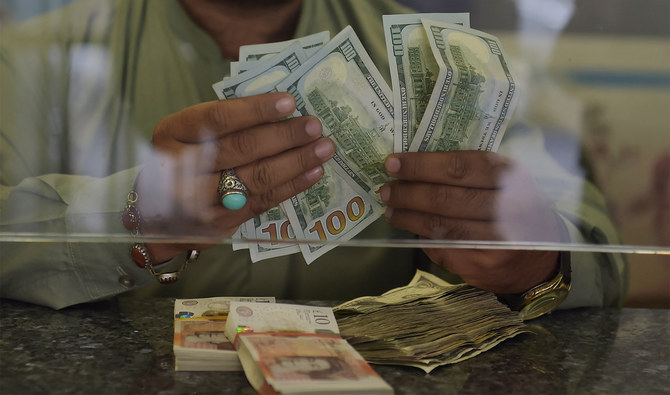
A Pakistani dealer counts US dollars at a currency exchange shop in Islamabad on October 9, 2018. (AFP/File)
Short Url
Updated 14 June 2024
Follow

Moody’s highlights Pakistan’s persistent debt issues, says budget to aid IMF negotiations

  • The global credit rating agency points toward additional taxes without significant cost-containment measures
  • It says sustaining economic reforms may become difficult amid risk of social disruption, coalition challenges

KARACHI: A leading global credit rating agency said on Friday Pakistan’s newly announced federal budget was likely to help the country with its ongoing negotiation with the International Monetary Fund (IMF), though it highlighted the country’s weak debt affordability and challenge of keeping economic reforms on track.

Moody’s Investors Service issued a brief assessment of Pakistan’s economy two days after Finance Minister Muhammad Aurangzeb presented the $67.76 billion federal budget in which he kept some high ambitious revenue generation targets.

The global agency noted the government sought to achieve quicker fiscal consolidation through increase in revenue, adding their were little spending containment measures.

“The announced budget will likely support Pakistan’s ongoing negotiations with the IMF for a new Extended Fund Facility (EFF) program that will be crucial for the government to unlock financing from IMF and other bilateral and multilateral partners to meet its external financing needs,” it said. “However, it will be the government’s ability to sustain reform implementation that will be key to allowing Pakistan to meet its budget targets and continually unlock external financing to meet its needs, leading to a durable easing of liquidity risks.”

“A resurgence of social tensions on the back of high cost of living (which may increase because of higher taxes and future adjustments to energy tariffs) could weigh on reform implementation,” it added. “Moreover, risks that the coalition government may not have a sufficiently strong electoral mandate to continually implement difficult reforms remain.”

Moody’s noted the government had set a challenging target to increase federal government revenue to PKR17.8 trillion, about 46 percent higher from a year ago.

It noted that this increase was led by a 40 percent increase in tax revenue that the government wanted to achieve through a combination of new taxes and stronger nominal growth.

“At the same time, the budget is targeting an overall federal government expenditure of PKR18.9 trillion, about 25 percent higher than a year ago,” it said. “The increase in expenditure reflects lack of significant cost-containment measures and Pakistan’s very high interest payments.”

It maintained the government had been spending more than half its revenue on interest payments, “indicating very weak debt affordability which drives high debt sustainability risks.”

“Having a significant share of its budget allocated toward debt payments will constrain the government’s capacity to service its debt while meeting essential social spending and infrastructure needs,” it added.


Pakistan Air Force conducts ‘Exercise Golden Eagle’ to test combat readiness, agility

Updated 10 February 2026
Follow

Pakistan Air Force conducts ‘Exercise Golden Eagle’ to test combat readiness, agility

  • The exercise follows an intense, four-day Pakistan-India military conflict in May 2025
  • It focused on AI-enabled operations integrating disruptive technologies, military says

ISLAMABAD: The Pakistan Air Force (PAF) has conducted “Exercise Golden Eagle” that successfully validated its combat readiness and operational agility through synchronized employment of the PAF’s complete combat potential, the Pakistani military said on Tuesday.

It comes months after Pakistan’s four-day military conflict with India in May, with Islamabad claiming victory in the standoff after the PAF claimed to have shot down at least six Indian fighter aircraft, including the French-made Rafale. New Delhi acknowledged some losses but did not specify a number.

The exercise was conducted on a Two-Force construct, focusing on AI-enabled, net-centric operations while integrating indigenous niche, disruptive and smart technologies in line with evolving regional security dynamics, according to the Inter-Services Public Relations (ISPR), the Pakistani military’s media wing.

Operating within a robust Integrated Air Defense System, friendly forces shaped the battlespace through seamless fusion of kinetic operations with cyber, space and electro-magnetic spectrum operations.

“The kinetic phase featured First-Shoot, First-Kill swing-role combat aircraft equipped with long-range BVR air-to-air missiles, extended-range stand-off weapons and precision strike capabilities, supported by Airborne Early Warning & Control platforms and Air-to-Air Refuelers,” the ISPR said in a statement.

“A key highlight of the exercise was Manned–Unmanned Teaming, with deep-reach killer drones and loitering munitions operating in a highly contested, congested and degraded environment, validating PAF’s capability to conduct high-tempo operations in modern warfare.”

In recent months, many countries have stepped up defense engagement with Pakistan, while delegations from multiple nations have proposed learning from the PAF’s multi-domain air warfare capabilities that officials say were successfully employed during the May conflict.

“The successful conduct of Exercise Golden Eagle reaffirms Pakistan Air Force’s unwavering commitment to maintaining a high state of operational preparedness, leveraging indigenous innovation and effectively countering emerging and future security challenges,” the ISPR added.
